


What is strategy execution?
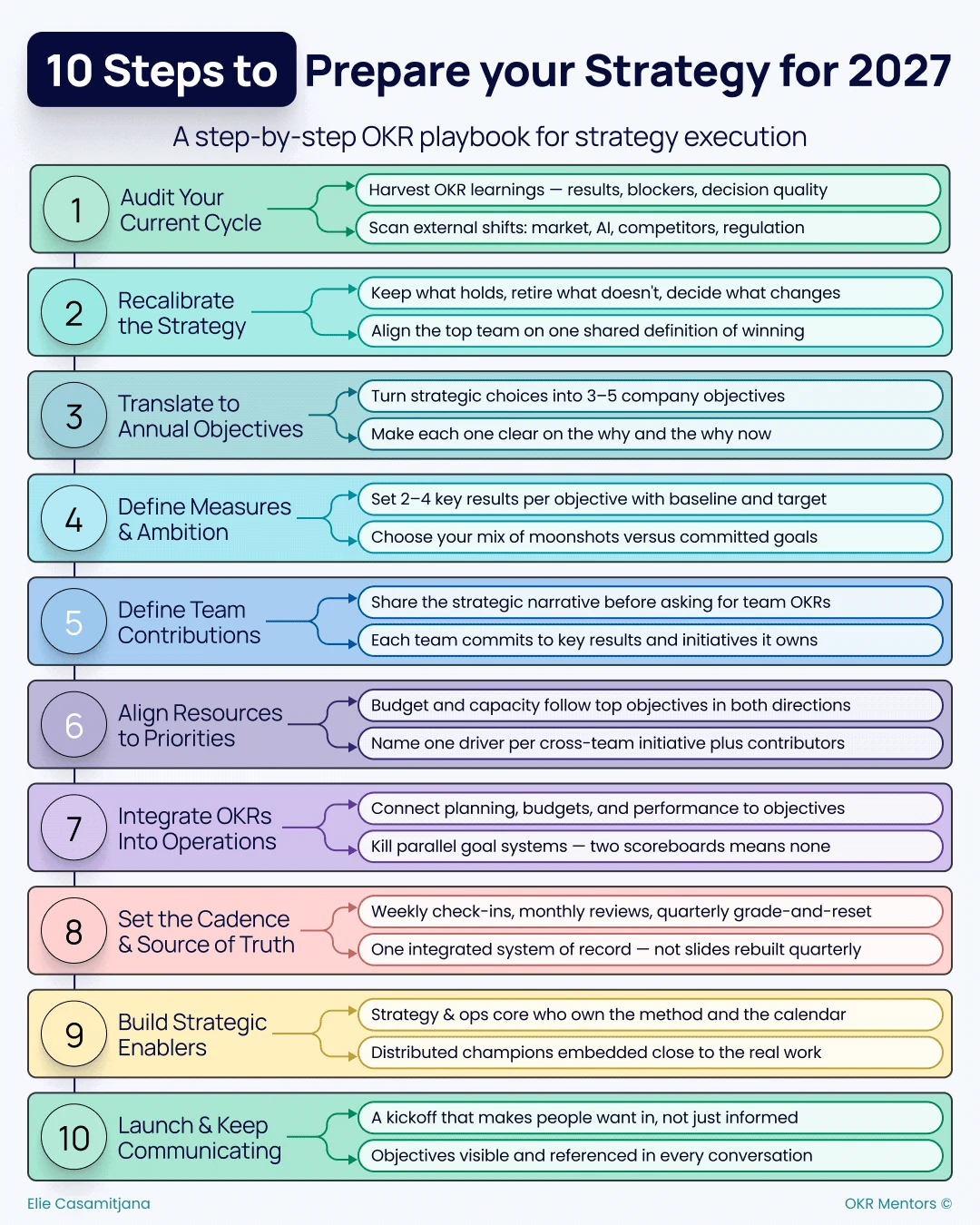
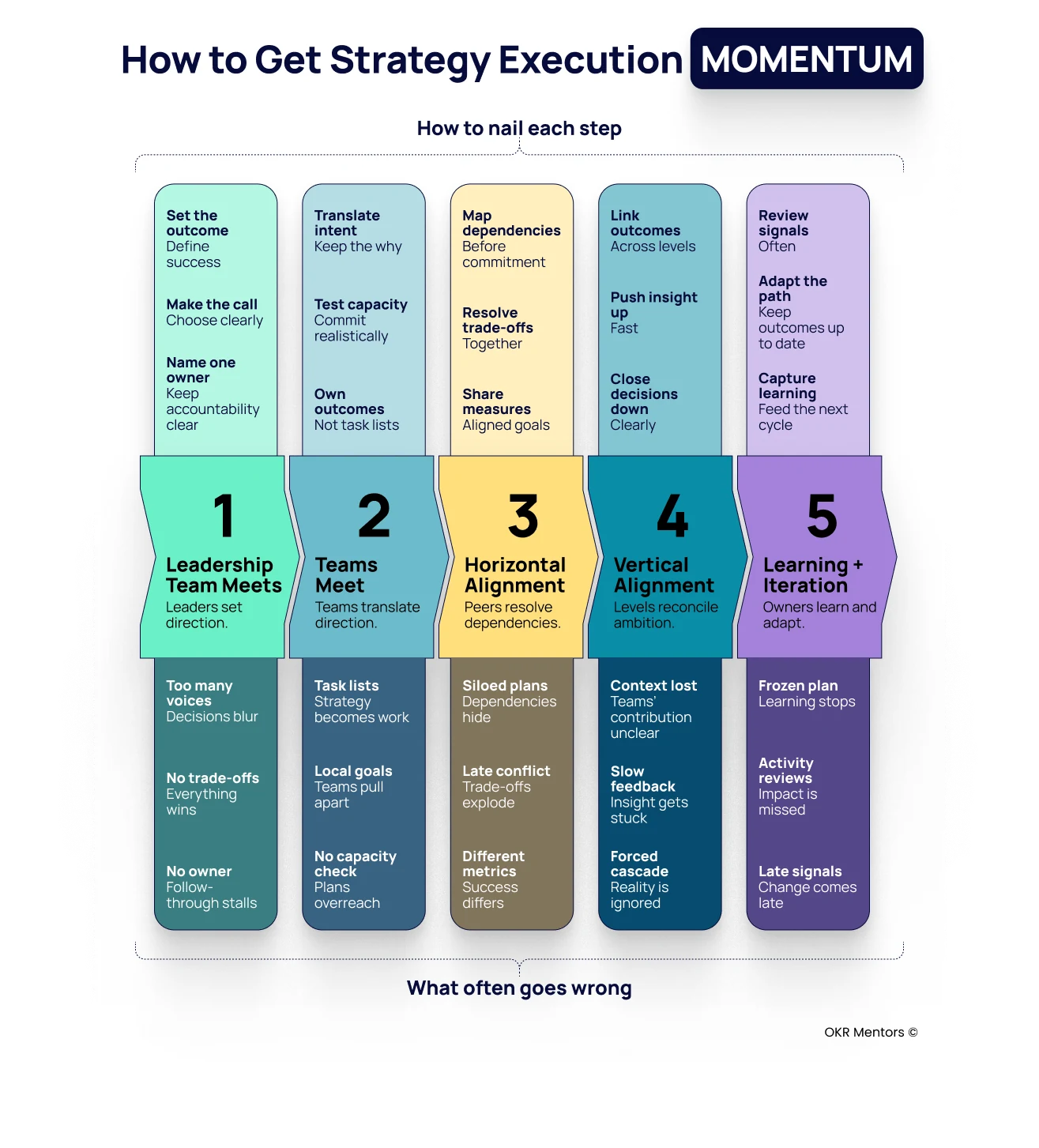
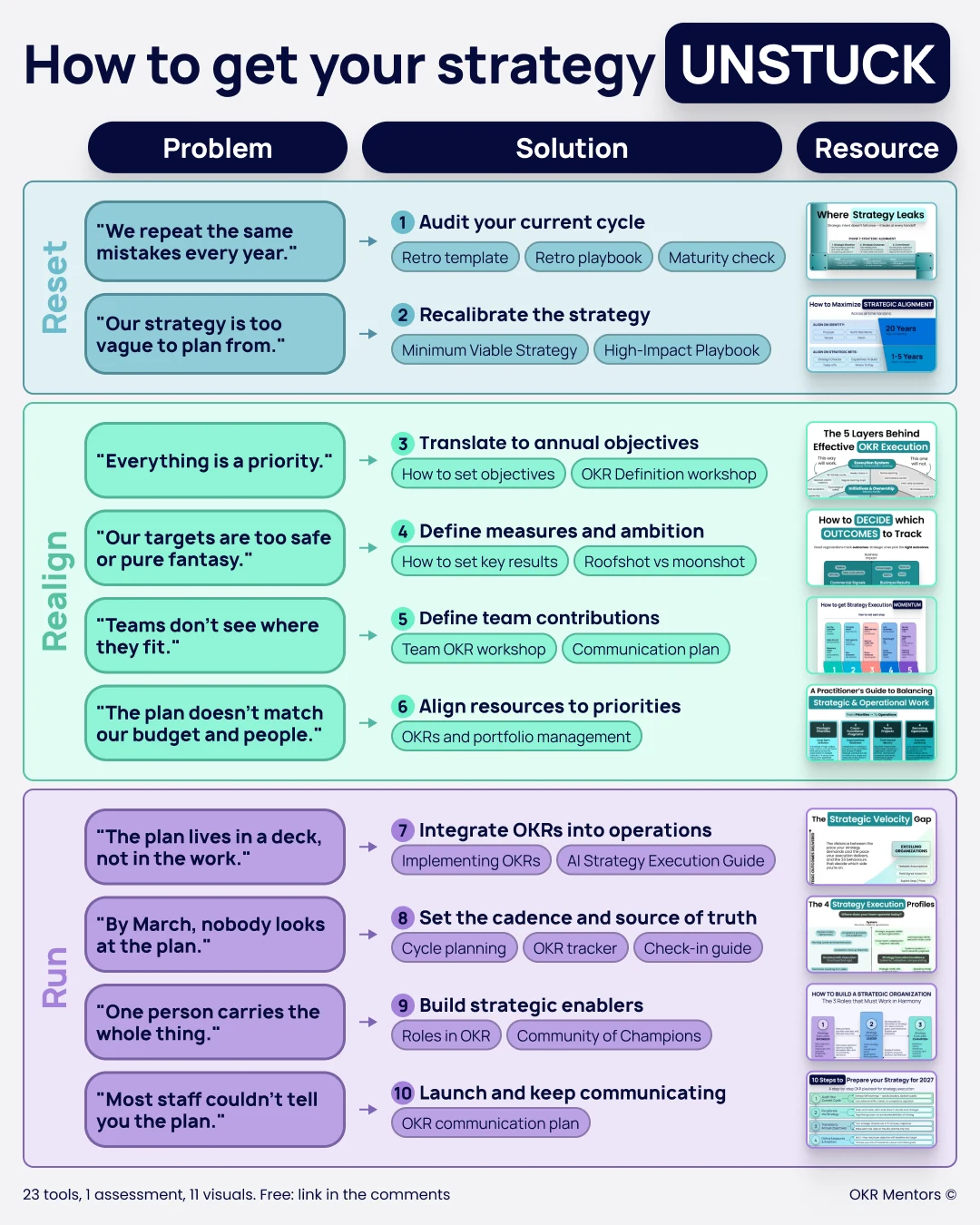
Strategy execution is the work of turning strategic choices into funded commitments, regular decisions and measurable results. This guide splits it into ten steps in three phases: Reset, Realign and Run.
It is written for Heads of Strategy and Operations, Transformation Directors, Strategy and Delivery leaders, Chiefs of Staff and their executive sponsors in mid-sized organisations.
“Your strategy is what you fund, what you stop and how your teams decide what to do every day.”
Elie Casamitjana, CEO, OKR Mentors
Why strategy execution fails: too many priorities, too little capacity
Count your strategic priorities. Now count your people. Each function arrives with its list; most now have an AI initiative (or more). Few leaders retire last year’s commitments. Yet running the business, unfinished work and new strategic change compete for the same teams, budget and calendar.
Capacity is often overcommitted before a strategy cycle begins: recurring operations, unfinished commitments and new priorities compete for the same scarce people. The pressure is measurable: in Korn Ferry’s 2026 workforce research, 62% reported heavier workloads, 45% said they could no longer deliver results that drive growth, and 52% said AI had added to their workload. [1]
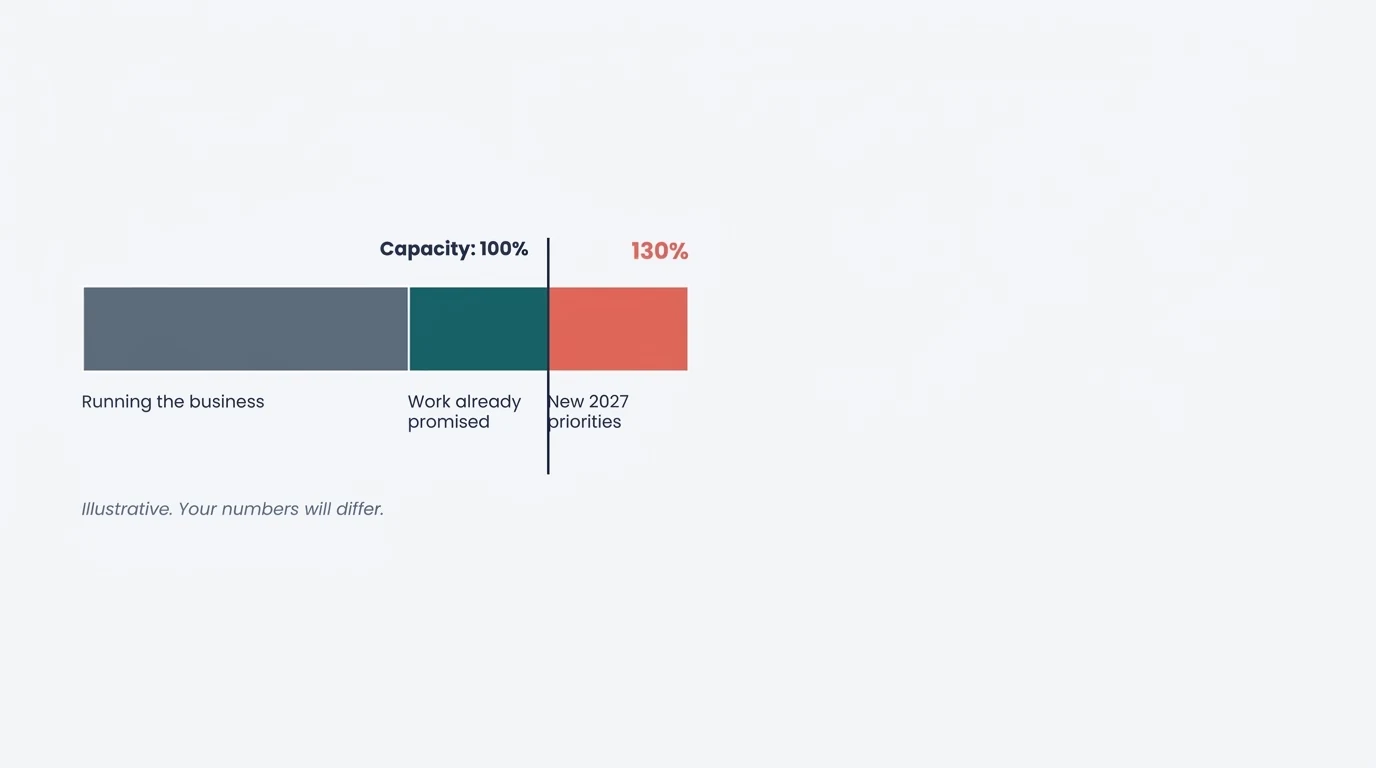
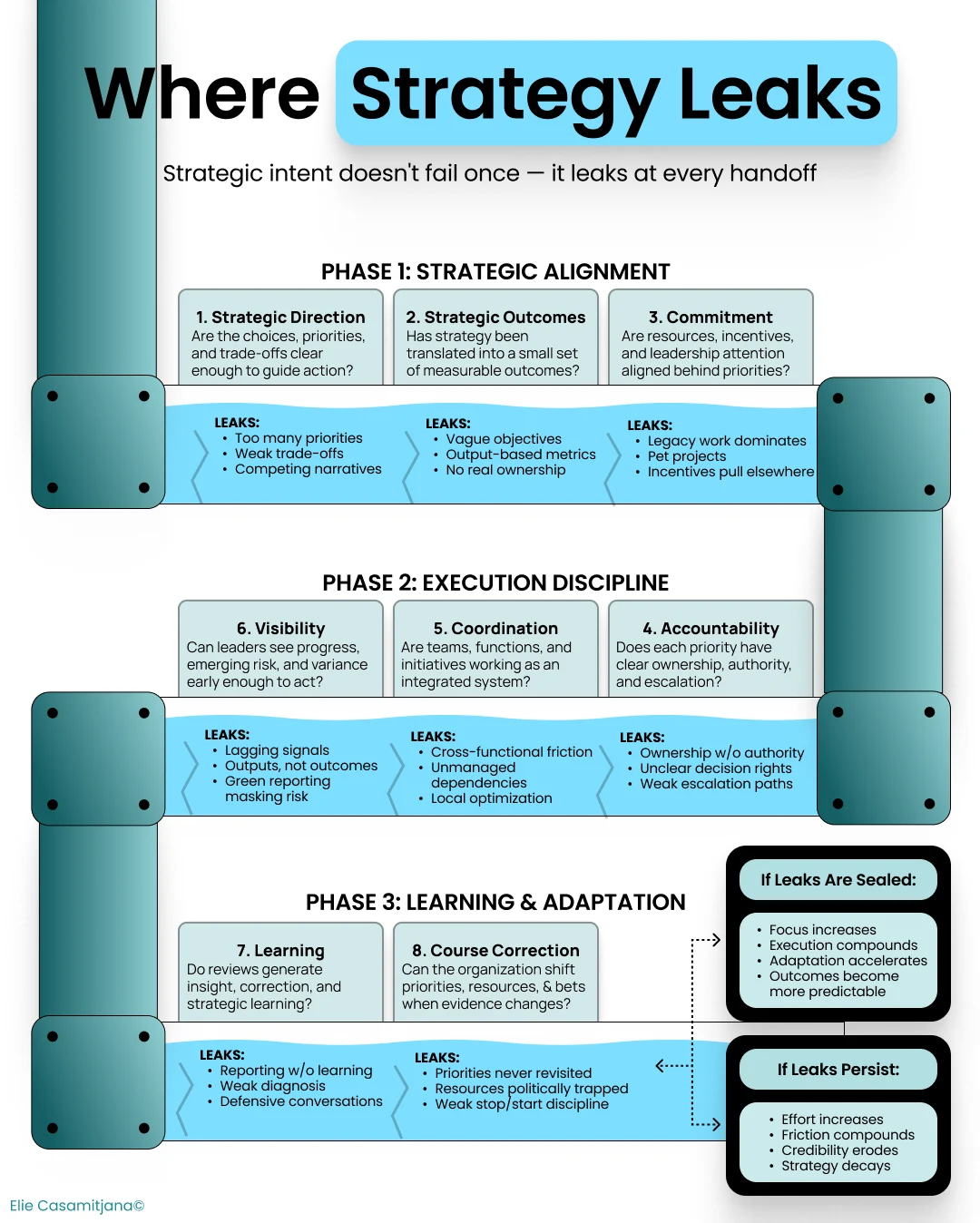
This is a leadership decision and governance problem before it is a planning problem. Strategy, budgets and team plans are often built in three different rooms. Each can look coherent on its own; together they can commit the same person twice. When strategy and budget disagree, the resource decision wins.
A working playbook with 23 tools
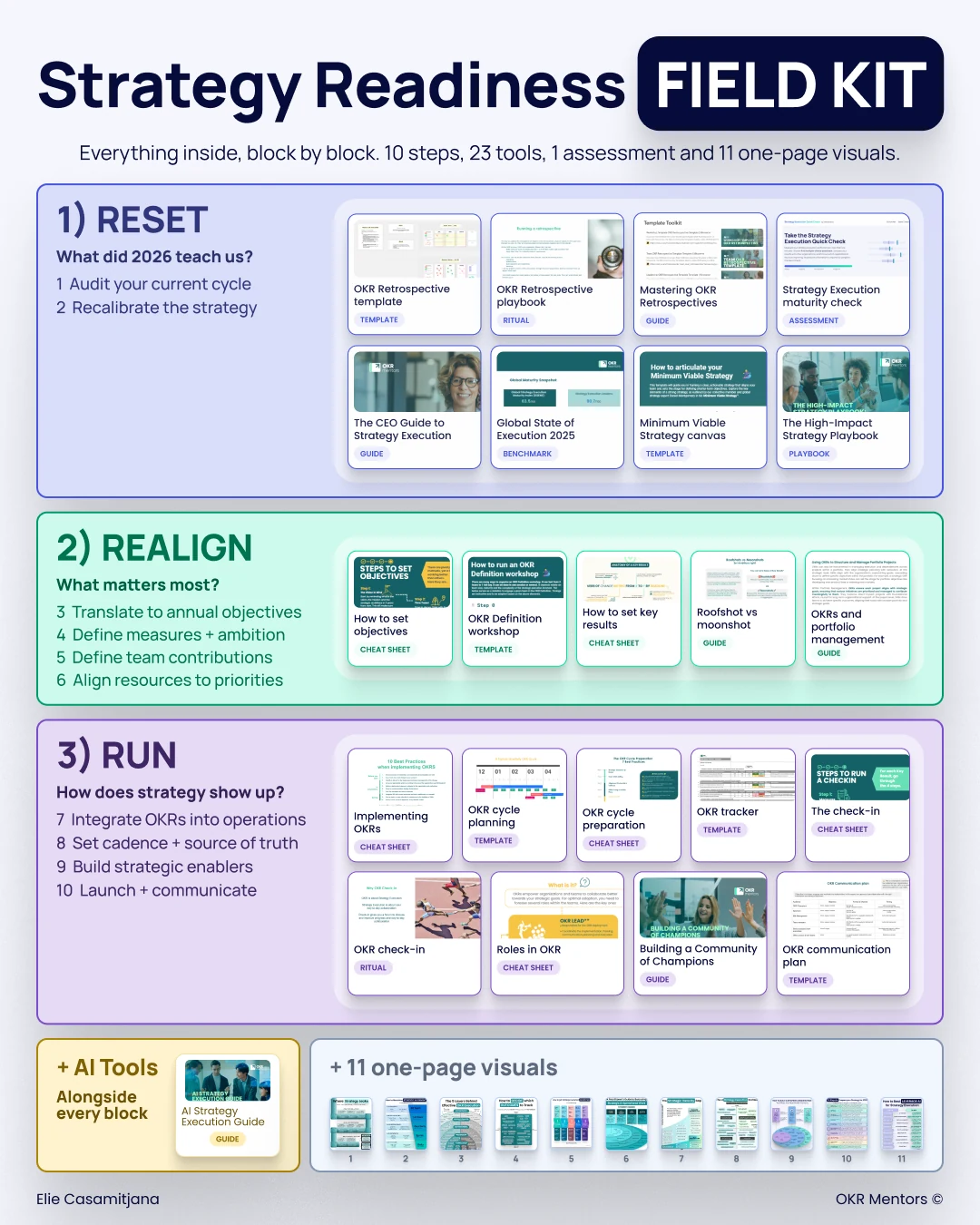
The free Strategy Readiness Field Kit follows the same ten steps with 23 practical tools, one maturity assessment and 11 one-page visuals. Every step points to a resource that helps produce a real decision or deliverable. Choose the step where your plan is stuck, open the tool, and use its output in your next leadership meeting.
Who is responsible for strategy execution?
The Strategy Operator is the person accountable for making the strategy cycle work without necessarily owning the teams who deliver it: a Head of Strategy, Strategy and Operations lead, Transformation Director, Chief of Staff or strategy PMO leader. The Strategy Operator makes trade-offs visible, prepares evidence, connects functional plans and gets decisions into the right executive forum.
The CEO and executives retain the authority to stop initiatives and move money. Deloitte’s 2026 survey found that only 35% of chief strategy officers co-lead or fully own decisions on their organisations’ top priorities. [2]
A useful operating model therefore designs around decision rights, rather than assuming the Strategy Operator has them.
What top performers do differently
In OKR Mentors’ Global State of Strategy Execution survey of 201 leaders in 30 countries, about 11% of organisations reached the highest strategy-execution maturity group. Within that group, 83% reported growing faster than competitors and 57% exceeding financial goals. These are reported associations, not proof that the practices caused the results. [3]
| Reset: learning and adaptation | Realign: strategic alignment | Run: execution discipline |
| 78% vs 22% retire outdated strategies quickly | 96% vs 41% align objectives across functions | 96% vs 27% hold weekly or biweekly check-ins |
| 78% vs 33% share lessons across the organisation | 91% vs 37% connect planning and budget | 74% vs 21% clear execution blockers within days |
| Evidence before the next bet | Funding and capacity behind the outcomes | Decisions and course correction while work runs |
Percentages compare the highest-maturity group (“leaders”) with all other respondents in the survey. [3]
The 10 steps of strategy execution readiness
| Phase | The leadership question | Output |
| Reset (steps 1 and 2): learning and adaptation | What did the last cycle teach us, and what do we stop? | Strategic insights and a genuine stop list |
| Realign (steps 3 to 6): strategic alignment | What matters most, and who pays for it? | A funded, capacity-tested plan |
| Run (steps 7 to 10): execution discipline | How does strategy show up in our week? | An execution system and the capability to sustain it |
A plan is real when it has moved three things: a resource (people and money follow priorities), a calendar (the first 90 days of reviews are booked) and a scoreboard (one trusted view governs strategic progress).
Reset: learning and adaptation
- The question: What did the last cycle teach us, and what do we stop?
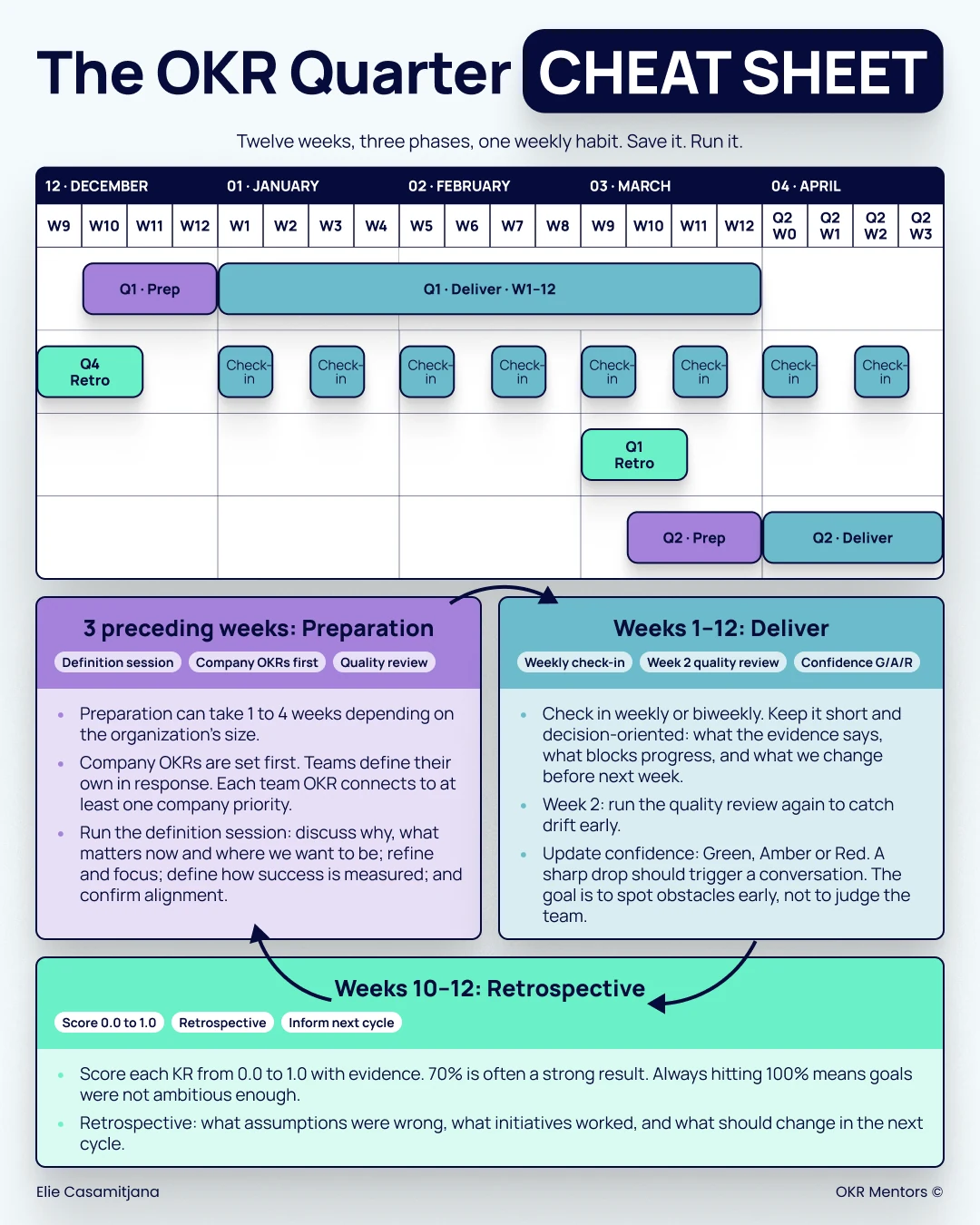
- When: Around 12 to 9 weeks before kickoff.
- You leave with: A tested fact base, strategic insights and a genuine stop list.
- The evidence: 78% of leaders retire outdated strategies quickly versus 22% of other organisations; 78% share learning across the organisation versus 33%. [3]
- Common traps: yesterday’s bet remains on the list “as a stretch”, and this year’s objectives are written without checking what the previous cycle taught.
In Reset, step 1 produces evidence and step 2 makes the choice. Keep them separate so the review stays about evidence rather than politics.
Step 1: Audit your current cycle
Harvest the evidence before discussing next year’s wishes. For every strategic bet, record the original assumption, results actually delivered, team and budget consumed, recurrent blockers and outside shifts in customer behaviour, competition, regulation or AI. Ask two questions that standard retrospectives miss: which funded initiatives did we actually stop, and which assumption from kickoff turned out to be false?
At Personio, Micaela Arizpe described a monthly loop around each metric: what do we observe, what do we infer, and what action do we commit to next month? After 22 quarterly planning cycles, the aim is for end-of-cycle learning to contain few surprises. [4]
- Strategy Operator prepares: A two-page review of bets, assumptions, outcomes, delivery leaks, external shifts and data gaps. Send it before the leadership planning meeting.
- Who decides: Nobody decides which bets survive yet; executive owners validate the evidence and challenge omissions.
- Done when: Leaders have read the fact base and the gaps are explicit before trade-offs begin.
- The antipattern: “It was green until it wasn’t” (automated green-washing): activity dashboards hide missing outcomes. “We’ll cover it in the retro” (submarine retrospective): lessons surface once and sink again. Check outcomes and recurring blockers monthly, not just at kickoff.
In the Field Kit: OKR Retrospective template; Mastering OKR Retrospectives; Strategy Execution Maturity Check; The CEO Guide to Strategy Execution.
Step 2: Recalibrate the strategy
Treat every surviving bet as if it were proposed for funding today. Double down, change, move to “next/later” with explicit resource limits, or retire it and release the money and people. Agree what winning means in one page: the strategic bets retained, the bets stopped, the assumptions still at risk and the few outcomes that would demonstrate success.
At Prosus, Alessandro Marasca described Now / Next / Later / Out prioritisation. “Out” was the hardest bucket to fill. Initiatives that miss their results may get a second cycle, but very few survive a third without evidence of value. [4]
- Strategy Operator prepares: Keep, change or stop recommendations, evidence for each bet, a one-page minimum viable strategy, and the draft stop list with people and budget to be freed.
- Who decides: CEO and leadership team. Stopping a strategic initiative and releasing its resources is an executive decision.
- Done when: The stop list contains actual initiatives, and the savings or people released have a new allocation or an explicitly uncommitted status.
- The antipattern: “Let’s keep it on the list as a stretch” (the empty out bucket). If “paused” work keeps funding and staff, it has not stopped. Ask: would we fund this bet from zero today?
In the Field Kit: Minimum Viable Strategy Canvas; The High-Impact Strategy Playbook.
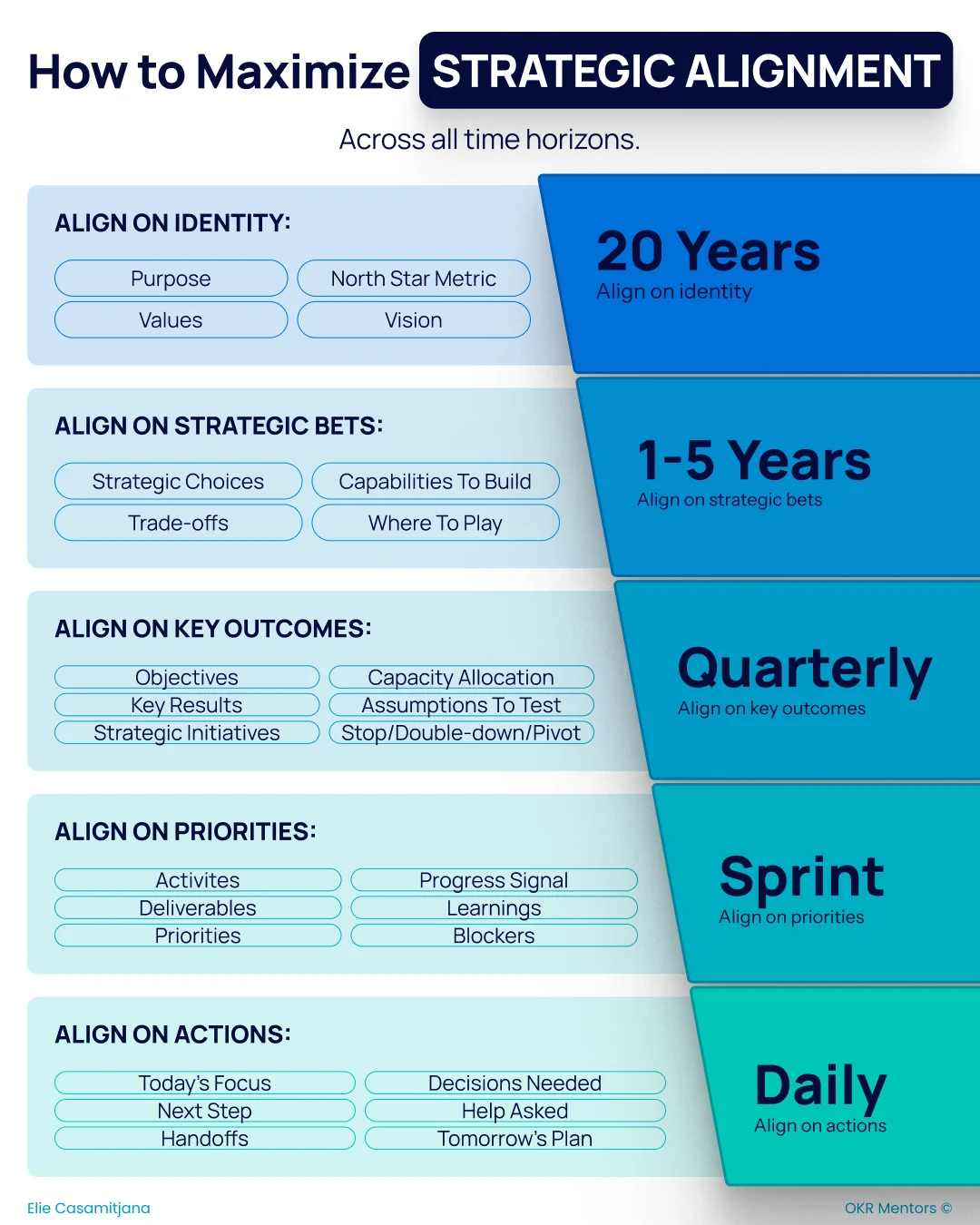
Reset in practice: from insight to a stop decision
- Diagnose gaps with the Strategy Execution Maturity Check and OKR Retrospectives.
- Prepare the learning brief and strategic choices with the Minimum Viable Strategy Canvas.
- Take an explicit keep, change or stop decision and release actual capacity.
Next action: open the Reset resources in the free Strategy Readiness Field Kit and take a proposed stop list to your next leadership meeting.
| Bet in the current plan | Evidence or assumption to test | Decision and actual release |
| Legacy partner portal | Usage is falling and the replacement channel now meets core needs | Retire with a transition date; release support and maintenance capacity |
| AI pilot across all functions | Several pilots compete for the same data and engineering support | Keep one evidence-backed pilot; close the rest and return the shared team to priorities |
Illustrative cases, not reported results. The critical test is whether capacity moves, not whether the status changes to “paused”.
Suggested Reset decision meeting: 45 minutes
- 10 minutes: review what changed and which assumptions failed.
- 10 minutes: validate the evidence for bets to continue or adapt.
- 20 minutes: explicitly approve the stop list and capacity releases.
- 5 minutes: assign owners and dates for communicating the decisions.
Realign: strategic alignment
- The question: What matters most, and who pays for it?
- When: Around 8 to 3 weeks before kickoff.
- You leave with: A funded, capacity-tested plan linking outcomes, teams and resources.
- The evidence: 96% of leaders align objectives across departments versus 41% of other organisations; 91% link strategic planning and budget versus 37%; 91% measure outcomes rather than tasks versus 33%. [3]
- Common traps: every function’s priority survives as a promise, and strategy, budget and team goals are set in three separate rooms.
Three planning rooms produce three different answers: the leadership team sets the strategy, Finance closes the budget, and managers later write team goals. The Strategy Operator must bring the three artefacts to one table. Do not permit an unfunded objective to survive as a promise.
Step 3: Translate to annual objectives
Turn the surviving strategic bets into three to five company objectives as a starting discipline, not a universal quota. Each objective states a change the business intends to create and why now. Name one owner at the leadership table; ask which competing objective it outranks when budget or capacity is scarce. Keep the “why” understandable by the manager who never attended the offsite.
- Strategy Operator prepares: Draft objectives, the rationale and trade-offs behind each, and the executive owner proposed for every outcome.
- Who decides: Leadership team approves objectives and owners.
- Done when: Objectives are agreed, owned by one executive each, and distinguishable from broad functional topics.
- The antipattern: “We can’t leave that out; the board will ask” (too many voices). A catalogue of functions is not a set of choices. Require each owner to say what its objective takes precedence over.
In the Field Kit: How to Set Objectives cheat sheet; OKR Definition workshop and template.
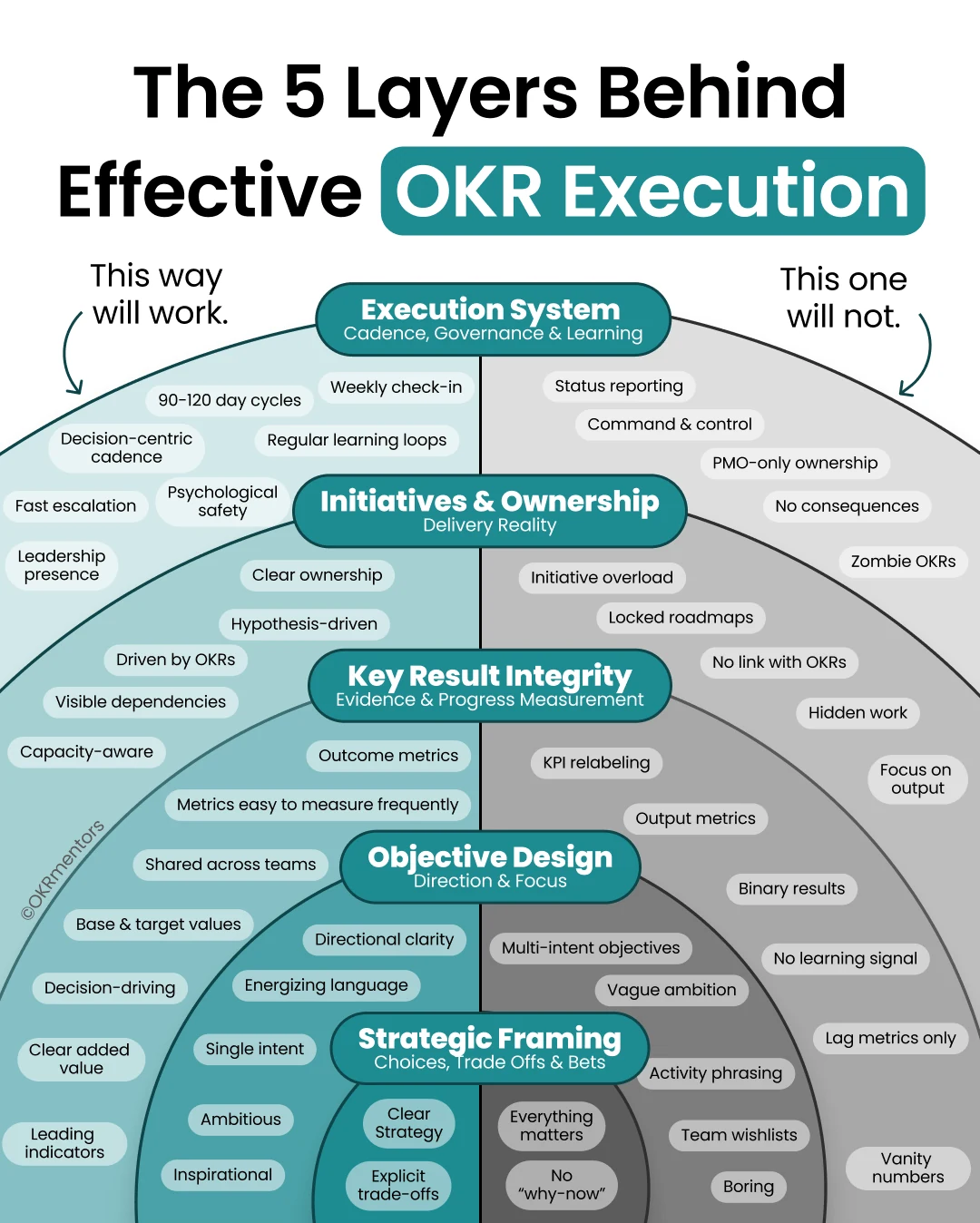
Step 4: Define measures and ambition
For each objective define two to four key results, each with baseline, target, data source and a distinction between a commitment and a stretch. Measure business or customer change rather than a delivery task: an initiative launched is an output; customer adoption or improved retention is an outcome. Use leading signals that can move during the cycle, alongside lagging confirmation of value.
Personio’s planning example made the “hockey stick” visible by asking the metric owner to state how much a customer-experience metric would move in each of the next three months, not merely its quarter-end target. [4]
- Strategy Operator prepares: Outcome scorecard including baselines, targets, leading signals, forecast monthly trajectory and an accountable metric owner. For material transformation bets, add a benefits hypothesis and a Finance-agreed validation approach.
- Who decides: Leadership team and objective owners set the ambition; Finance validates financial-benefit definitions where material.
- Done when: Every key result has a credible baseline and source; material benefits have an owner and verification method.
- The antipattern: “We’ll find the baseline later” (the task list in disguise) and “It will shoot up in month three” (the hockey stick). No baseline, no key result; require the month-one, month-two and month-three trajectory.
In the Field Kit: How to Set Key Results cheat sheet; Roofshot vs Moonshot guide; OKR Definition template.
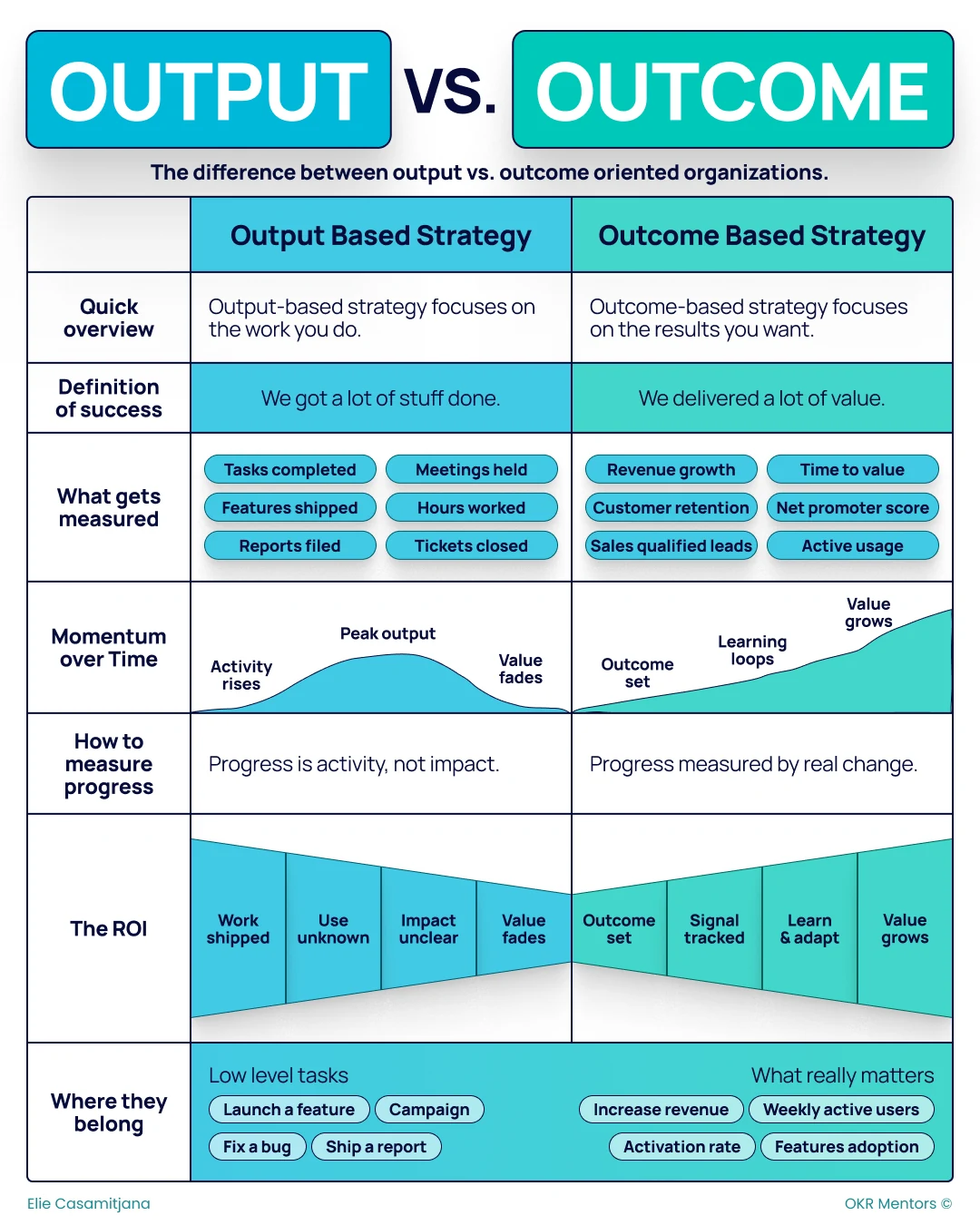
Step 5: Define team contributions
Send the strategy narrative before sending any objective template. Leadership owns the why and the what; teams build the how. Ask each team which company outcome it can move, the work it will commit to, what it will stop to make room, and which other team it depends on. Reconcile contributions horizontally across functions and vertically against ambition and capacity.
Micaela Arizpe’s example at Personio: when many teams review tools to increase efficiency at the same time, procurement becomes the shared bottleneck. Bring the delivery teams into scoping early because they can identify those dependencies before leadership locks the plan. [4]
- Strategy Operator prepares: One-page company narrative; team contribution map; named drivers for shared initiatives; explicit dependencies and a deadline for teams to confirm commitments.
- Who decides: CEO signs the narrative; team leads commit their contributions; the accountable executive objective owner validates alignment.
- Done when: Every top outcome has committed team contributions, and shared dependencies have owners and escalation routes.
- The antipattern: “Just send the template” (context lost) and “We copied the company objective and added our team name” (forced cascade). Narrative first; team design second; dependency reconciliation third.
In the Field Kit: OKR Definition workshop and template used with teams; OKR Communication Plan (also listed in Run).
Step 6: Align resources to priorities
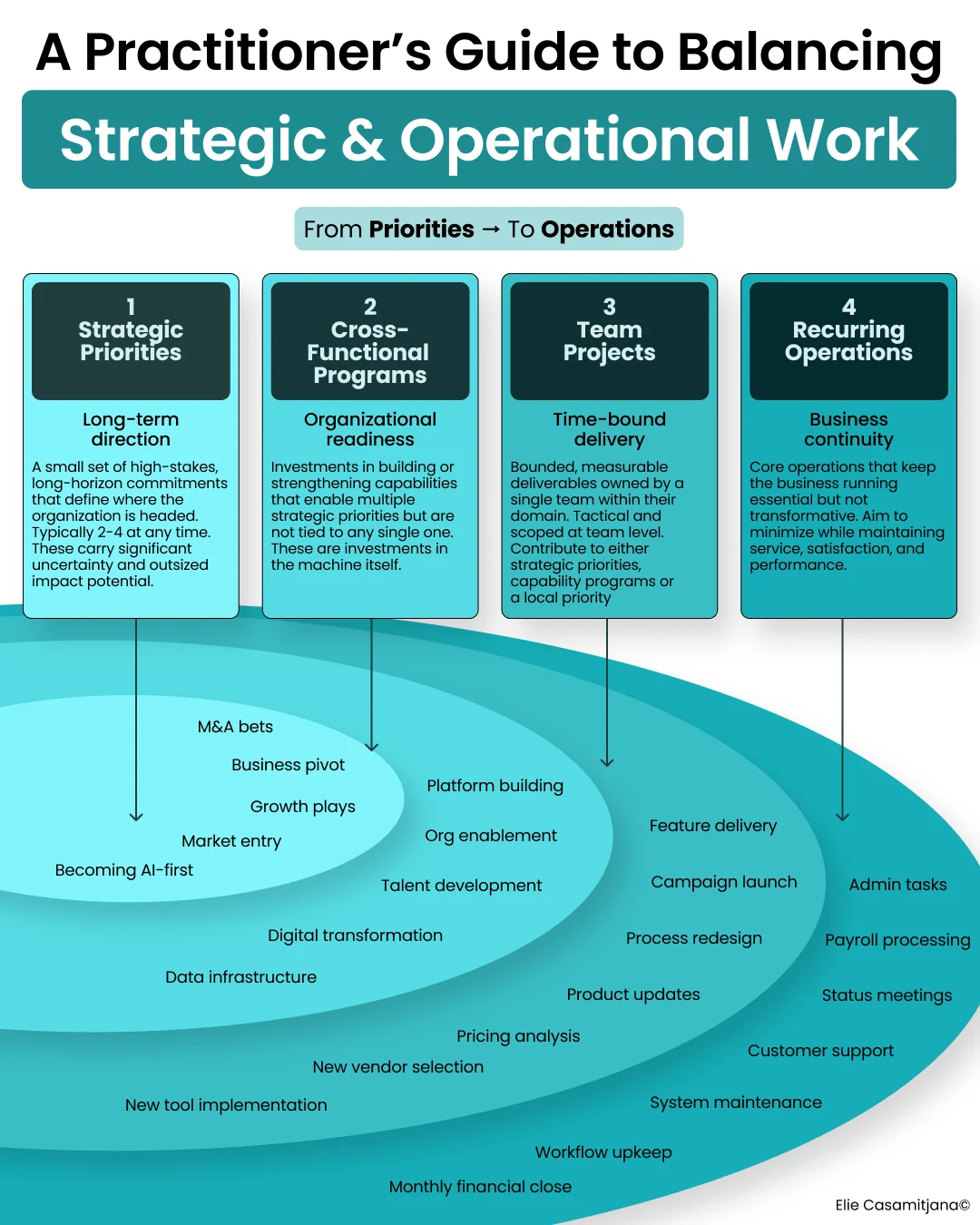
Put the full workload against real capacity: strategic priorities, cross-functional programmes, team projects, recurring operations and the previous cycle’s carry-over. Think of the capacity jar: the big rocks are the strategic priorities, not business-as-usual work; the stones are cross-functional programmes; smaller projects are gravel; and recurring operations are the sand. Reserve the essential operating minimum explicitly, then place discretionary work in that order. The analogy is about making trade-offs visible, not assuming routine operations can be compressed without limit. If the jar is full, stop, sequence or resize work rather than promising more capacity. Compare options by expected value, strategic importance, risk and scarce skills.
Test the total workload, not just the new strategic initiatives: business-as-usual plus prior commitments plus proposed change must fit within available capacity. Where the work does not fit, executives must decide which initiatives to stop, sequence or resize.
- Strategy Operator prepares: Capacity and portfolio view; objectives without funding; funding without objectives; two or three feasible allocation scenarios showing what moves and what stops.
- Who decides: CEO and CFO approve the movement of budget and people, with functional executives providing delivery commitments.
- Done when: Each top objective has a budget line, named capacity, a cross-functional driver and a feasible delivery sequence.
- The antipattern: “The budget was approved in September” (money stuck in yesterday’s bets). Show the contradiction on one page: priorities without money and money without priorities. Bring the choice to the sponsor.
In the Field Kit: OKRs and Portfolio Management guide; one-page visual: A Practitioner’s Guide to Balancing Strategic and Operational Work.
A real decision has a capacity consequence
Illustrative example: sales automation and a retention platform both require the same five engineers in the first quarter. The Strategy Operator does not ask each owner to negotiate privately; the Strategy Operator shows the executive the options and their cost.
| Choice | Strategic implication | Capacity consequence |
| A: Retention first | Prioritises evidence of customer value | Five engineers assigned now; sales automation shifts one quarter |
| B: Sales automation first | Prioritises commercial efficiency | Five engineers assigned now; retention work shifts one quarter |
| C: Split the team | Both bets remain visibly in progress | More context switching; higher risk of delay on both |
Illustrative decision scenario, not an example attributed to a specific company. The accountable executive decides; the Strategy Operator makes the trade-off impossible to miss.
Realign in practice: from objectives to a funded plan
- Define measurable outcomes with How to Set Objectives and How to Set Key Results.
- Align teams with the OKR Definition workshop and check ambition with Roofshot vs Moonshot.
- Test ownership, funding and scarce capacity with OKRs and Portfolio Management.
Next action: open the Realign tools in the free Strategy Readiness Field Kit and take a funded portfolio decision to the executive team.
Run: execution discipline
- The question: How does strategy show up in our week?
- When: From two weeks before kickoff through week 16.
- You leave with: A delivery system, decision cadence and capability to sustain results.
- The evidence: 96% of leaders hold weekly or biweekly check-ins versus 27% of others; 83% visibly link roadmaps to strategic goals versus 28%; 74% clear blockers within days versus 21%. [3]
- Common traps: treating kickoff as the finish line, and expecting teams to coordinate automatically.
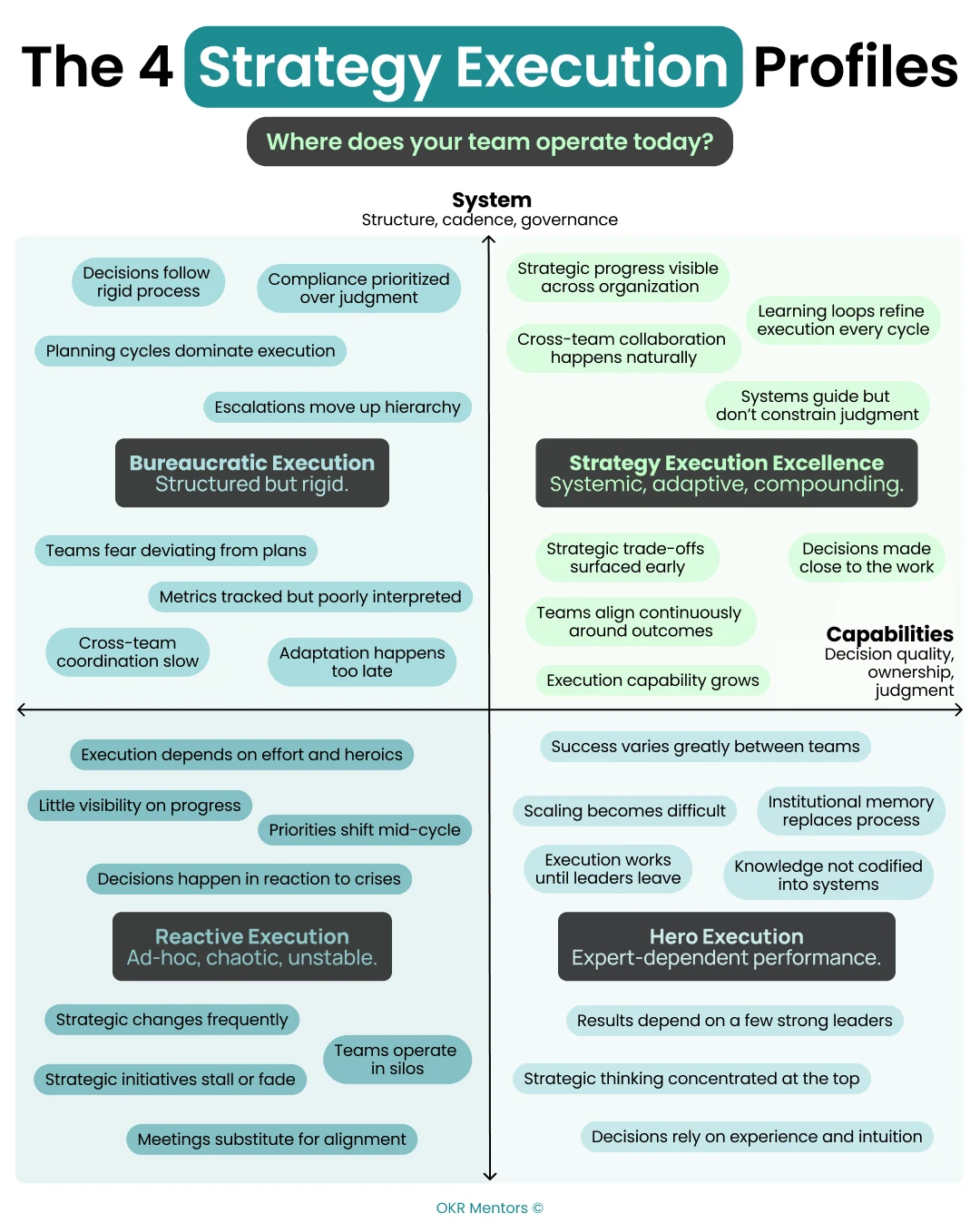
Structure without capable people becomes bureaucracy; capable people without structure become heroes. The Strategy Operator’s job is to make decisions and learning repeatable, not to become indispensable.
Step 7: Integrate OKRs into operations
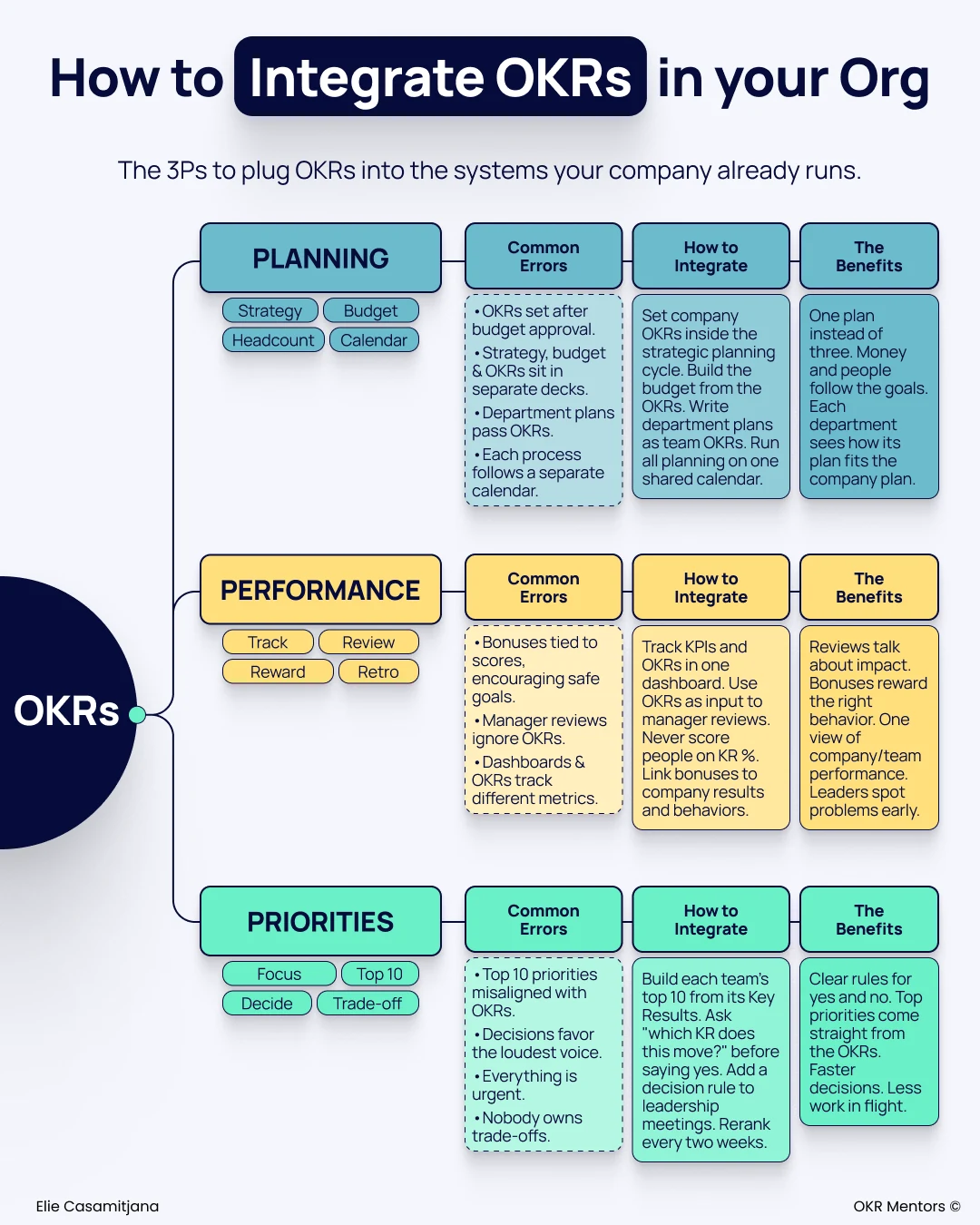
Connect OKRs to strategic planning, portfolio roadmaps, funding and management reviews. Keep one trusted source for strategic commitments. KPIs remain visible to show the health of ongoing operations; OKRs indicate the change sought this cycle. A KPI may become a key result when leaders choose to improve it. Do not build a second or third competing system that scores the year differently.
- Strategy Operator prepares: Inventory of current goal systems, dashboards, budgets and review forums, with a migration proposal and a clear system-of-record decision.
- Who decides: Leadership team with Finance and HR agrees the integrated system of record and how operational KPIs will be reviewed.
- Done when: Every decision forum reads from the same strategic record and duplicated goal reporting is retired.
- The antipattern: “The dashboard is never right anyway” (the broken process, automated; the fragmented stack). First agree on measures, owners and review discipline; then automate. New software cannot repair unmade decisions.
In the Field Kit: Implementing OKRs cheat sheet; AI Strategy Execution Guide (the AI companion for every phase).
Step 8: Set the cadence and the source of truth
Book a weekly or biweekly outcome check-in around three questions: what moved, what is blocked and what must be decided? Use a monthly executive review for cross-functional trade-offs and a first full course correction in weeks 12 to 16. Set intervention triggers for every critical outcome: which number, by what date, means the leadership team should act? Give daily actions, weekly delivery and quarterly outcomes appropriate rhythms.
Micaela Arizpe suggested spending less effort pretending the annual plan can foresee every dependency and more agreeing on the triggers that reveal when to intervene. [4]
- Strategy Operator prepares: The first 90 days of reviews already in calendars; concise decision-led agendas; intervention triggers; owners and due dates for escalated choices.
- Who decides: Leadership team owns strategic reviews and course correction; the Strategy Operator owns the calendar, decision log and follow-through.
- Done when: The reviews are booked; they use the system of record; open decisions and triggers have named owners.
- The antipattern: “If we plan it right, we won’t need to change it” (the crystal ball) and “Sunday night, building the deck again” (manual assembly). Use alarms and automated preparation to get the decision into the meeting sooner.
In the Field Kit: OKR High-Level Cycle Planning template; OKR Cycle Preparation cheat sheet; OKR Tracker; The Check-in cheat sheet; OKR Check-in ritual.
Step 9: Build strategic enablers
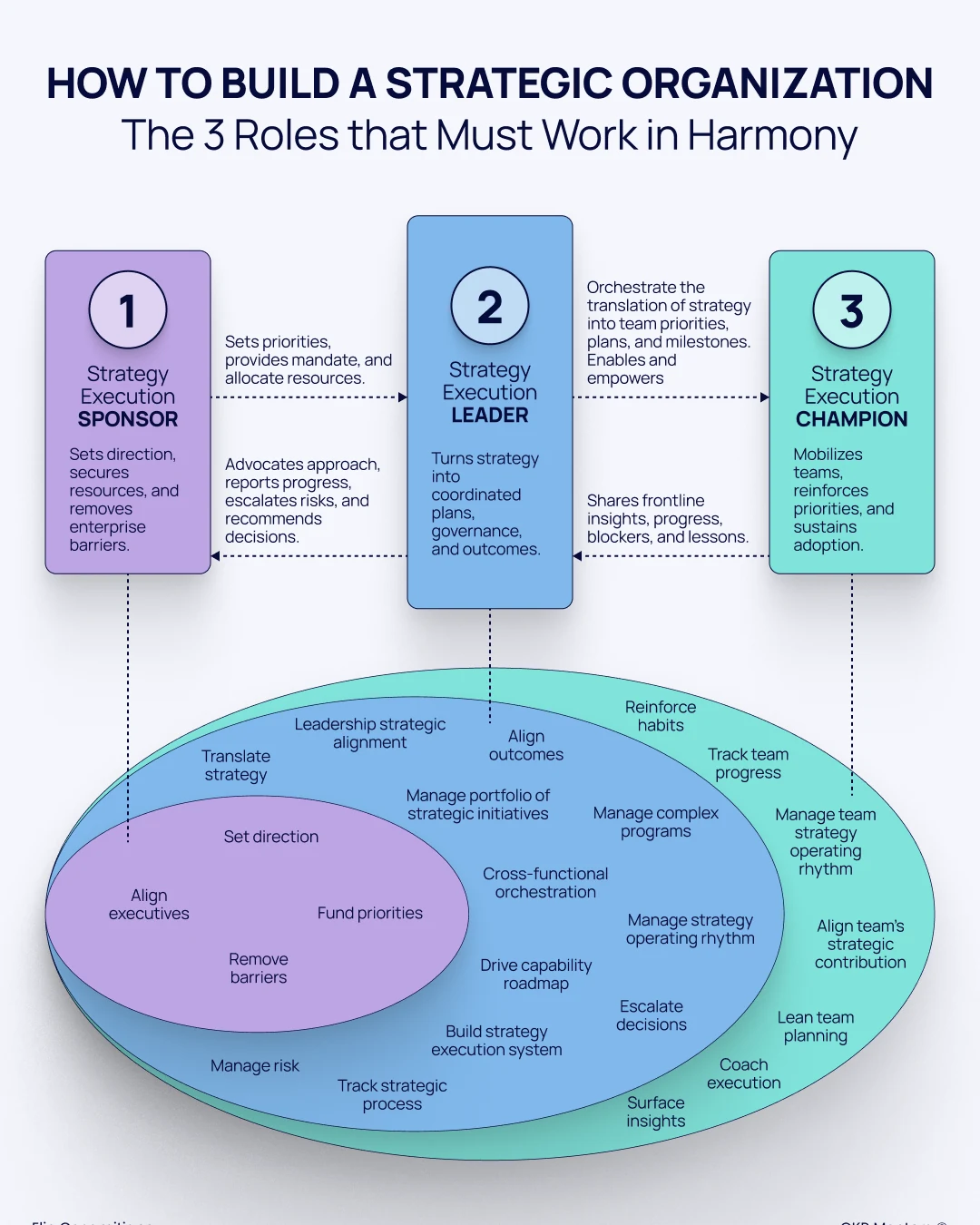
A delivery system needs three named roles that operate together: executive sponsor (makes the calls and secures resources), Strategy Operator (connects the method, plan and cadence), and embedded champions (help teams adopt practices and surface obstacles). Clarify decision rights: who can settle cross-team conflicts, stop an initiative, reallocate capacity and change a target. Build the capability to use the system through coaching, shared practice and targeted skills development.
Working closely with hundreds of organisations, we can distinguish strong systems from strong individuals: the durable outcome is both. Champions and practical training help the system survive a sponsor change or reorganisation.
- Strategy Operator prepares: One-page decision-rights charter; sponsor, Strategy Operator and champion map; readiness of each team’s champion; practical enablement plan.
- Who decides: CEO appoints the sponsor and approves decision authority; function heads nominate champions; the Strategy Operator runs the network.
- Done when: Every team knows where to escalate; sponsors are named; champions can support check-ins and learning without the system relying on one person.
- The antipattern: “You run the OKRs, you sort it out” (the Strategy Operator without a mandate). Responsibility without the right to escalate or obtain a decision creates heroic effort and no system. Make authority explicit in writing.
In the Field Kit: Roles in OKR cheat sheet; Building a Community of Champions guide.
Step 10: Launch and keep communicating
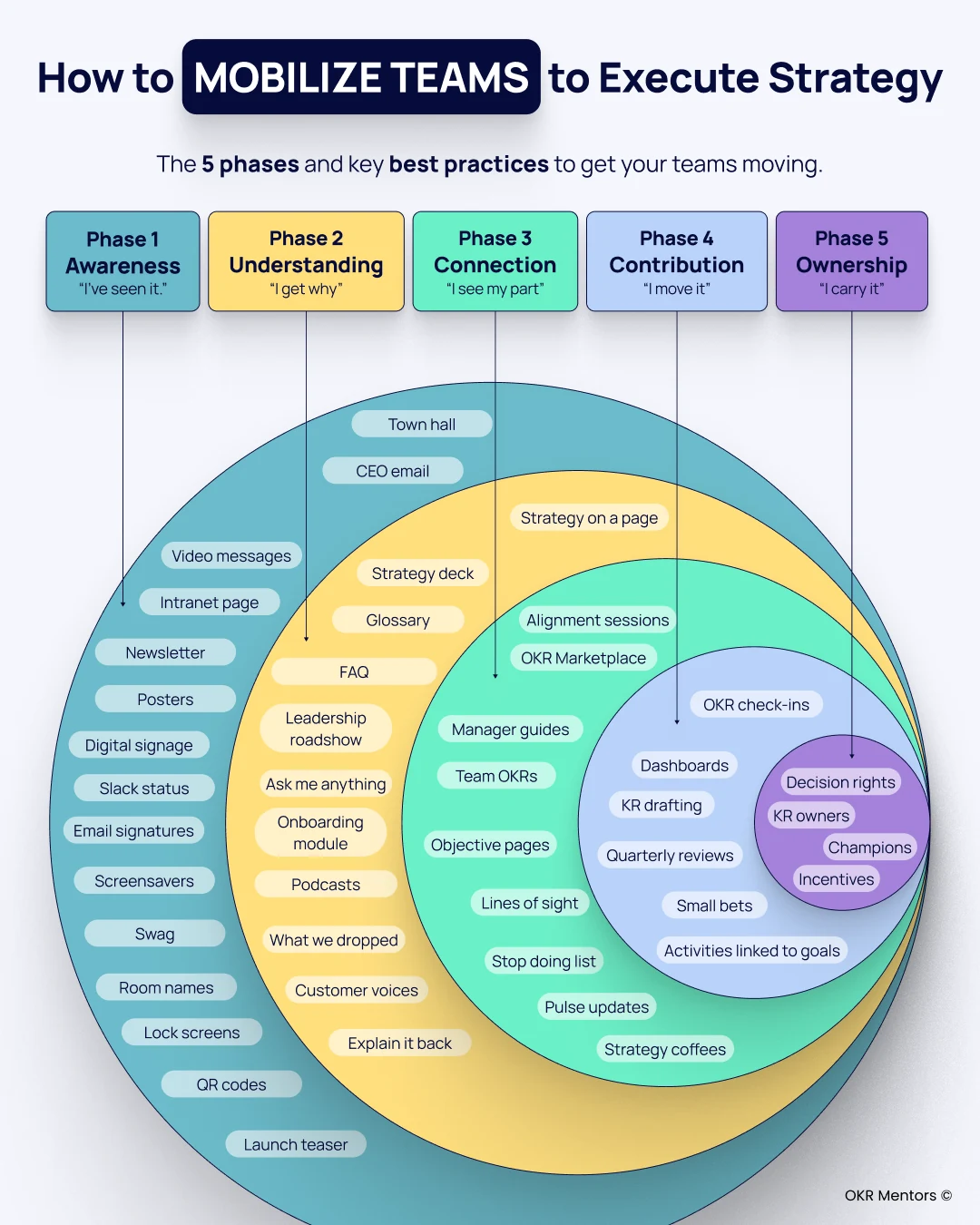
Use kickoff to reveal the choices already made: what is changing, which initiatives have stopped, the outcomes and owners, and how decisions and results will be reviewed. Keep the narrative alive in leadership meetings and team check-ins. Communication proves the priorities still shape decisions after the meeting.
- Strategy Operator prepares: Kickoff narrative based on step 5; visible stop list; ownership map; communication plan linking each message to the next decision or milestone.
- Who decides: CEO leads the launch; outcome owners reinforce the priorities in their own teams.
- Done when: Managers can explain the strategy in plain language without slides, and the first review is already scheduled.
- The antipattern: “Let’s get the kickoff right and work out the rest after” (kickoff as step one). In a ready organisation, kickoff ends planning and begins execution; it does not substitute for steps 1 to 9.
In the Field Kit: OKR Communication Plan template; ten-step visual to help managers tell the story.
Run in practice: from kickoff to weekly delivery
- Connect the execution system using Implementing OKRs and the OKR Tracker.
- Book the first 90 days with Cycle Planning and the OKR Check-in resources.
- Equip owners through Roles in OKR, Community of Champions and the OKR Communication Plan.
Next action: open the Run tools in the free Strategy Readiness Field Kit and start the first decision-led review.
Where AI helps in strategy execution
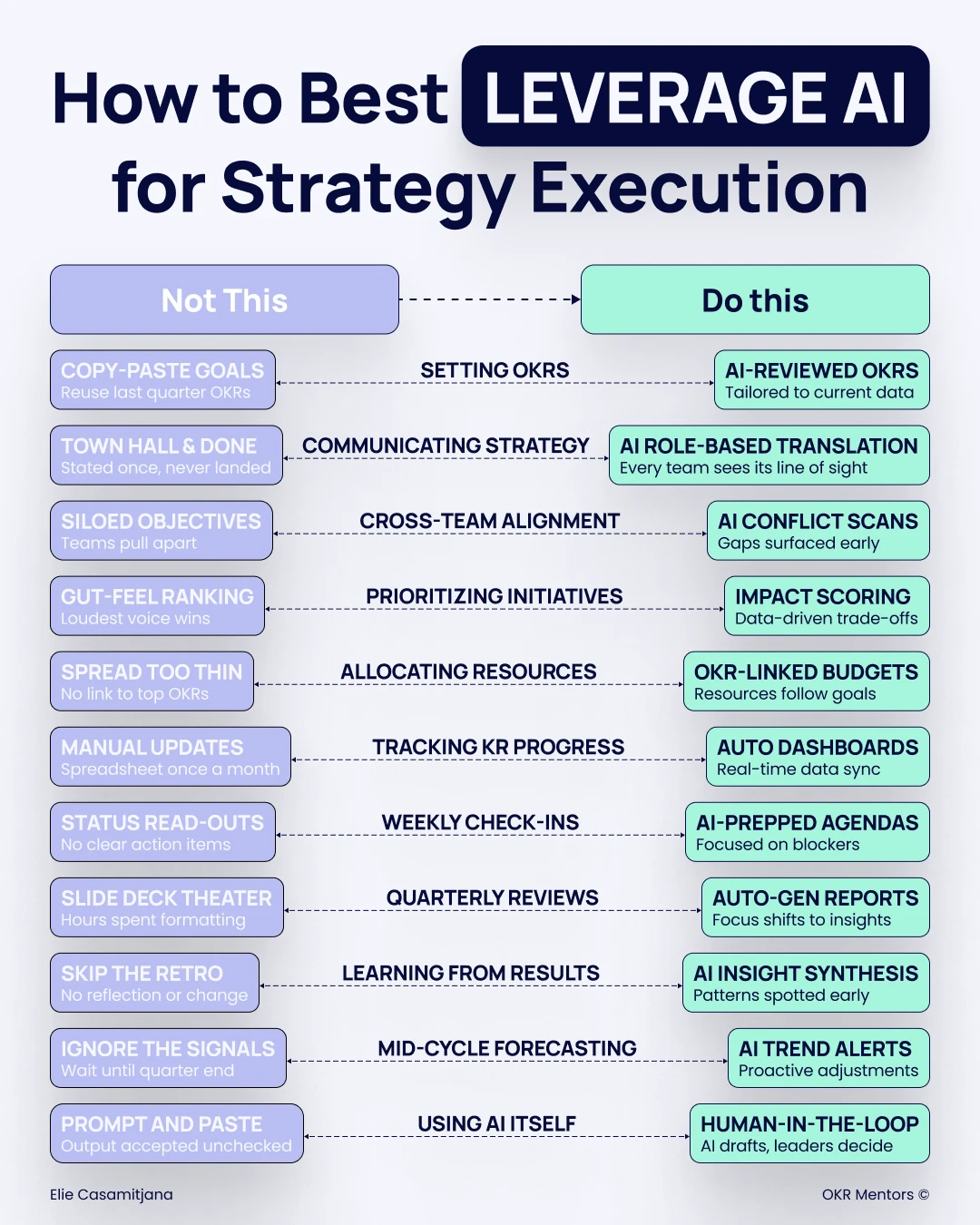
AI accelerates the first half of planning: synthesising updates, analysing the last cycle and preparing draft outcomes. But that speed can widen the gap between more proposals and the same constrained people. The larger gain is in reconciliation during execution. Use AI to identify patterns and draft options; keep judgement with accountable leaders.
| Phase | Replace this | With this AI-supported work |
| Reset | Skipped retrospective or gut-feel stop calls | Insight synthesis across teams; impact scoring supported by recorded evidence |
| Realign | Siloed goals and duplicated scarce resources | Conflict scans, gaps in team contributions, OKR-linked budget and capacity scenarios |
| Run | Status read-outs and manual deck assembly | Decision-led agendas, alerts and a trusted live scoreboard |
At Prosus, Alessandro Marasca described a monthly leadership dashboard connected to a central data lake, with data-driven results refreshed within a few working days and qualitative measures still guided by human judgement. He also described one portfolio company’s searchable record of strategic discussions and decisions, turning institutional memory into a working asset. The principle matters more than the tools: AI should build on shared evidence, not on isolated fragments of it. [4]
Micaela Arizpe’s caution is equally relevant: AI is more useful for strengthening an existing point of view than inventing the judgement the Strategy Operator or executive has not formed. [4]
Field Kit companions: AI Strategy Execution Guide; The Human Engine in the Age of AI; the 11 one-page visuals include an AI visual alongside one for each of the ten steps.
The Strategy Readiness Field Kit
This runbook identifies the leadership decisions. The free Field Kit supplies the working resources that help the Strategy Operator prepare them: 23 tools, one Strategy Execution Maturity Check, and 11 one-page visuals mapped to Reset, Realign and Run. It is designed to be used selectively, starting with the unresolved decision rather than read cover to cover.
| If your plan is… | Start with… | Leave with… |
| Not started | Strategy Execution Maturity Check, then the step 1 retrospective tools | A diagnosis and a two-page learning brief |
| Already in draft | The ten-question readiness check below; go to the first “no” and its step-specific tool | A decision register and a funded, credible plan |
| Approved or launched | Step 7: Implementing OKRs, then the Tracker, Check-in and Roles in OKR | One source of truth and the first 90 days of reviews |
The ten-question readiness check
One question for each step. Every “no” is a gap to close and a line on the Strategy Operator’s decision register.
| Step | Readiness question |
| 1. Audit your current cycle | Did leaders review the last cycle’s outcomes, assumptions and recurring blockers before planning? |
| 2. Recalibrate the strategy | Is there a real stop list, with money and capacity actually released? |
| 3. Translate to annual objectives | Are there a few agreed enterprise objectives, each with one executive owner? |
| 4. Define measures and ambition | Does each key result have a baseline, target and credible data source? |
| 5. Define team contributions | Did teams receive the strategy narrative before committing their contributions? |
| 6. Align resources to priorities | Does each top objective have named capacity and funding that fit the total workload? |
| 7. Integrate OKRs into operations | Is there one trusted strategic system of record linked to plans and reviews? |
| 8. Set the cadence and the source of truth | Are the first 90 days of reviews booked, with intervention triggers? |
| 9. Build strategic enablers | Are sponsor, Strategy Operator, champions and decision rights explicit? |
| 10. Launch and keep communicating | Can managers explain the priorities, and is the first reset already scheduled? |
Choose the three most consequential “no” answers. For each, name the decision, its owner, the date, the affected teams and the Field Kit resource that will make the choice easier.
Four moves the Strategy Operator can make now
The readiness check shows the gaps. The Strategy Operator can turn those gaps into evidence and decision-ready options without waiting for new authority.
- Make unmade decisions visible. Record what is contested, the accountable owner, the decision deadline, the early signal that would trigger a change of course and a proposed option for approval. Ask which decision has remained open for two leadership meetings.
- Use existing executive forums. Put each decision into a budget review or leadership meeting already on the calendar instead of creating a parallel committee. Give it an owner and a date.
- Expose the real capacity constraints. Put operations, carry-over, cross-functional programmes and new priorities on one page. Show where the same scarce people appear in two approved plans, and which outcome has no accountable end-to-end owner.
- Build support for the trade-offs. Speak with initiative owners before the meeting. Ask which bet they would not fund from zero today and what could be stopped, delayed or reduced. Present evidence and acceptable options rather than a unilateral stop order.
The Strategy Operator can prepare the recommendation, convene the right discussion and track the decision. Only accountable executives can approve stopping initiatives or reallocating money and people.
One example: the decision register
| Unmade choice | Executive owner and deadline | Decision-ready proposal |
| Sales and Product need the same five engineers in Q1 | COO, before the next portfolio review | Fund the higher-value bet first; sequence the other into Q2. Confirm the owner, capacity release and review date. |
Two calls only executive leadership can make
First: which strategic initiatives are genuinely retired? Second: where do the released money and people go? The Strategy Operator can make the trade-offs clear and impossible to leave open, but cannot substitute for the executives who must make and communicate the call.
Free download: make the next decision easier
Get the free Strategy Readiness Field Kit: 23 tools, 10 steps, one maturity assessment and 11 one-page visuals. Pick the first failed readiness question, open its step-specific tool and bring the output to a leadership meeting already on your calendar.
If the gaps are cross-functional and politically difficult, use the Field Kit as the shared evidence for a strategy readiness review with your leadership team. The strongest next step is one decision made, one resource moved and one review booked.
Frequently Asked Questions
Strategy execution is the work of turning strategic choices into funded commitments, regular decisions and measurable results. It covers what you stop, where money and people go, how teams commit to outcomes, and how leaders review progress and change course during the year.
This guide uses ten steps in three phases.
Reset: audit your current cycle and recalibrate the strategy.
Realign: translate to annual objectives, define measures and ambition, define team contributions, and align resources to priorities.
Run: integrate OKRs into operations, set the cadence and source of truth, build strategic enablers, and launch and keep communicating.
The CEO and executive team own the decisions: what stops, where money and people go, and who owns each outcome.
A Strategy Operator, such as a Head of Strategy, Chief of Staff or Transformation Director, runs the cycle: preparing evidence, connecting plans and getting decisions to the right forum. Embedded champions help teams adopt the practices.
Strategic planning decides where to go and which bets to make. Strategy execution makes those choices real: it funds them, assigns owners, connects team work to them and reviews progress every week or two.
A plan that skips execution stays in a slide deck; execution without clear choices spreads people across too many priorities.
Sources
[1] Korn Ferry, Workforce 2026 Global Insights Report (September 2026), as reported by Staffing Industry Analysts.
[2] Deloitte, 2026 Chief Strategy Officer Survey (12 February 2026).
[3] OKR Mentors, Global State of Strategy Execution 2025, 201 leaders across 30 countries.
[4] “AI, priority overload, alignment: one clear plan by January”, OKR Mentors live webinar, 27 October 2026, with Micaela Arizpe (Personio) and Alessandro Marasca (Prosus). Practitioner examples are paraphrased from the session.
