


What is OKR Implementation?
OKR implementation is the process of embedding Objectives and Key Results (OKRs) into the organisation’s strategy execution system, connecting priorities to measurable outcomes and creating a regular rhythm for alignment, progress review, learning, and adaptation.
A successful OKR implementation includes:
- improving the system over multiple cycles
- defining strategic priorities
- training leaders and teams
- designing rollout processes
- integrating OKRs into workflows
- running regular check-ins
Why some OKR implementations fail
Most OKR failures are caused by organizations that implement OKRs as a reporting process instead of a strategy execution system.
On paper, OKRs are simple:
- define priorities,
- measure outcomes,
- review progress,
- adapt quickly.
In practice, implementation fails when the surrounding behaviors, incentives, and leadership habits do not change with the framework.
Organizations often say they are “doing OKRs” while continuing to operate exactly as they did before. Teams still chase too many priorities. Managers still reward activity over outcomes. Check-ins become status reporting sessions. Objectives become top-down targets instead of shared commitments. The framework exists, but the operating model underneath it remains unchanged.
Effective OKRs vs reporting theater
Organizations often fail with OKRs not because the framework is flawed, but because they unknowingly implement it as a reporting system instead of a strategy execution system.
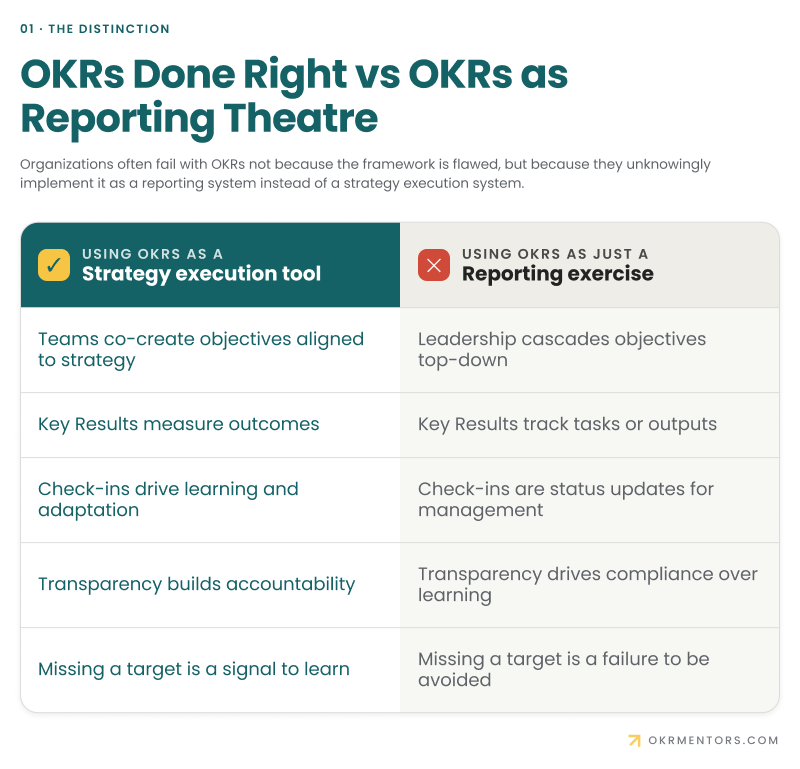
Most failed OKR implementations are not failures of the framework itself. They are failures of implementation behavior, leadership modeling, and organizational incentives.
Before you implement OKRs
OKRs translate strategy into concrete, measurable goals. They do not generate the strategy. Rushing into OKRs without a defined direction leads to misaligned objectives and organizational resistance.
A defined strategy
Strategy gives OKRs their direction. Without it, teams may set locally meaningful goals that pull in different directions at the organizational level.
Before beginning OKR design, the leadership team should be able to answer these four questions:
- Who are we, and why do we exist? (Vision, Mission, and North Star)
- What opportunities are available in the market?
- Where do we want to play? (Target market and value proposition)
- What do we need to excel at to win?
If these questions do not have clear answers, the first OKR cycle should focus on developing them rather than setting operational objectives.
If you are unsure how well your organization currently executes on its strategy, the SEM360™ diagnostic provides a structured way to assess execution maturity across key dimensions before committing to an OKR rollout.
Translating strategy into OKRs
Once the strategy is defined, the next task is to convert it into a short, focused set of OKRs. In OKR Mentors’ practice, this is done in a structured conversation, not in a solo drafting exercise. The output matters, but so does the shared understanding that produces it.
Defining OKRs together is worth the time for two reasons:
- Collective intelligence. Different perspectives surface better priorities and more realistic outcomes.
- Team buy-in. When people help define the OKRs, they are more committed to delivering them.
For the first cycle, this workshop is usually run with the leadership team. From the second cycle onward, each team runs its own workshop to translate the company’s direction into its own OKRs.
The six steps to running an OKR Definition workshop
A typical workshop follows six steps. The time spent on each varies with team size and maturity, but the sequence is consistent.
1. Start with the Why. Open by revisiting the strategy, the current context, and the priorities for the period ahead. The goal is to zoom out before zooming in. A leader often gives this framing. It takes 10 to 30 minutes.
2. Review what matters now. Look at the current situation, the main challenges, and where relevant, the lessons from the previous cycle. This anchors the conversation in reality before it shifts to aspiration. 10 to 60 minutes.
3. Imagine where we want to be. Ask the team to describe what success would look like at the end of the cycle. Encourage open participation from everyone. The aim is breadth: get the full range of possibilities on the table before narrowing. 30 to 60 minutes.
4. Focus and refine. Cluster the ideas. Identify the few that matter most. Converge on 1 to 3 Objectives. This is where focus is made or lost; resist the pull to keep everything. 60 to 120 minutes.
5. Define how success will be measured. For each Objective, draft the Key Results that will provide measurable evidence of progress. Keep to 2 to 5 Key Results per Objective. Define what each metric actually counts, and where the data comes from, before moving on.
6. Wrap up and confirm alignment. Review the proposed OKRs as a group. Do a round table to confirm everyone is aligned on both the content and the plan to deliver. Agree on next steps before finalizing.
A first definition workshop usually runs from a couple of hours to a full day. The goal is not speed. It is clarity and shared commitment to the priorities of the cycle.
A discipline worth keeping
Whatever the workshop produces, the final set should be small: at most 3 Objectives, with 2 to 5 Key Results each. If the team cannot cut further, the strategic choices have not yet been made. Fewer goals, chosen well, will always outperform more goals chosen partially.
Leadership buy-in and the OKR Lead
OKRs require consistent visible commitment from leadership. Leaders do not just endorse the process; they model it by setting their own OKRs openly, attending check-ins, and discussing their own progress in front of their teams.
In parallel, organizations that implement OKRs well typically designate an internal OKR Lead. This person drives the implementation program, coordinates with team-level OKR Champions, and acts as the main point of contact for questions and support. The role does not require an expert at the start, but it does require credibility, communication skills, and organizational influence.
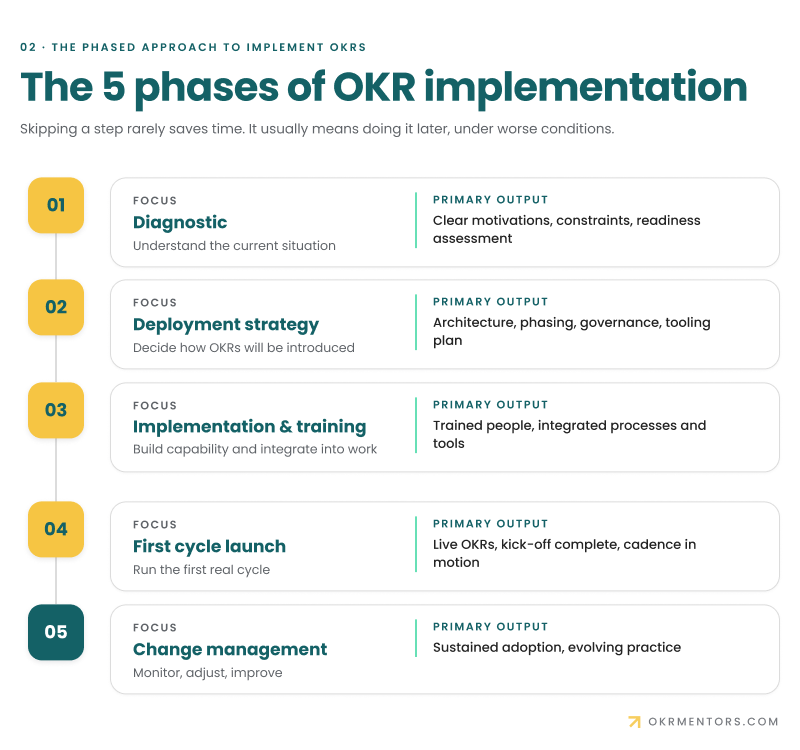
The 5 phases of successful OKR implementation
A structured OKR implementation follows five steps. This sequence is used across OKR Mentors certification programs and reflects what works in practice across hundreds of rollouts. Skipping a step rarely saves time; it usually means doing it later under worse conditions.
Step 1: Run a Diagnostic
Before launching OKRs, organizations need to understand the execution problems they are actually trying to solve. A diagnostic gives you a clear picture of the organization’s current strategy execution challenges, readiness for OKRs, and real motivation for introducing them.
What is a Diagnostic?
An OKR diagnostic is the analysis of current strategy execution challenges, organizational readiness, and leadership motivations that shapes the deployment strategy.
It helps determine whether the organization is ready for OKRs, what conditions may block adoption, and where the rollout should begin.
A strong diagnostic prevents organizations from treating OKRs as a generic management trend or a quick fix for deeper execution problems.
A diagnostic answers three questions:
- What are the current strategy execution challenges?
- What is the organization’s readiness for OKRs?
- What are the real motivations for introducing them?
Common execution challenges that you might encounter
- Not enough time for what matters most
- Too many competing priorities
- Execution that is not consistently effective
- Low engagement and weak accountability for outcomes
How to run the diagnostic
The diagnostic is usually a mix of conversations with direct stakeholders, a short survey like SEM360 across management levels, and qualitative interviews with a sample of team members. The aim is to get insight from senior leadership, middle management, and front-line teams, not just from the sponsor.
Red flags to watch for at this stage
These signals suggest the conditions are not yet right for OKRs.
- “This is hype. My managers told me we should do this.”
- “I want OKRs because I need a better reporting framework for what my team is doing.”
- “I want OKRs implemented, but my management team should not spend much time on it.”
- “We need OKRs to fix our performance problem.”
If these are dominant, the conversation is not yet about implementation. It is about whether OKRs are the right intervention at all.
Becoming culturally ready for OKRs
Successful OKR adoption also depends on cultural readiness. These do not need to be perfect, but they need to be directionally present:
- Openness to transparency across teams and levels
- Willingness to focus on outcomes instead of activities
- Comfort with team autonomy, including letting teams shape their own goals
- Tolerance for agility and mid-cycle adjustments
- A person who can credibly lead the deployment
- A clear method, and the patience to let it land over a few cycles
If more than one of these conditions is missing, focus first on building the foundation before launching the first OKR cycle.
OKRs work best in environments where teams are willing to prioritize openly, collaborate across functions, learn continuously, and adapt as new information emerges. Without those conditions, the process often becomes mechanical compliance rather than meaningful strategy execution.
Step 2: Design the Deployment strategy
Once the diagnostic is complete, the next step is designing the OKR deployment strategy. This determines how OKRs will be introduced, adopted, and integrated into the organization over time.
An effective deployment strategy is not a single decision. It is a coordinated set of choices across people, processes, governance, and tooling. The goal is to design a rollout that fits the organization’s structure, culture, and execution challenges rather than forcing a generic OKR model onto every team.
What is a Deployment Strategy?
In this context, an OKR deployment strategy is the structured approach used to roll out OKRs across the organization. It defines how the implementation will be phased, who will be involved, how teams will align, which processes will change, and how OKRs will integrate into the company’s existing operating model.
Three areas every OKR deployment must address
Every change initiative that touches how an organization works must address three areas. Ignoring one of these areas usually creates predictable implementation problems.
- People:
who is involved, what roles they play, what skills they need, how will they acquire those skills - Process:
which processes for priority, planning, and performance will change, and how OKRs will integrate into current meetings and rituals - Tooling:
what tools are currently used by teams, how can OKRs integrate with the existing stack, what new tools may be needed
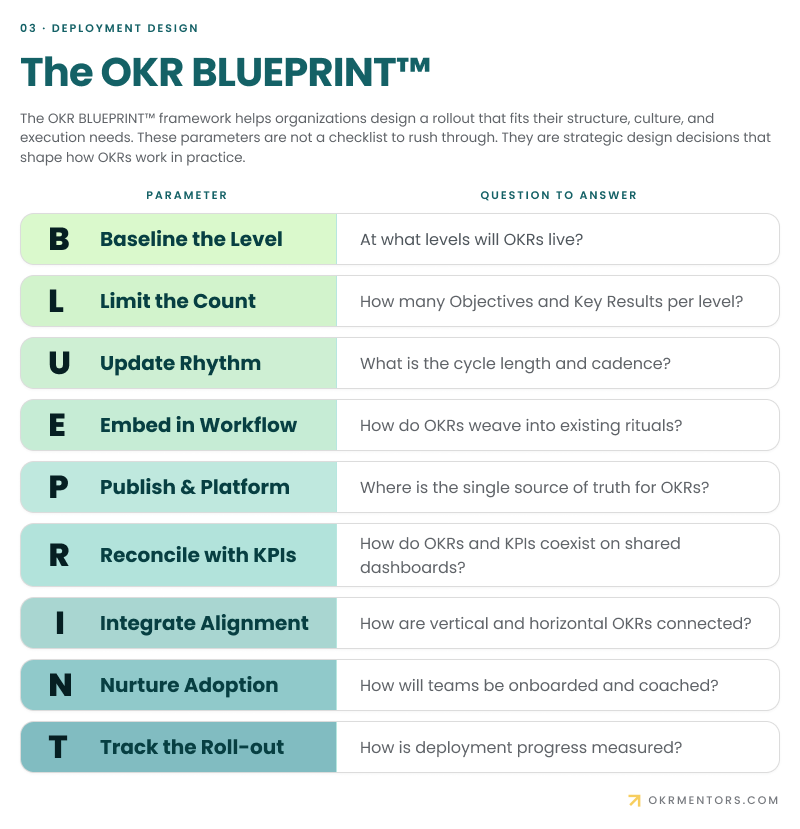
The Nine Deployment Parameters of the OKR BLUEPRINT™
The OKR BLUEPRINT™ framework helps organizations design a rollout that fits their structure, culture, and execution needs. These parameters are not a checklist to rush through. They are strategic design decisions that shape how OKRs work in practice.
How to Structure OKRs Across the Organization
These principles apply to almost every organization:
- Start as high as possible.
Leadership OKRs set the direction team OKRs respond to. - Minimize the number of layers.
Each additional layer multiplies the time spent on alignment. Top and bottom matter most; middle layers can often be skipped. - Avoid individual OKRs, especially at first.
They tend to pull OKRs into performance management and fragment focus.
For cycle length, quarterly is the default for teams. Yearly cycles are often more relevant at the top of the organization. Start with a single cycle length; add variation only once the base rhythm is stable.
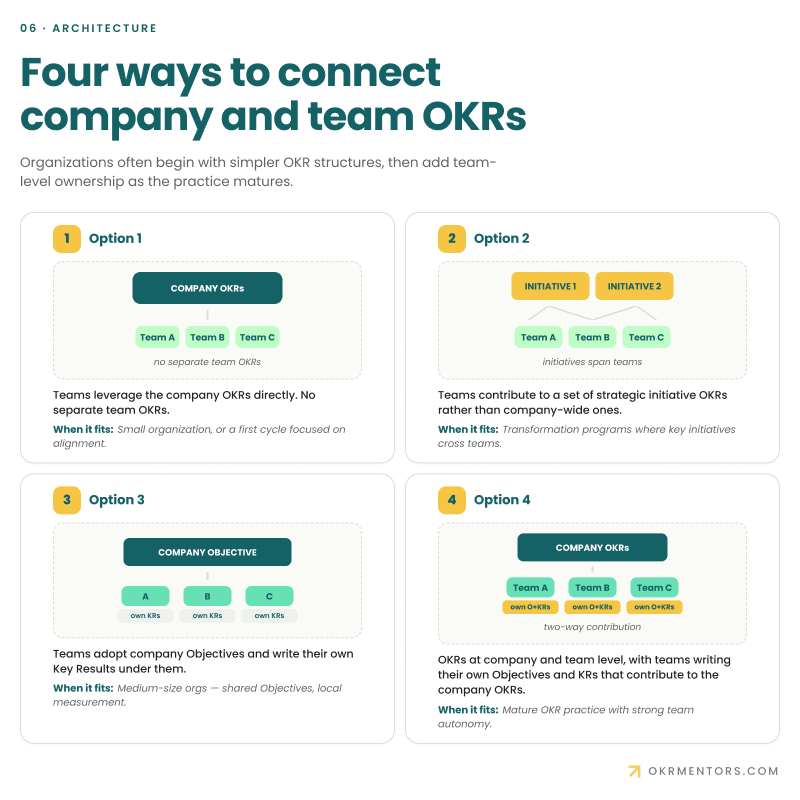
Four common approaches to company and team OKRs
Depending on culture, size, and motivation, one of four architectures will usually fit best. Organizations often start with a simpler option and move progressively toward more distributed OKRs as the practice matures.
Three Common OKR Rollout Scenarios
The motivations identified during the diagnostic phase should shape how the rollout is phased across the organization.
| Primary motivation | Typical phasing |
| Alignment and focus | Start with company OKRs. Cascade priorities vertically. Bring teams in progressively once direction is clear. |
| Customer-centricity and empowerment | Use company OKRs as inspiration. Start with a small number of teams writing their own Objectives and Key Results. Roll out horizontally. |
| Deep transformation | Focus on key transformation initiatives. Bring in the teams and individuals directly engaged in the transformation first. Broader rollout comes later. |
Step 3: Train Teams and Build OKR Implementation Capabilities
With the deployment strategy defined, the next step is to build the skills, confidence, and habits people need to use OKRs well. Training should not happen in isolation. It should be connected to the way teams already plan, prioritize, deliver, and review work.
Audience-based training
Not everyone needs the same level of OKR training. A senior leader, team manager, contributor, and OKR Champion each play a different role in the rollout. Training should reflect that difference.
| Certification | Audience | Estimated time | Covers |
| OKR Foundations | All employees being introduced to OKRs | 20 minutes | What OKRs are, why they work, and when to implement them |
| OKR Practitioner | Contributors working within OKRs | 2 hours | Foundations: Writing strong Objectives and Key Results, OKR dos and don’ts, intro to OKR Cycle and Rituals oundations |
| OKR Leader | Managers and team leaders leading with OKRs | 8 hours | OKR Foundations, cycle and rituals, strategy-based OKRs |
| OKR Champion | Team-level facilitators and coaches | 12 hours | OKR Foundations, cycle and rituals, leadership and adoption |
| OKR Professional Coach (OKRPC) | Professionals deploying OKRs across an organization | 18 to 20 hours | All of the above, plus coaching and change management |
Match the training to the role. Training everyone as a coach is unnecessary, but training managers only as practitioners is not enough. Leaders need to know how to use OKRs as a management system, not just how to write them.
Integrating OKRs with existing processes
If OKRs sit outside existing planning, prioritization, delivery, and performance conversations, teams will default to old habits. The OKR process then becomes an extra reporting layer instead of a better way to execute strategy.
Work through three integration points:
- Planning: How do teams currently define their plans? What meetings, tools, and documents do they already use? Decide how OKRs will shape and inform that planning process.
- Prioritization: How do teams decide what matters most? OKRs should become a filter for priority decisions, helping teams focus on work that moves Key Results forward.
- Performance: How do teams discuss performance today? OKRs should improve performance conversations without being directly tied to individual appraisal or financial bonuses.
Choosing the Right Tools for OKR Implementation
Choose tools based on what each OKR ritual needs to accomplish, not by vendor category. The right tool should support the behavior, conversation, or decision the ritual is designed to create.
| Ritual | What it needs | Common formats |
| OKR Definition workshop | A space for drafting and iterating | Whiteboard and post-its, Miro, Mural |
| OKR sharing and alignment | A way to publish and compare drafts | Slides, Canva, shared docs |
| OKR kick-off | Broad communication | Slides, printed posters, screens |
| Activity plans and delivery | Linking activities to Key Results | Project management tools (Notion, Jira, Monday, ClickUp, Trello) |
| OKR Check-in | An evolving view of team OKRs | Sheets, specialized modules in Jira or Notion |
| OKR Retrospective | Structured reflection | Whiteboard and post-its, Miro, Mural |
Specialized OKR tools can combine all of these in one platform and integrate with the existing stack. They are usually worth exploring for organizations that want to make strategy execution a competitive advantage and benefit from the best-in-class technology approach.
This is often especially useful after the pilot phase, once leaders understand the potential of OKRs at scale
Step 4: Preparation and launch of the first OKR cycle
Once teams are trained and the deployment strategy is defined, the organization is ready to launch its first OKR cycle. For most organizations, this starts with the leadership team and, where relevant, two toor three pilot teams before broader rollout across the organization.
The OKR cycle preparation sequence
- Strategic guidance. Leadership frames the direction for the next cycle.
- Team OKR setting. Each team runs an OKR Definition workshop and drafts 1 to 3 Objectives with 1 to 3 Key Results each.
- Alignment. Priorities and OKRs are aligned across teams, vertically and horizontally.
- Cycle kick-off. The new OKRs are communicated to everyone and the cycle starts.
- Activity plans. Teams draft the initiatives that will support the Key Results.
How long should an OKR cycle preparation take?
Cycle preparation length usually runs from one week to one month depending on organizational complexity, alignment needs, and OKR maturity. Over time, the goal should be to:
- shorten the preparation phase
- reduce process overhead
- simplify alignment conversations
- increase team autonomy
Early in the rollout, prioritize simplicity over perfect alignment. Full organizational alignment rarely happens in the first cycle and usually improves significantly by the second or third iteration.
Step 5: Change management and optimization
Once OKRs are in use, the focus shifts from rollout to adoption, behavior change, and continuous improvement. The first OKR cycle acts as a diagnostic in itself. It reveals where teams are struggling, which habits are forming, and what parts of the implementation need reinforcement.
Monitor Both Results and Behaviors
Track both the Key Results being produced and observe how teams are using the OKR system in practice.Questions to monitor include:
- Are check-ins producing real decisions and prioritization changes?
- Are Key Results being updated consistently?
- Are teams using OKRs to guide new work and trade-off decisions?
- Is leadership referencing OKRs outside formal review meetings?
- Are teams improving the quality of their Objectives and Key Results over time?
Strong OKR adoption is visible not only in the metrics, but in the organization’s operating behavior.
Optimize the Process After Each Cycle
Every cycle creates new learning opportunities. Use retrospectives, feedback sessions, and coaching conversations to improve:
- alignment
- check-in quality
- prioritization discipline
- leadership participation
- training gaps
- OKR writing quality
The organizations that succeed with OKRs are usually not the ones that launch perfectly. They are the ones that continuously refine the process over multiple cycles.
Key OKR Implementation Terms
Before rolling out OKRs across an organization, it helps to understand a few important roles and concepts that appear throughout the implementation process.
| Term | Meaning |
| OKR implementation | the process of designing, launching, and sustaining OKRs as a way of working across an organization. Distinct from writing a single team’s OKRs. |
| Diagnostic | the analysis of current strategy execution challenges, readiness, and motivations that grounds the deployment strategy. |
| Deployment strategy | the coherent set of choices about levels, cycle length, phasing, roles, tooling, and training that defines how OKRs will be introduced. |
| OKR Lead | the person responsible for the end-to-end deployment. Often sits in transformation, strategy, HR, or program management. |
| OKR Sponsor | a senior leader who champions OKRs at the leadership level, signals that OKRs matter, and removes blockers. |
| OKR Champion | a team-level expert who facilitates OKR rituals and supports adoption inside their team. Typically five to ten percent of their time. |
| Cycle preparation | the window at the start of each cycle during which OKRs are defined, aligned, and communicated, before delivery begins. |
| Pilot | a small, deliberate subset of teams running OKRs in the early cycles to generate reference points and surface process issues before broader rollout. |
The six change management challenges in OKR Implementation
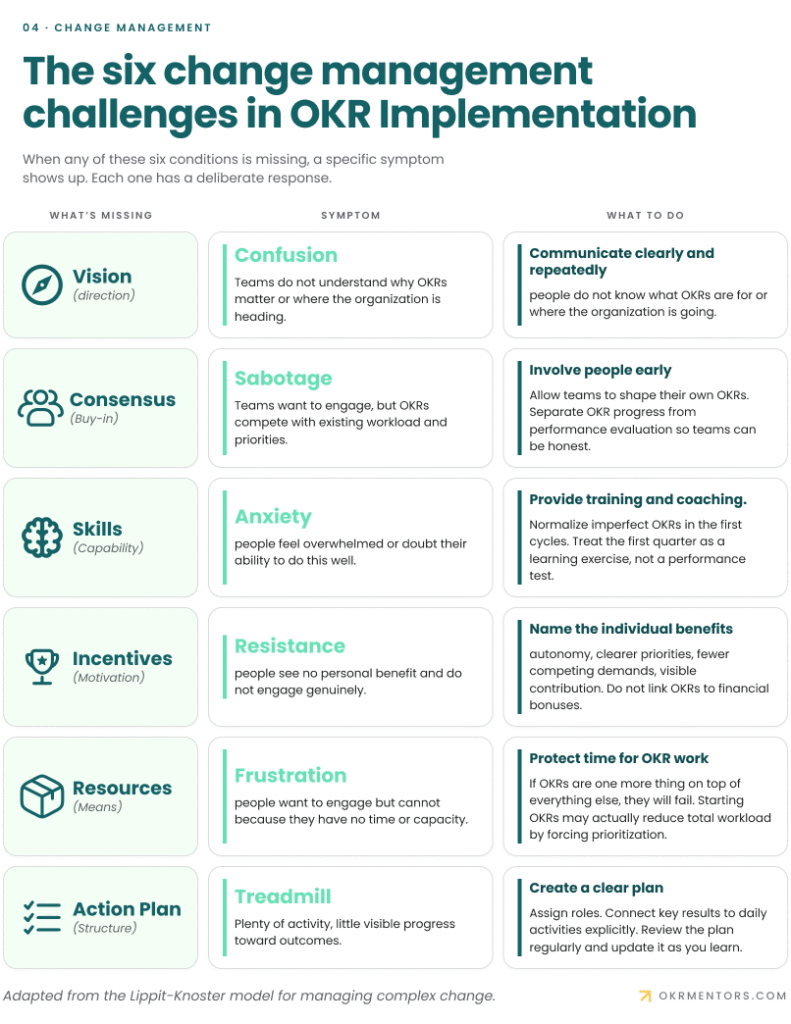
OKR implementation is not just a goal-setting exercise. It is an organizational change initiative. That means the success of the rollout depends as much on behavior, culture, and adoption as it does on writing good Objectives and Key Results.
A Lippitt-Knoster Model identifies six conditions that, when present together, create the environment for any transformation to succeed. When one of these conditions is missing, predictable implementation problems begin to appear
Understanding these conditions helps leaders identify friction early and strengthen the rollout before momentum stalls.
Three Common OKR Implementation Challenges Explained
Some implementation challenges deserve deeper attention because they often emerge quietly and can undermine adoption long before leaders notice the problem.
Resistance and Sabotage: How hidden pushback slows adoption
Sabotage is the most difficult challenge to identify because it often happens behind the scenes.
A manager may agree publicly with OKRs and then tell their team privately to treat it as another initiative that will pass. This is not always deliberate: it often reflects a fear that transparency will expose previous underperformance.
The most effective structural response is to make OKR adoption itself a shared goal.
When individual resistance is persistent, address it directly and early. The conversation should focus on the behavior and its impact, not on the person’s motives. If resistance becomes entrenched, tolerating it weakens trust in the rollout and slows broader adoption across the organization
Anxiety: the perfectionism trap that delays execution
One of the most underestimated sources of anxiety in OKR implementations is perfectionism. Teams spend months refining objectives, adding detail to the perfect key results, and building elaborate tracking systems before they have run a single cycle. The result is a process that never starts.
The antidote is to emphasize learning over precision. The first set of OKRs will not be perfect. An average KR that is measurable is better than the perfect KR that will take months to be trackable. That is expected and acceptable. Running an imperfect cycle and learning from it generates more organizational capability than planning a perfect one that never runs.
The treadmill: When teams stay busy but results do not improve
A treadmill occurs when an organization is generating a great deal of activity but OKRs are not progressing. Key results are updated but the numbers barely move. Initiatives are running but they are not connected to the outcomes that matter.
The root cause is usually a failure to link day-to-day priorities to OKR progress. Teams continue doing what they always did and record OKR updates separately. The fix is to make OKRs the filter for prioritization: if a piece of work does not contribute to a Key Result, it should be deprioritized or stopped.
How to run weekly OKR check-ins and monitoring
OKRs are designed for a short cycle, for instance a quarter. Within each quarter, a regular check-in rhythm is what separates organizations that use OKRs as a living tool from those that treat them as a planning artifact.
What is a weekly check-in?
A weekly check-in should be short, focused, and consistent. A meeting of 20-30 minutes is enough. The goal is not a status report but a learning conversation that surfaces obstacles and keeps the team aligned.
Three questions that drive effective check-ins
- What obstacles need to be resolved to make progress?
- What is the current status of each Key Result?
- Is this better or worse than expected, and why?
Add a confidence indicator for each Key Result. A declining confidence score is an early warning signal, not a failure indicator. It gives the team a reason to act before the quarter ends.
Check-ins work best when they are integrated into existing meetings rather than scheduled as separate events. Embedding OKR check-ins into a team’s recurring sync reduces friction and increases consistency.
Why does monitoring matter?
Think of OKRs like a rocket programmed with a destination. As soon as it launches, it begins drifting. Without regular course corrections, it misses the target entirely. OKR monitoring is the system of checks and corrections that keeps it on track.
During any quarter, priorities shift, blockers emerge, and teams learn things they did not know at the start. Monitoring creates the space to surface these realities and respond to them, rather than discovering at the end of the quarter that goals were missed and no one knew why.
Best Tools for Tracking and Monitoring OKRs
Two tools work together to make OKRs visible: a tracker and a dashboard. Most organizations get the best results by investing in a dedicated OKR platform that combines both.
OKR tracker:
A record of the current state of each Key Result. It shows the starting value, the target value, the current value, and the trend over time. Format can range from a purpose-built OKR platform to a structured spreadsheet. What matters is that data is updated regularly and visible to the team.
A spreadsheet can work for a short pilot, but as soon as more than a handful of teams are involved, a dedicated OKR tool pays for itself. Dedicated platforms keep definitions consistent across teams, make updates fast, connect Key Results to the initiatives that support them, and integrate with the systems your teams already use for planning and reporting.
OKR dashboard:
A visualization of tracker data that makes the overall business health of the OKRs visible at a glance. A good dashboard shows for each OKR: current progress toward each Key Result, whether that progress is ahead of, on, or behind expectations, and any Key Results that are at risk.
The dashboard is a team tool, not a management reporting tool. The goal is not status upward but visibility to the people doing the work.
Why dedicated tools matter as you scale.
A spreadsheet asks every team to maintain its own version of the truth. A dedicated platform gives the whole organization a single source, with version control, permissions, alignment views, and reporting built in. It also signals that OKRs are part of how the organization runs, not a side project tracked in a shared document.
Whatever tool you choose, both the tracker and the dashboard should be visible to everyone working on the OKRs. Transparency is what makes alignment real and accountability shared.
Adjusting OKRs mid-cycle
OKRs are not fixed contracts. If a Key Result becomes irrelevant because the context has changed, it should be updated. The same applies if a metric turns out to be the wrong measure of the Objective.
Adjustments should be made deliberately and with a clear rationale, not as a way to avoid accountability. A Key Result that was achievable but missed because of poor strategy execution should remain as the record shows it. A Key Result that became meaningless because the business context changed is a different situation.
How to make OKRs sustainable
OKR implementations that feel light and energizing generate engagement rather than compliance. Engagement is what produces better outcomes: teams that own their priorities, surface obstacles early, and use the cycle to learn. That is the goal of the three principles that follow.
Three principles help keep the process sustainable:
1. Accept imperfect OKRs, especially early
The first cycle is where the team learns the practice. Expect some objectives to evolve, some key results to sharpen as data becomes available, and some confidence levels to firm up as the team builds intuition for where the numbers will land.
The first cycle’s value is in what it teaches: how to write stronger OKRs, how to structure check-ins that drive decisions, and which metrics the team actually has access to. Every cycle after this one starts from a better place because of it.
2. Give teams genuine autonomy
Autonomy is one of the strongest motivators in OKR adoption. When teams have meaningful input into their objectives, they own the outcome differently. The check-in format, meeting timing, and tracking tools can all vary by team as long as the principles are consistent.
Some teams run daily check-ins, some prefer weekly, some integrate OKRs into existing Scrum ceremonies and some hold a standing Friday session. None of these approaches is wrong if the team is genuinely engaged with their OKRs and progressing toward the outcomes.
3. Treat OKRs as the prioritization filter
One of the most practical benefits of OKRs is clarity about what not to do. When a team has clear Key Results, any new request can be evaluated against a simple question: does this help us achieve one of our Key Results this quarter? If the answer is no, the work should be deferred, delegated, or dropped.
This is not rigidity, it is about focus. And it reduces the treadmill effect more effectively than any tracking tool.
OKR implementation checklist and templates
First 30 days plan
Week 1. Diagnose. Take the SEM 360™ assessment to have a structured, evidence-based starting point. Identify the primary strategy execution challenge OKRs are being used to address, and name any red flags that need resolving before launch. Confirm that leadership is ready to treat the rollout as a change program, not as a framework implementation.
Week 2. Design. Choose the architecture (which levels get OKRs, and how many), the cycle length, the first phase of rollout, and the integration surface with current planning, prioritization, and performance processes. Decide the single source of truth for OKR content.
Week 3. Enable. Train leadership on OKR fundamentals and the cycle mechanics. Identify and brief the OKR Lead and the first OKR Champions. Communicate to mid-management and teams what is coming and why, using the stakeholder-appropriate channel for each group.
Week 4. Launch. Run the leadership OKR definition workshop. If pilot teams are ready, run their definition workshops too. Confirm the cadence in the calendar. Schedule the first check-ins and the end-of-cycle retrospective before the cycle starts.
The OKR implementation checklist
Use this checklist as a working reference across the implementation. It follows the full implementation sequence, from diagnostic and deployment design through to the first cycle and retrospective. Check each item as it is completed.
| Before we start |
| [ ] The leadership team agrees to implement OKRs |
| [ ] leadership review and agree on the OKR pre-requisites |
| [ ] A diagnostic of readiness, constraints, and execution challenges has been completed |
| [ ] The main strategy execution challenge OKRs should address is clear |
| [ ] The initial rollout scope is defined |
| [ ] The OKR architecture is agreed: company, team, or other levels. |
| [ ] A reference person and sponsor’ are named |
| Before the first cycle |
| [ ] Organizational strategy is defined and documented. |
| [ ] Leadership has run an OKR Definition workshop and produced a first draft OKR set. |
| [ ] Leadership team has drafted their OKRs for the first cycle. |
| [ ] All team members have received a basic orientation on OKRs. |
| [ ] A kick-off session is scheduled. |
| Cycle kick-off |
| [ ] Strategy brief delivered by team leader. |
| [ ] Organizational OKRs shared with the team. |
| [ ] Team OKRs drafted using the definition workshop format. |
| [ ] Each Key Result has a named owner. |
| [ ] A check-in schedule has been set for the quarter. |
| [ ] OKR tracker is set up and shared with the team. |
| During the cycle (weekly) |
| [ ] Key Result values updated in the tracker. |
| [ ] Confidence levels reviewed for each Key Result. |
| [ ] Obstacles discussed and actions assigned. |
| [ ] Progress is visible to all team members. |
| End of cycle retrospective |
| [ ] Key Results scored against the target. |
| [ ] Retrospective completed: what worked, what did not, what to change. |
| [ ] Learnings documented for the next cycle. |
| [ ] Next cycle kick-off scheduled. |
OKR writing templates
Example 1
Customer experience team
Objective: Make customers feel genuinely supported from the moment they sign up.
- KR 1: Increase new customer onboarding completion rate from 42% to 75% by end of Q2.
- KR 2: Reduce median first-contact resolution time from 3 days to 4 hours by end of Q2.
- KR 3: Achieve a customer satisfaction score of 8.5 or higher by end of Q2.
Initiatives (separate from the OKR, supporting KR achievements): rewrite onboarding welcome sequence, pilot live chat for high-value tickets, restructure triage rules.
Example 2
Marketing team
Objective: Become the go-to resource for mid-market teams researching goal-setting approaches.
- KR 1: Grow organic search sessions from 8,000 to 18,000 per month by end of Q3.
- KR 2: Increase qualified inbound leads from 45 to 120 per month by end of Q3.
- KR 3: Reach an average time on page of 4 minutes for OKR guides by end of Q3.
Initiatives: publish six new practitioner guides, run a technical SEO audit, launch a quarterly research report.
Example 3
Product team
Objective: Deliver a product experience that makes our users’ workday noticeably easier.
- KR 1: Increase daily active users from 1,200 to 2,000 by end of Q4.
- KR 2: Reduce critical bug resolution time from 5 days to 48 hours by end of Q4.
- KR 3: Raise Net Promoter Score from 32 to 52 by end of Q4.
Initiatives: ship the new dashboard, redesign the notification system, run a monthly user interview program.
Example 4
Sales Team
Objective: Build a healthier pipeline that supports predictable growth.
- KR 1: Increase qualified pipeline coverage from 2.0x to 3.0x of next-quarter target.
- KR 2: Improve SQL-to-close rate from 18% to 24%.
- KR 3: Reduce median sales cycle length from 52 days to 45 days.
Initiatives: refresh the ideal customer profile, roll out updated stage-exit criteria, run a sales enablement program on discovery calls.
Example 5
People and operations team
Objective: Create a working environment where new hires become effective faster.
- KR 1: Reduce time-to-productivity for new hires from 90 days to 60 days.
- KR 2: Increase 90-day new hire engagement score from 6.8 to 8.0.
- KR 3: Reduce first-year attrition from 22% to 12%.
Initiatives: redesign the first-30-days experience, pair each new hire with a structured buddy, launch monthly new hire feedback sessions.
The check-in template
| Weekly OKR Check-in Template (20-30 minutes) |
| For each Key Result: |
| Status: Current value vs. target value |
| Confidence: High / Medium / Low |
| Progress since last check-in: What changed? |
| Why it changed: What drove or blocked progress? |
| Next actions: What will we do before the next check-in? |
| Close with: |
| Any adjustments needed to OKRs or priorities? |
| Any cross-team dependencies or escalations needed? |
Signs your OKR implementation is working
An OKR implementation is working when the organization starts behaving differently, not when dashboards are well-formatted. These are the signals that show up across organizations that sustain OKRs. They rarely all appear at once; most appear unevenly across the first two or three cycles.
Leadership OKRs show up in decisions, not just in slide decks. A new initiative lands mid-quarter. A leader pauses and asks how it connects to the cycle’s OKRs before agreeing to it. That sentence, spoken out loud in a real meeting, is the single clearest sign the implementation is landing.
A pilot team voluntarily changes an initiative mid-cycle. Not because a manager told them to, but because the Key Result evidence made the case obvious. This is the behavior the whole framework is designed to produce. When it shows up without being engineered, the team has internalized the practice.
A team goes red in week three and the response is “what do you need?” The first time a team flags a Key Result as red early rather than hiding it until week eleven, watch the room. If leadership responds with support, trust compounds. If leadership questions competence, every other team in the organization just learned to stay green. Protect the first team that goes red honestly.
A check-in produces an uncomfortable decision in under ten minutes. Early check-ins tend to be long and inconclusive. When the cadence is working, the team sees a trend, names it, and changes direction with little ceremony. The speed is the signal.
Someone says “that’s not in our OKRs” and it sticks. A new request arrives. Someone tests it against the current OKRs and names the trade-off openly: we can do this, but it means this Key Result slows down. The team engages with the trade-off rather than simply adding the work. Focus has become structural.
Mid-management refers to OKRs in operational conversations. Not in the quarterly review, not in the OKR meeting. In the hallway, in the prioritization thread, in the budget discussion that was not supposed to be about OKRs. When middle managers start using the language spontaneously, the framework has moved from a process to an operating habit.
The retrospective changes the next cycle. A lesson from the retrospective visibly shapes how the next set of OKRs is written or how the cadence is structured. When retrospectives translate into concrete changes, each cycle builds on the last and the practice compounds.
A champion surfaces a problem before the OKR Lead does. The champion network is working when champions raise issues, share patterns, and coach each other without prompting. This takes two to three cycles to build. When it lands, adoption stops being a centrally driven effort.
In most organizations, one or two of these appear in the first cycle, more in the second, and the full pattern takes three or four cycles to establish. Progress in strategy execution maturity is rarely visible in the quality of the written goals. It is visible in how the organization behaves when the goals meet reality.
Frequently Asked Questions
Start with the leadership team.
Company OKRs set the direction that team OKRs respond to, so leadership needs to have run the practice themselves before teams are asked to. From there, add two or three pilot teams in the next cycle to generate reference points and surface process issues before broader rollout. Trying to cover the whole organization at once usually produces chaos and confusion rather than alignment.
Pick teams whose leaders are genuinely motivated, whose work is visible to the rest of the organization, and where outcomes can be measured within a quarter. Avoid teams in the middle of a crisis or a reorganization.
The goal of the pilot is to generate stories and patterns that help the rest of the organization see what OKRs look like in practice, so visibility matters as much as readiness.
You should look to integrate OKRs inside the processes. OKRs fail when they run as a parallel universe to the planning, prioritization, and performance conversations teams are already having.
Work through three points:
1. how do teams currently plan?
2. how do they currently prioritize?
3. how do they currently discuss performance?
OKRs should feed and inform each of those, not duplicate them.
The OKR Lead owns the deployment end-to-end: coordinating implementation, training, communication, and rhythm. This person usually sits in transformation, strategy, HR, or program management. They do not need to be an OKR expert at the start, but they need credibility, communication skills, and organizational influence. The Lead works closely with OKR Champions at the team level, who facilitate rituals inside their teams.
First, they participate visibly: setting their own OKRs, attending check-ins, and discussing progress openly.
Second, they build a coalition with peers so the commitment is not just one person’s.
Third, they communicate the business reasons for the change and why it is a priority.
When leaders do these three things consistently, the rollout has the air cover it needs. When they do not, mid-management reverts to old patterns within a cycle.
Middle managers are the bridge between strategy and execution, so their buy-in matters more than almost anyone else’s.
Resistance usually comes from one of three sources:
1. fear that transparency will expose previous underperformance
2. skepticism from past initiatives that did not land
3. lack of capacity to add another process
Address each directly. Name the behavior, not the motive. Make OKR adoption itself a shared priority so blocking it becomes visible. And invest in training early so managers feel equipped, not exposed.
Most organizations need two to three cycles before the practice feels natural.
The first cycle is messy: rough OKRs, inconsistent check-ins, uneven tooling. By the second cycle, patterns stabilize. By the third, teams refer to OKRs in trade-off conversations without prompting. The shape of the practice compounds over cycles, which is why cutting the rollout short after one difficult cycle is almost always a mistake.
Leaders reference OKRs in unscripted moments. Not in the quarterly review, not in the OKR meeting, but in the hallway, in the Slack thread, in the budget conversation that was not supposed to be about OKRs.
When that happens, OKRs have moved from a process the organization runs to an operating logic the organization uses.