


What are OKRs?
Objectives and Key Results, or OKRs, are a goal management framework used to translate priorities into measurable outcomes for a defined time period, typically a quarter. In practice, it plays a key role in strategy execution by helping organizations connect strategy to day-to-day work and track whether priorities are truly progressing. The defining feature is the pairing of an intent statement (the Objective) with measurable evidence (the Key Results). If you cannot measure whether you are making progress, you do not yet have an OKR.
A simple phrasing:
We will [Objective] as measured by [Key Results].
Source: Measure What Matters, John Doerr
What are the two components of OKRs?
Objective
a short, qualitative and ambitious statement describing the outcome you want by the end of the cycle. It is inspiring, directional, and time-bound.
Key Results
a set of 2-5 measurable outcomes that prove the Objective was achieved. They are quantitative, verifiable, and outcome-focused, not task-focused.
| Component | Example |
| Objective | Make onboarding faster and more reliable for customers |
| Key Result 1 | Increase onboarding completion from 62% to 78% |
| Key Result 2 | Reduce time-to-first-value from 10 days to 5 days |
| Key Result 3 | Reduce customer complaints related to onboarding speed from 60% to 45% |
If the Objective is phrased from the customer’s perspective, at least one Key Result should measure the customer experience directly, not only internal process efficiency.
What Is the Difference Between OKRs, KPIs, and Initiatives?
This distinction is the single most common source of confusion in early OKR implementations.
Rule of thumb: if it describes a change in results, it may be a Key Result. If it describes work to be completed, it is usually an initiative.
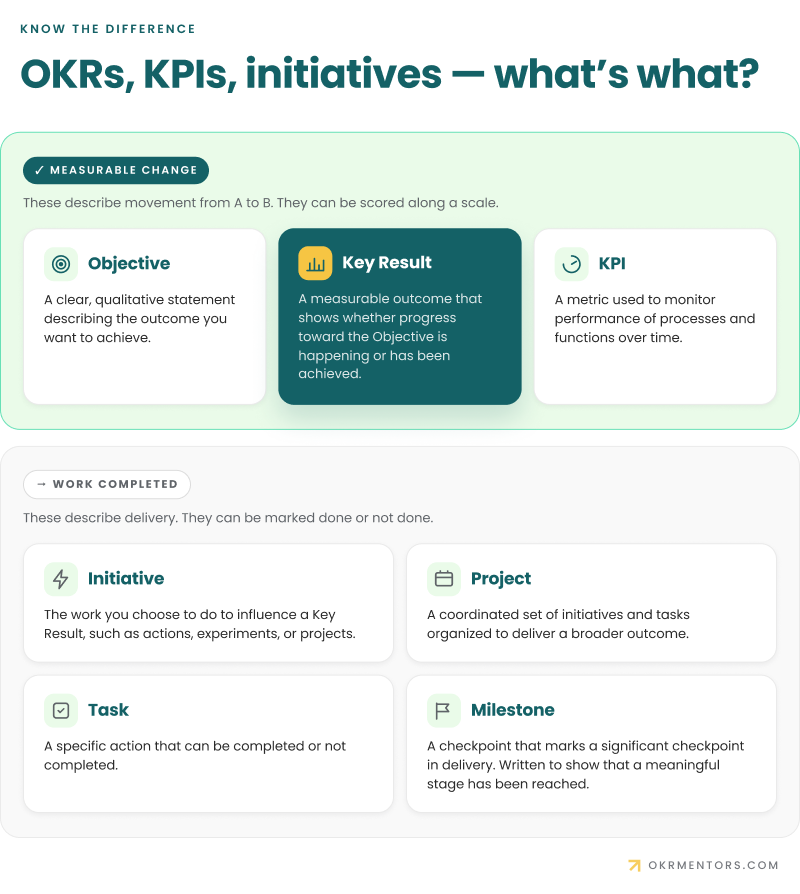
In simple terms, OKRs define what you want to change, KPIs help monitor performance, and initiatives describe the work you choose to do.
Quick diagnostic:
Ask: does this describe measurable movement from A to B? If not, and it can simply be marked as “done” or “not done” it is probably an initiative rather than a Key Result. Key Results show progress or impact and can be scored along a scale.
Example:
Initiative: Redesign onboarding emails. You can finish this and still fail to improve onboarding.
Key Result: Increase onboarding completion from 62% to 78%. This proves improvement.
OKRs should be stable enough that initiatives can change mid-cycle without rewriting the goal. That is one of the practical benefits of separating outcomes from day-to-day work.
What do you need before using OKRs?
Before implementing OKRs, a few basic conditions should be in place. OKRs are a framework for translating strategy into clear priorities and measurable outcomes, but they work best when the organization is ready for the way of working they introduce:
A strategy exists.
OKRs translate strategy into goals. Teams should have a clear and aligned understanding of the organization’s direction, its mission, and the priorities that define success.
Openness to transparency.
OKRs make goals and progress visible across the organization. Teams need to be comfortable sharing results, challenges, and learnings openly.
An outcome-driven mindset.
OKRs shift the focus from activities to results. Organizations need to be willing to measure progress based on outcomes rather than tasks completed.
Empowerment and ownership.
OKRs work best in environments where teams are trusted to take ownership of outcomes and decide how to achieve them.
Decision model clarity.
Teams need to understand what decisions they can make independently and what requires escalation, particularly when priorities need to change mid-cycle.
Governance constraints.
Approval processes and reporting structures should allow teams to adjust initiatives without excessive delay.
Incentive alignment.
Performance and reward systems should not be directly linked to OKRs and should not discourage transparency or penalize teams for identifying risk early.
Roles & responsibilities.
Successful implementations usually define clear roles and responsibilities, including who guides the deployment, supports teams, owns Objectives or Key Results, and ensures the cadence is followed.
Systems and tooling.
There should be a clear and consistent place to define, update, and review OKRs, whether through a dedicated Strategy Execution platform or existing management tool. Without a single source of truth, tracking fragments and visibility declines.
Defined OKR structure and vocabulary.
Teams need shared rules for how OKRs are written and used, including how many Objectives and Key Results are expected, what good looks like, and what terms such as on track or at risk actually mean. Without this, each team invents its own version and alignment becomes difficult.
Data and measurement capability.
Teams need access to the data, dashboards, and definitions required to track progress against Key Results. Without this, they are likely to revert to activity tracking or stop updating altogether.
If transparency, outcome orientation, and ownership are weak, OKRs can still be written, but they are unlikely to be used effectively in practice.
OKRs are rarely perfect from the first cycle. Most organizations refine their approach over several cycles as teams learn how to define stronger outcomes and use the framework more effectively.
Why do organizations use OKRs?
Organizations adopt OKRs because they offer a simple yet powerful way to address common execution challenges, particularly around focus and alignment.
- Clarity & Focus: OKRs encourage teams to concentrate on a small number of priorities that truly matter, reducing fragmentation across projects.
- Alignment: They create a shared language for priorities, helping teams understand how their work connects to broader strategic objectives, break out of silos and work together toward shared outcomes.
- Transparency, Motivation and Accountability: Progress becomes visible across teams, making it easier to identify risks early and support each other in achieving outcomes.
- Customer centricity & outcome mindset: Shaping strategic conversations around prioritizing customers and outcomes, you can empower teams and individuals to envision the value they can create and the outcomes they aim to achieve.
- Engagement and purpose: When priorities are clear and measurable, people better understand how their work contributes to shared outcomes and the organization’s success.
- Continuous Learning and adaptability: The regular OKR cadence encourages teams to review progress, learn from results, and adjust initiatives as needed.
The Origin of OKRs
OKRs were developed by Andy Grove at Intel in the 1970s. Grove adapted the core ideas of Peter Drucker’s Management by Objectives (MBO) into a faster, more transparent system suited to the pace of a technology company.
Grove’s version introduced two important changes. First, it separated the directional goal (the Objective) from the measurable proof of progress (the Key Results). Second, it made goals visible across the organization rather than keeping them confined to manager-to-employee conversations.

Source: The OKR Origin Story, Giulia Pines
In 1999, venture capitalist John Doerr who learned OKRs from Grove while working at Intel introduced the framework to Google, where Larry Page and Sergey Brin adopted it early in the company’s life. Doerr later described the system in his book Measure What Matters, which brought OKRs to a wider audience and accelerated adoption across industries.
How are OKRs used today?
Today, OKRs are used by organizations of all sizes, from early-stage startups to global enterprises. What has not changed is the core logic: define where you want to go, and measure progress with honest, quantitative outcomes.
As adoption has grown, a broader ecosystem of practitioners, coaches, researchers, and implementation experts has emerged to help organizations apply OKRs effectively in practice. Among them, OKR Mentors was founded in 2023 to support professionals and organizations in strengthening their capabilities in strategy execution through OKRs. Since its creation, OKR Mentors has supported thousands of professionals and advised more than 600 organizations worldwide.
Why did OKRs become popular across industries?
Although OKRs became especially visible in fast-growing companies, their value is not limited to those environments. They can help any organization or team improve focus, alignment, and execution quality, including teams that are already performing well and want to go further.
OKRs are especially useful in environments where organizations need to translate strategy into action and adapt to changing priorities, including periods of growth, transformation, or shifting focus.
They can support accountability without micromanagement when decision authority is clear, governance supports local action, and teams are trusted to act on the evidence provided by their Key Results. When those conditions are in place, visible Key Results and defined outcomes give teams a clearer standard against which to self-manage.
How are OKRs structured?
OKRs operate at multiple levels in an organization. Understanding the structure helps you connect individual effort to company-wide priorities.
What are the different levels of OKRs in an organization?
| Level | Who sets them | Purpose |
| Organization OKRs | Leadership team | Define the most important outcomes for the organization in the period |
| Division / Department OKRs | Division or department leaders | Translate company priorities into outcomes relevant for a specific business unit or function. |
| Team OKRs | Team leads with their teams | Define what each team will achieve to support broader organizational priorities. |
| Individual OKRs (optional) | Individual contributors | Define personal contribution to organization, division/department, or team OKRs |
OKRs do not need to exist at every level of the organization. In fact, adding too many layers often creates complexity without improving focus or alignment. As a general rule, use the fewest levels necessary to make priorities clear and actionable.
Team OKRs are usually the most important because they connect strategic direction to strategy execution. Organization OKRs set the overall priorities, and Department OKRs can be useful where major functions need to translate these into their own outcomes, but they are not always required.
Individual OKRs are optional and should usually be introduced only in more mature implementations, once the organization, department, and team levels are already working well. Otherwise, they tend to create excessive fragmentation, encourage task-based goal setting, and increase the risk of linking OKRs too closely to individual performance management.
How do OKRs work in a cycle?
OKRs often run on a quarterly cycle. This is a common cadence because it is short enough to stay relevant and long enough to achieve meaningful outcomes. However, organizations may choose longer or shorter cycles depending on their industry, operating rhythm, planning model, and the speed at which priorities change.
In OKR Mentors’ Global State of OKRs research, top-performing organizations were more likely to use shorter OKR cycles, suggesting that a faster rhythm can support stronger focus, adaptability, and execution when the context allows for it. In more stable or regulated environments, longer cycles may sometimes be more practical, provided teams still maintain a regular check-in rhythm.
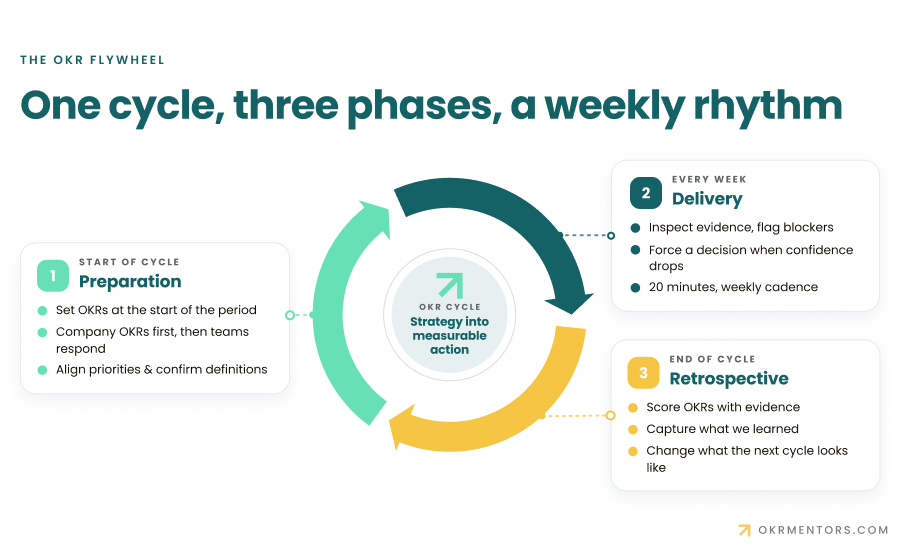
The cycle is typically structured in three phases:
- Preparation: set OKRs at the start of the period. Company OKRs are set first, then teams define their own in response.
- Delivery: check in weekly or bi-weekly. Teams update evidence and flag blockers.
- Retrospective: at the end of the cycle, score OKRs with evidence, hold a retrospective, and inform the next cycle.
What roles are needed for OKRs to work?
OKRs do not run themselves. A successful implementation involves distinct roles:
| Role | Who typically holds it | What they do |
| OKR Lead | Dedicated cross-functional role | Owns the OKR process end-to-end. Coordinates rollout, supports teams in writing OKRs, runs the cadence, ensures consistency across the organization. |
| OKR Sponsor | Senior leader or executive | Champions OKRs at leadership level. Signals that OKRs matter, removes blockers, and connects the process to strategic priorities. |
| OKR Champions | Team leads or managers | Advocates within their team. Facilitates local definition sessions, drives weekly check-ins, escalates blockers to the OKR Lead. |
| Team Leaders | Managers or team leads responsible for delivery | Own the team OKRs and ensure they are actively used. They guide the team in making progress on Key Results, and escalate risks or dependencies when needed. |
| Team Members | Individual contributors | Participate in defining team OKRs, contribute to progress on Key Results, update evidence where relevant, and flag risks early. Their engagement determines whether OKRs stay alive mid-cycle. |
| KR Owner | Individual contributor, manager, or subject matter owner | Owns a specific Key Result by maintaining its definition, updating evidence, tracking progress, and raising risks early. Helps ensure the KR remains visible, measurable, and actively discussed throughout the cycle. |
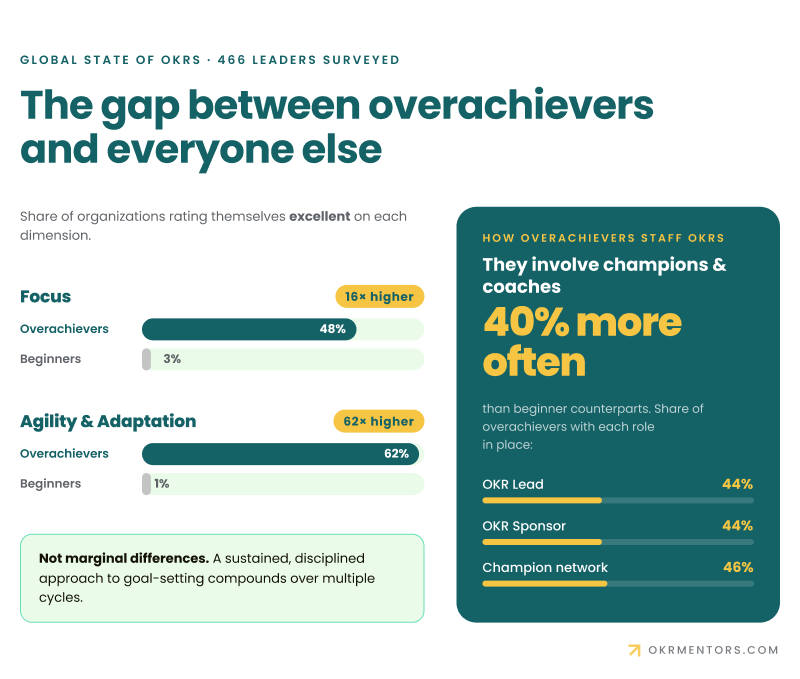
OKR Mentors’ Global State of OKRs survey of 466 leaders in 2023 found that OKR overachievers are more likely to have an OKR Lead (44%), Sponsor (44%), and Champion Network (46%), involving champions and coaches 40% more often than their beginner counterparts.
How do you write effective OKRs?
Writing OKRs is a skill. Most first attempts are too vague, too task-oriented, or structured as activity lists rather than outcome statements.
Writing a strong Objective
A good Objective is outcome-oriented, readable, and specific enough that 2-5 measurable Key Results naturally fit beneath it. It should describe direction and value without prescribing the solution.
An Objective should be:
- Qualitative and directional, rarely numerical
- Inspiring enough that the team understands why it matters
- Achievable within the time period
- Clear to anyone in the organization without further explanation
Quick Test:
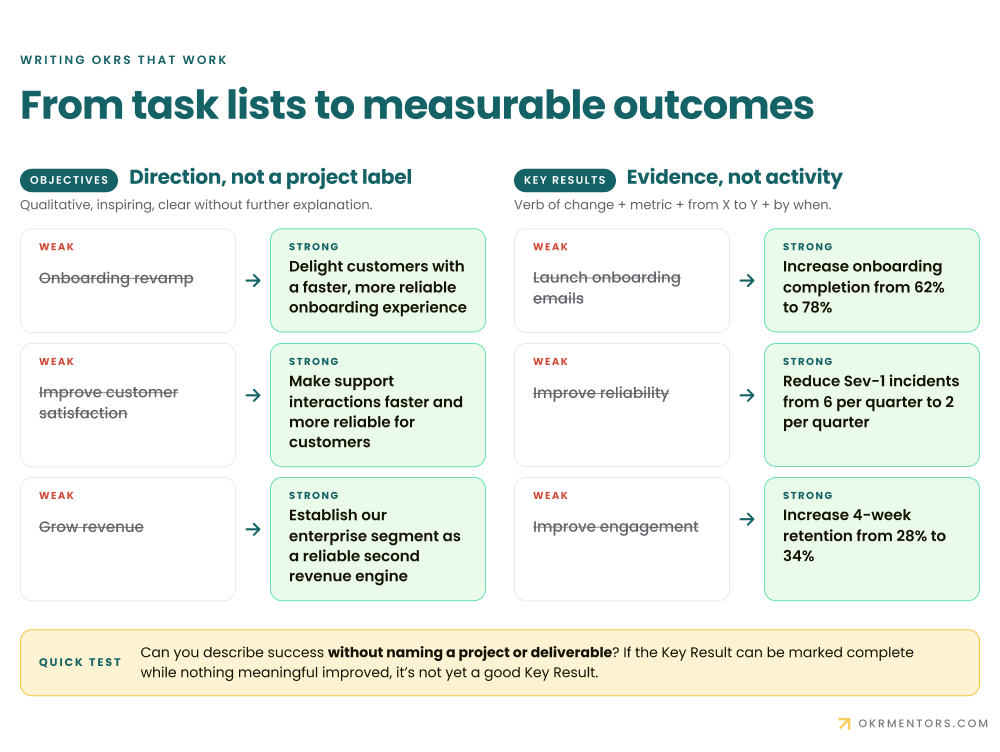
Can you describe success without naming a project or deliverable? If not, the Objective is probably a project label.
Examples of Good Objectives vs Weak Objectives
| Weak Objective | Strong Objective |
| Onboarding revamp | Delight customers with a faster, more reliable onboarding experience |
| Improve customer satisfaction | Make support interactions faster and more reliable for customers |
| Implement a new analytics tool | Make product decisions faster by improving access to trusted usage insights |
| Grow revenue | Establish our enterprise segment as a reliable second revenue engine |
Writing strong Key Results
A strong Key Result defines measurable evidence that the Objective is progressing or has been achieved. It should be outcome-focused, time-bound, and specific enough that progress can be reviewed regularly without debate. In practice, Key Results are easiest to use when they describe a clear change from a starting point to a target within a defined period.
A useful way to write a Key Result is:
verb of change + metric + from X to Y + by when
For example:
- Reduce median first-response time from 12 hours to 4 hours by the end of the quarter.
- Increase onboarding completion from 62% to 78% by the end of Q2.
This structure matters because it makes the Key Result easier to interpret, track, and discuss. A good Key Result makes explicit what will change, how it will be measured, where the team is starting from, where it intends to get to, and by when. It should also be clear enough to measure regularly, ideally weekly or every two weeks, using a defined source of data.
Why do strong Key Results Matter?
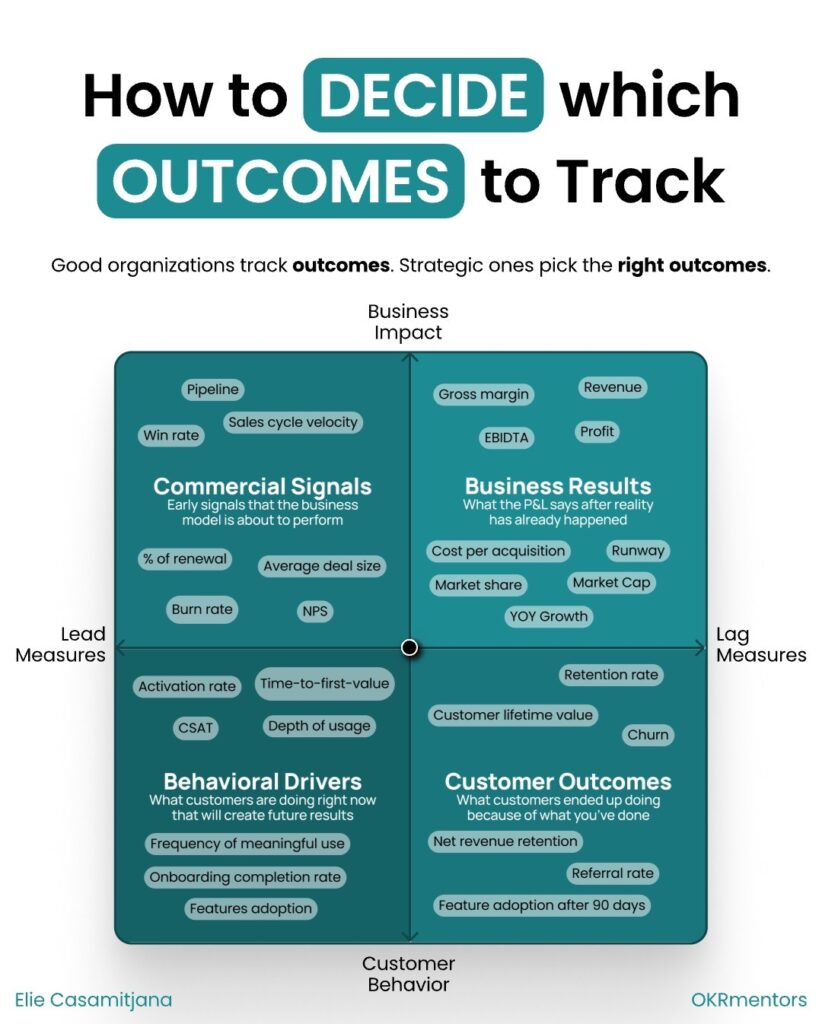
Strong Key Results are not just measurable. They are useful for decision-making. If a metric is too vague, too delayed, or too difficult to update, the team will struggle to use it during the cycle. That is why many teams use a mix of lagging and leading indicators. Lagging indicators show whether the end result was achieved, but they often appear too late to support adaptation. Leading indicators help teams spot earlier signals and adjust course before the cycle ends. In some cases, proxy metrics can also be useful when the ideal metric is difficult to measure regularly, as long as the proxy is meaningfully correlated with the result that matters.
A strong Key Result should also reflect real value. It should not simply measure throughput, task completion, or delivery volume unless those are genuinely the best available evidence of progress. As a practical rule, if the Key Result can be marked complete even when nothing meaningful improved, it is probably not yet a good Key Result.
Quick Test:
Can someone update this Key Result in under 60 seconds using a single source of truth? If not, it will become a debate.
Examples of strong Key Results vs weak Key Results:
| Weak Key Result (task or vague) | Strong Key Result (outcome) |
| Launch onboarding emails | Increase onboarding completion from 62% to 78% |
| Improve reliability | Reduce Sev-1 incidents from 6 per quarter to 2 per quarter |
| Increase adoption | Increase weekly active usage of feature X from 8k to 14k users |
| Improve engagement | Increase 4-week retention from 28% to 34% |
What is the difference between Outcomes and Outputs?
This is one of the most misunderstood parts of OKRs. Outputs are the things a team delivers, such as a feature, a campaign, a training program, or a workshop. Outcomes are the measurable changes those things are meant to create, such as higher activation, faster onboarding, better retention, or stronger customer satisfaction. In simple terms, outputs are what you produce, outcomes are what changes because of it.
OKRs are designed to keep the focus on outcomes. A team can complete all its planned work and still fail to improve what matters. That is why Key Results should describe business impact, user change, or performance movement, not activity completion. In the OKRPC material, examples such as “Launch European version” or “Run influencer campaigns” are explicitly rewritten into outcome-based Key Results such as activation rate, bank account linkage, or cost per signup. The point is not that delivery does not matter. It does. But in OKRs, delivery belongs in initiatives, while Key Results should show whether the delivery made a difference.
How do you make Key Results clear and measurable?
Ambiguity usually comes from hidden definitions. For example, activation might mean creating an account, completing setup, or performing the first meaningful action. If you do not define it, teams will score it differently and trust will erode.
For each Key Result, add:
- What is counted
- What is excluded
- Where the number comes from
- How it clearly contributes to the Objective
You do not need perfect analytics to do this at the fundamentals level. You do need consistency. A not-so-perfect metric that is easily measurable is better than the perfect metric that requires extensive work to be calculated.
How should you use Leading and Lagging Indicators?
Some outcomes show up late, and some show up earlier and predict later outcomes. If your main success outcome is lagging (for example, retention or revenue), include at least one earlier signal so you can adapt before the cycle ends.
Example pattern:
- Lagging KR: Increase retention from 84% to 87%.
- Leading KR: Reduce time-to-first-value from 10 days to 5 days.
The key is not to add many KRs. It is to add one early signal that helps decisions during the cycle.
How many OKRs should a team have?
OKRs are a focus mechanism. When there are too many, they stop functioning. A practical default: 1-3 Objectives per team per cycle, with 2-5 Key Results per Objective.
If a team cannot recall their priorities without looking them up, the set is too large. The discipline of choosing what not to include is as important as choosing what to include.
What does it mean for a Key Result to be scoreable?
A KR is scoreable when someone can assess it using evidence, without debate. Scoreability forces clarity, and clarity makes progress discussable.
A simple convention: 0.0-1.0 scale where 1.0 means the target was met. What matters most is that the method is consistent and tied to evidence.
Avoid turning scores into performance verdicts. Scores should drive learning: what assumptions were wrong, what initiatives were effective, what to change in the next cycle.
The OKR definition session: One of the core OKR rituals
The OKR definition session is one of the core rituals in the OKR cycle, alongside regular check-ins and the end-of-cycle review and retrospective.
A well-structured OKR definition session helps teams identify the right priorities and build alignment on what matters most for the next cycle. The goal is not only to write OKRs, but to create shared understanding and commitment within the team.
Defining OKRs together is important for two main reasons:
- Leverage collective intelligence. Different perspectives help identify better priorities and more realistic outcomes.
- Build team buy-in. When people participate in defining the OKRs, they are more committed to delivering them.
A typical OKR definition workshop often follows these steps:
- Start with the “Why”. Briefly revisit the strategy, the current context, and the priorities for the next period. This helps the team zoom out before defining specific goals.
- What matters now. Discuss the current situation and key challenges. In some cases, this can include a short reflection on the previous cycle.
- Where we want to be. Ask the team to imagine what success would look like by the end of the next cycle. Encourage open brainstorming and participation from everyone.
- Refine and focus. Cluster ideas and converge on the few priorities that matter most. Typically this leads to identifying 1–3 Objectives.
- Define how success will be measured. Draft the Key Results that will provide measurable evidence of progress toward each Objective.
- Wrap up and confirm alignment. Review the proposed OKRs, confirm team alignment, and agree on next steps before finalizing them.
Depending on the team size and maturity, a definition workshop can last from a couple of hours to a full day. The most important outcome is not speed, but clarity and shared commitment to the priorities for the cycle.
Why do OKRs work better than traditional goals?
OKRs are not a repackaging of standard goal-setting. They introduce a specific set of design principles that change how goals function inside an organization.
Transparency by default
OKRs are public. Every team’s Objectives and Key Results should be visible across the organization. When goals are visible, teams can see where their work connects to others, identify dependencies before they become blockers, and spot misalignment early.
Focus on outcomes over outputs
Traditional goal-setting often tracks activity. OKRs track outcomes. A team can complete every task on its list and still fail to move the metric that matters. OKRs force the question: did the work change anything measurable?
In practice, organizations often revert to tracking activity because outcomes are not always easy to measure and may depend on delayed, incomplete, or cross-team data. Without clear metric definitions and accessible data sources, teams default to outputs. Maintaining an outcome focus requires deliberate investment in measurement and agreement on what constitutes valid evidence.
Set ambitious goals
OKRs are typically written to be ambitious. A common principle from Google’s early OKR practice is that a score of 70% is considered a strong result. The logic: if you always achieve 100%, your goals were not ambitious enough.
This is a cultural norm, not a universal rule. What matters is that goals are honest, not sandbag targets designed to guarantee success.
Alignment without top-down control
OKRs create alignment through transparency and shared context, not through top-down mandates. Teams define their own OKRs in response to company priorities. This means teams understand why their goals exist and have ownership over how they are achieved.
This is a meaningful distinction from cascaded targets, where numbers are handed down and teams are measured on compliance. OKRs invite teams to contribute to the direction.
What most OKR guides miss
Most introductions to OKRs focus on the mechanics: write an Objective, add Key Results, score at the end of the quarter. That is the easy part. What determines whether OKRs take hold is the layer underneath: whether leadership uses OKRs to make real trade-offs, or treats them as a parallel process that sits alongside how decisions are actually made.
In our work with hundreds of organizations – including Fortune500 and leading global brands such as KPMG, Disney, Indeed, Sage, etc – the ones that get sustained value from OKRs share one characteristic: their leaders refer to OKRs in the room when priorities conflict. Not in the planning meeting. In the moment, when a new initiative lands and someone has to decide whether it displaces existing commitments. That is when OKRs either prove their worth or get exposed as wallpaper.
The framework is simple but the discipline is not. That gap is where most implementations stall, and it is what the rest of this deep dive is designed to help you close.
How do OKRs improve team focus?
One of the most common complaints in growing organizations is that teams are busy but not productive. Work is happening everywhere, but it is not always the right work. OKRs address this directly.
Why is lack of focus a structural problem?
Lack of focus is rarely a motivation problem. It is usually a clarity problem. When priorities are unclear, teams default to doing more rather than doing what matters. Every request feels equally urgent. Every project feels equally valid.
OKRs create a structural answer: when a team has 1-3 clear Objectives with measurable Key Results, every incoming request can be tested against a simple standard: does this move our OKRs? If not, it needs to be weighed carefully before it takes time from the team.
How do weekly check-ins improve execution?
OKRs are not a once-a-quarter exercise. They require a weekly rhythm to be effective.This matters because execution improves when teams shorten the time between seeing a signal, discussing its implications, and changing course.
What should a good check-in include?
A good check-in is short and decision-oriented. It should answer these three questions:
- What will we change before next week?.
- What does the evidence say about each KR today?
- What is preventing progress?
The purpose of this cadence is to reduce decision latency. Frequent inspection of evidence allows teams to detect when progress is off track and adjust before outcomes are fixed. When check-ins do not produce decisions, latency increases and OKRs become a reporting mechanism rather than a tool for adaptation.
If a KR is off track, the check-in should produce at least one output: a change in initiative, a trade-off decision, or a concrete ask for help or resources. If the team leaves with no decisions while confidence is low, the cadence is not doing its job.
What are confidence scores and how should you use them?
A confidence level is a forward-looking indicator of how likely a team is to achieve a Key Result. It reflects the team’s current assessment based on available evidence and progress.It is not a performance rating.
Confidence can be expressed either as a numerical score (for example on a 0–10 scale) or through a simple status level:
- Green – Confident or highly confident the Key Result will be achieved.
- Amber – At risk, progress is uncertain and may require attention or adjustment.
- Red – Critical risk or blocked, achievement is unlikely without intervention.
A confidence level that drops sharply between check-ins should trigger a conversation. The goal is not to judge the team, but to identify obstacles early and decide what to change.
How do teams use OKRs to make better trade-offs?
A team using OKRs well develops a natural habit of testing new work against current priorities. When a new request arrives mid-quarter, the OKR-literate question is: if we take this on, which Key Result do we de-prioritize, or which do we accept will be slower? This makes trade-offs visible rather than implicit.
Micro-case: rewriting a KR so the check-in can make a decision
| Stage | Content |
| Context | A product team wants to improve onboarding, but their first draft Key Result describes work rather than evidence. |
| Before (task-like KR) | Launch onboarding email sequence. |
| After (decision-shaping KR) | Increase onboarding completion from 62% to 78% by cycle end. |
| Metric definition | Onboarding completion = user reaches the first value event within 7 days of signup. Data source: analytics dashboard. |
| Check-in decision | In week 2, completion is 63% (needs 68% to stay on track). Decision: stop one lower-impact initiative and run two onboarding experiments before next check-in. |
Common OKR mistakes and how to avoid them
OKRs do not create focus or alignment on their own. They make focus and alignment visible. Their effectiveness depends on the operating conditions in which they are used, including how decisions are made, how priorities are governed, and how teams are enabled to change direction. When those conditions are not in place, OKRs often degrade into reporting rather than decision-making.
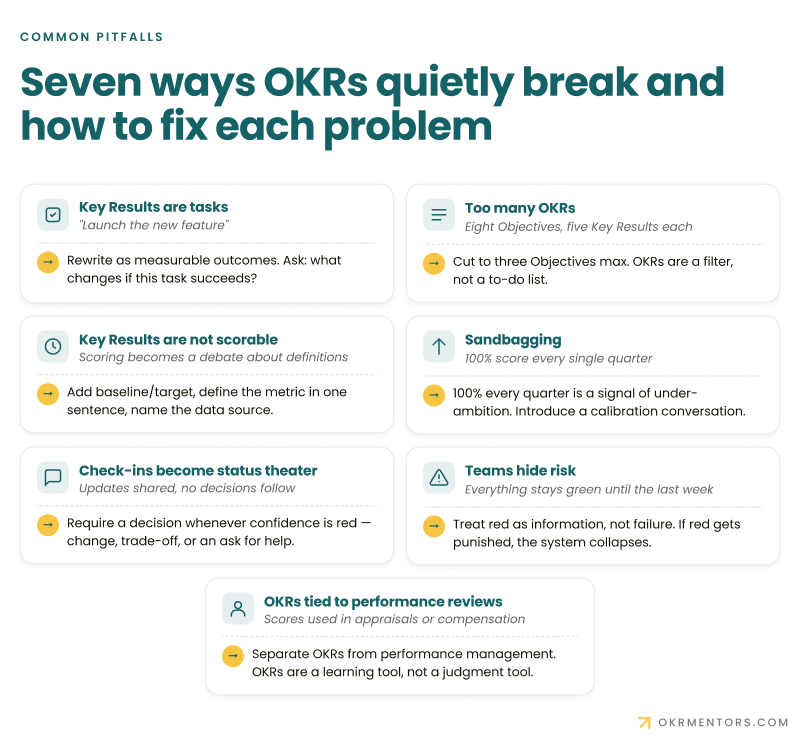
These mistakes are often not caused by lack of effort or understanding. They typically emerge from underlying constraints such as risk-averse governance, limited decision authority, or performance systems that reward predictability over learning. Addressing the symptoms without addressing these conditions will usually result in the same patterns reappearing in later cycles.
How do you know OKRs are working?
Most guides tell you what good OKRs look like on paper. That matters, but it is not how you know the framework is actually working. OKRs are working when they start changing behavior, not when they are well-formatted.
These are the signals we look for across the organizations we work with. None of them require a perfect implementation. Most appear unevenly — in one team before others, in one meeting before it becomes a habit. What matters is that they appear at all.
1. A team voluntarily kills or changes an initiative mid-cycle.
This is often the single clearest sign. It means the team looked at the Key Result evidence, concluded the current approach was not working, and changed course without being told to. Before OKRs, this kind of pivot either did not happen or required escalation. When a team does it on their own because the data made the decision obvious, the framework is doing its job.
2. Someone says “that is not in our OKRs” and it sticks.
Not as a bureaucratic refusal, but as a genuine prioritization move. A new request arrives. Someone tests it against the current OKRs and names the trade-off: we can do this, but it means this Key Result slows down. When that sentence is spoken out loud and the group engages with the trade-off rather than just adding the work, focus has become structural rather than aspirational.
3. A check-in produces an uncomfortable decision in under ten minutes.
Early check-ins tend to be long, cautious, and inconclusive. When the cadence is working, the team sees a KR trending off track, names the problem, and agrees on a change — sometimes in a single exchange. The speed is the signal. It means the evidence is clear, the definitions are shared, and the team trusts the process enough to act on what they see.
4. A team goes red early and the response is curiosity, not blame.
This is a cultural signal more than a process signal. The first time a team flags a Key Result as red in week three or four rather than hiding it until week twelve, watch what happens in the room. If leadership responds by asking what the team needs, the system is building trust. If leadership responds by questioning the team’s competence, the system is about to collapse — and every other team just learned to stay green.
5. Leaders reference OKRs in unscripted moments.
Not in the quarterly review. Not in the planning meeting. In the hallway, in the Slack thread, in the budget conversation that was not supposed to be about OKRs. When a leader says “let me check how this connects to our Q2 Objectives” outside a structured OKR meeting, the framework has moved from process to operating logic.
6. The retrospective changes the next cycle.
Many organizations run retrospectives. Few let the findings alter how the next cycle is designed. The signal is specific: a lesson from the retrospective — about KR quality, cadence frequency, metric definitions, or alignment gaps — visibly shapes how the next set of OKRs is written or how the next check-in rhythm is structured. If the retrospective produces a document that no one references in the following quarter, it is ceremony.
7. Not every signal needs to be present.
In most organizations, one or two of these appear in the first cycle, more in the second, and the full pattern takes three or four cycles to establish. The important thing is to know what you are looking for. Progress in OKR maturity is rarely visible in the quality of the written goals. It is visible in how the organization behaves when the goals meet reality.
What happens when goal-setting is poor?
Most organizations underestimate what poor goal-setting costs. In medium and large organizations, the impact is far from conceptual. Misaligned effort, slow decisions, and wasted initiatives can translate into millions of dollars in lost value every month. The visible costs are easy to miss because they accumulate gradually.
What problems does poor goal-setting create?
- Misaligned effort: teams work hard on things that do not connect to what the organization needs most. The effort is real, the impact is diffuse.
- Decision paralysis: without clear priorities, every decision requires negotiation. Teams stall because they cannot tell which of two competing requests matters more.
- Accountability gaps: vague goals make it impossible to hold anyone accountable for anything specific. If the goal is “improve customer experience,” who is responsible, and how would you know if it was achieved?
- Wasted planning cycles: organizations that set goals without measurable outcomes run planning processes that consume significant time and produce documents no one uses after the first week.
- Talent erosion: high performers leave organizations where their contribution is invisible. The people most likely to leave are the ones who want their work to matter.
- Repeated mistakes: without outcome measurement, teams cannot learn what worked. The same approaches get recycled quarter after quarter with no improvement in results.
How do these problems compound over time?
These costs do not happen in isolation. Misaligned effort leads to accountability gaps. Accountability gaps lead to repeated mistakes. Over time, the organization develops a cultural tolerance for vagueness that becomes difficult to reverse.
The value of a disciplined goal-setting system like OKRs is not just in the goals themselves. It is in the habits of clarity and measurement that build up over multiple cycles.
What Does Strong Goal-Setting Make Possible?
The Global State of OKRs survey of 466 leaders found that organizations which rated themselves as OKR overachievers showed dramatically stronger performance across every strategic dimension. Among overachievers, 48% rated themselves as excellent at maintaining focus, 16 times higher than organizations just starting out. On agility and adaptation, 62% rated themselves as excellent, 62 times higher than beginners.
These are not marginal differences. They reflect a sustained, disciplined approach to goal-setting compounds over time. None of it happens in the first cycle.
How do you implement OKRs step by step?
Step 1: Diagnostic
Analyze the current situation, including the organization’s strategy execution challenges, operating model, decision-making patterns, planning cadence, leadership alignment, and readiness for OKRs. The goal is to understand where OKRs can add value and what conditions may need to be strengthened first.
Step 2: Deployment strategy
Based on the diagnostic, define how OKRs will be introduced. This includes choices around scope, cadence, governance, roles, tooling, training needs, and the level at which OKRs will initially operate. In many cases, the best starting point is a first pilot with the leadership team, and sometimes with 2–3 additional teams, before expanding further.
Step 3: Implementation and training
Support the pilot and early rollout through training, facilitation, and coaching. This often includes helping leadership define the first company OKRs, supporting teams in writing their own OKRs, and enabling the OKR Lead, champions, and managers to run the cadence effectively.
Step 4: Preparation and launch of the first OKR cycle
With the first teams involved, prepare and launch the initial OKR cycle. In many organizations, this starts with the leadership team and, where relevant, a small number of pilot teams before broader rollout. This stage includes defining OKRs, aligning them, communicating the new cycle clearly, and establishing the operating rhythm.
Step 5: Change management and optimization
Once OKRs are in use, monitor adoption and effectiveness over time. Strengthen weak points, adjust the process, improve KR quality, refine the cadence, and address resistance or misuse. The goal is not only to deploy OKRs, but to make them part of how the organization executes strategy.
OKR Mentors Quality Review checklist
Use this as a quick diagnostic before the cycle starts, and again in week 2 to catch drift early.
- Objective is likely strong when: it describes an outcome (not a project) and implies what better means.
- Key Result is likely strong when: it measures an outcome, includes baseline and target where possible, and has a clear definition and data source.
- Set is likely strong when: it is small enough to discuss weekly and coherent enough that hitting the KRs clearly means the Objective was achieved.
If you do only one improvement step: take every KR and ask, Is this evidence of an outcome, or is it work? Then move work into initiatives.
OKR Examples to Copy
Example 1
Product onboarding
Objective: Delight customers with a faster, more reliable onboarding experience.
- KR 1: Increase onboarding completion from 62% to 78%.
- KR 2: Reduce time-to-first-value from 10 days to 5 days.
- KR 3: Increase activation from 45% to 60%.
Initiatives (separate): Onboarding email redesign, in-app checklist experiment, reduce signup friction.
Example 2
Sales pipeline quality
Objective: Build a healthier pipeline that supports predictable growth.
- KR 1: Increase qualified pipeline coverage from 2.0x to 3.0x next-quarter target.
- KR 2: Improve SQL-to-close rate from 18% to 24%.
- KR 3: Reduce median sales cycle length from 52 days to 45 days.
Initiatives (separate): ICP refresh, enablement programme, stage-exit criteria update.
Example 3
Platform reliability
Objective: Make the platform trusted during peak usage.
- KR 1: Reduce Sev-1 incidents from 6 per quarter to 2.
- KR 2: Improve p95 API latency from 900ms to 600ms.
- KR 3: Maintain 99.9% uptime during peak usage weeks.
Initiatives (separate): Performance profiling, incident playbook updates, capacity planning.
Example 4
Customer support speed
Objective: Make support faster and more predictable for customers.
- KR 1: Reduce median first response time from 12 hours to 4 hours.
- KR 2: Increase tickets resolved within 48 hours from 55% to 75%.
- KR 3: Reduce repeat-contact rate from 22% to 15%.
Initiatives (separate): Triage rules, macro library clean-up, staffing schedule redesign.
Example 5
Engineering delivery
Objective: Reduce delivery friction so teams ship meaningful improvements faster.
- KR 1: Reduce lead time from first commit to production from 14 days to 7 days.
- KR 2: Reduce failed deployments from 9% to 4%.
- KR 3: Increase work items delivered within the planned cycle from 60% to 75%.
Initiatives (separate): CI/CD improvements, definition-of-done tightening, dependency mapping.
Frequently Asked Questions
A KPI is a standing metric that monitors ongoing performance, for example monthly revenue or churn rate. An OKR is a time-bound goal that defines where you want to move a metric in a specific period. KPIs tell you how you are performing. OKRs tell you what you are trying to change.
1-3 Objectives per team per quarter, with 2-5 Key Results per Objective. If a team cannot recall their priorities without looking them up, the set is too large.
A measurable outcome with a clear start point and a clear target. “Increase monthly active users from 10,000 to 15,000” is a strong KR. “Launch the new user dashboard” is not. The test: can you score it with evidence at the end of the quarter?
No. They require clear definitions and consistent tracking. If the metric is imperfect, name the limitations and improve it over time. The goal is to eliminate ambiguity, not to achieve analytical perfection.
Sometimes. Use evidence-based milestones that are hard to game. If it is mainly a deliverable, keep it as an initiative. The rule: the measurable evidence must still matter.
No. When OKRs are tied to compensation or appraisals, teams set safe targets rather than ambitious ones. OKRs are a learning and alignment tool. Separating them from performance management preserves the conditions for honest, stretch-oriented goal-setting.
Commitment comes from clarity, ownership, and leadership follow-through. People take OKRs seriously when priorities are clear, progress is reviewed regularly, and leaders use OKRs to guide real decisions. Accountability should come through the cadence and visibility of progress, not through direct reward or penalty.
A missed OKR is a learning signal, not a failure verdict. The right question is: what did we learn about our assumptions, our capacity, or our environment? Organizations that treat missed OKRs as failures quickly find teams start sandbagging to avoid the same outcome.
Most organizations need two to three cycles before the process feels natural. The first cycle is typically messy. Teams write tasks instead of outcomes. Confidence scores are unused. Alignment is partial. This is normal. The value compounds over time.
Four roles make OKRs work:
1. the OKR Lead – owns the process
2. OKR Sponsor – senior leader who signals it matters
3. OKR Champions – drive adoption within teams
4. Team Members – define and update OKRs
In addition, each Key Result should usually have a clear owner responsible for tracking progress, maintaining evidence, and raising risks early. Early-stage organizations often combine Lead and Sponsor into one person. What matters is that someone owns the process and every team has a local point of contact.
Team OKRs should be aligned with company OKRs. Each team OKR should connect to at least one company priority. If a team OKR cannot be traced to a company-level goal, it is worth asking whether it belongs in the OKR cycle at all.
That is valuable information. It means the initiatives did not lead to the desired impact, the assumptions were wrong, or the measures were misdefined. OKRs are designed to surface this. Use the retrospective to capture what the miss revealed and change your approach next cycle.