


The gap between delivery and outcomes
Few roles are as closely associated with execution as transformation leadership and project management. They manage complexity across functions, coordinate portfolios and programs together under pressure, and build the delivery discipline that turns strategic ambition into real-world change. Using OKRs for project management gives that delivery strength a clear, measurable outcome to aim at.
One question that delivery systems often fail to ask, or struggle to answer consistently, is:
How do we know this work produced the change it was designed to create?
Milestones and delivery schedules confirm that work was completed. Benefits and value realization practices extend the view beyond delivery, but they are usually not translated into explicit cycle-level outcomes and a regular rhythm for reviewing them. OKRs help bridge this gap.
OKRs add a specific goal-setting and review layer: a clear, cycle-level definition of what success looks like in outcome terms, and a rhythm for tracking whether that success is materializing. Projects and workstreams remain the delivery engine. OKRs provide the outcome lens that shows whether that engine is pointed in the right direction. By making those outcomes explicit and reviewable without replacing project management, they can help turn a portfolio of delivery activity into a system that learns and adapts.
For transformation leaders and PMO heads, this shift is significant. It changes how success is made explicit, what governance focuses on, and what conversations happen in steering committees. It also clarifies what OKRs are asked to do: not to manage delivery, but to define and track the change that delivery is meant to produce.
If you are in a hurry
Jump to Section 4 for the Initiative OKR structure and how to connect strategic goals to project execution.
Jump to Section 5 for the PMO and OKR Champion model.
Jump to Section 9 for the implementation checklist and OKR templates adapted for transformation and project-driven environments.
In this guide, transformation refers to the broader effort to change how an organization operates and creates value. That effort may be continuous even though the delivery vehicles supporting it are time-bound.
Transformation Core Principles
Outcomes over outputs. Projects necessarily deliver outputs: a system, a process, a feature, a report. OKRs start from a different question: what change are we trying to create, and what evidence would show that it is happening? If a transformation effort can complete every planned deliverable and still fail to move the strategic metric, the Key Results were written as activity, not outcome. The discipline of outcomes over outputs is what distinguishes a strategy execution system that delivers measurable value from a project tracker.
The value of cadence. Transformation environments can rely on governance rhythms that are too slow to surface outcome drift early. At initiative or team level, OKRs often introduce a weekly check-in that produces a decision when a Key Result is amber or red. A check-in that surfaces a problem in week three and leads to a change in approach is the mechanism that prevents teams from reaching week twelve with nothing left to adapt. Cadence over artifact: a weekly conversation that changes direction beats a beautifully built program plan that no one questions. For example, if delivery remains on plan in week three but the activation Key Result is flat, the check-in should trigger a change in approach rather than simply record a green delivery status.
Horizontal and vertical alignment. Transformation efforts typically involve multiple teams, functions, and sometimes geographies working toward a shared goal. OKRs make alignment visible and verifiable. Vertical alignment connects team-level OKRs to the strategic OKRs above them. Horizontal alignment ensures that when one team’s Key Result depends on another team’s work, that dependency is named before the cycle starts, not discovered in week seven.
What makes OKRs different for transformation and project management audiences
OKRs can feel more intuitive in product teams or leadership groups, where iterative cycles and outcome-based language may already be familiar. The logic is straightforward: those teams already work in iterative cycles and think naturally in terms of outcomes. Transformation portfolios and project-driven environments can be a harder fit, and that difficulty is worth understanding before trying to solve it.
A different starting point
Project managers and transformation leads already operate within established systems for planning, governance, delivery, risk, benefits, and performance. Historically, project management success was often associated with scope, schedule, and budget. That view is evolving.
Project Management Institute (PMI) now distinguishes between project management success and the broader concept of project success. Its Maximizing Project Success research defines successful projects in terms of delivering value worth the effort and expense. Its subsequent M.O.R.E. work calls on project professionals to Manage Perceptions, Own Success, Relentlessly Reassess, and Expand Perspective. This explicitly extends accountability beyond execution toward value, adaptation, and alignment with broader organizational goals.
That evolution matters for how OKRs are positioned. OKRs do not introduce outcomes into a discipline that ignores them. They provide a focused goal-setting and review mechanism that makes selected outcomes explicit, measurable, visible across teams, and part of a recurring decision cadence.
The tension OKRs introduce
When OKRs are introduced into a project-driven organization, they create an immediate tension. Project managers are accountable for delivery and, increasingly, for the value that delivery creates. When initiative OKRs are introduced, teams may nevertheless feel that they are being held accountable for outcomes they do not fully control. A project team can complete every deliverable and still fail to move the Key Result if the business context changed, the user behavior did not shift, or the upstream dependency was not ready.
This tension is productive if it is understood. It is destructive if it is ignored. The guide returns to this distinction in Section 8, where it covers how to handle accountability without turning OKRs into a performance management tool.
For project managers, this can mean managing two legitimate accountabilities at once: delivery commitments and evidence that delivery is creating the intended value. Governance therefore needs to distinguish between what the team controls directly, what it can influence, and what depends on external conditions or other teams.
What OKRs add alongside project management
Project, program, portfolio, and Agile practices provide methods for selecting, planning, governing, coordinating, and adapting delivery and for realizing benefits. They are delivery systems. OKRs add a focused goal-setting layer that makes the outcomes to be advanced during a given cycle explicit and measurable. Rather than sitting above project management as a separate system, they should connect strategic intent to the delivery and governance practices already in place.
They help make one question explicit and recurring in governance: how will we know whether this work is producing the outcome it is intended to create?
In that sense, OKRs make the connection between organizational strategy and the project and program portfolio explicit and reviewable. This becomes clearer when the different jobs performed by the management mechanisms already in place are separated explicitly.
The job distinction that prevents most confusion
OKRs answer a different but complementary question to the frameworks already used in transformation environments. KPIs and dashboards monitor ongoing health and performance. Project, program, portfolio, and Agile practices coordinate delivery, governance, prioritization, and benefits realization. OKRs define a focused set of outcomes to advance during a given cycle and track whether those outcomes are moving. Keeping these roles distinct but connected prevents OKRs from becoming another reporting tool.
The core problem: why projects deliver outputs but transformations need outcomes
That broader definition of project success shifts the question from whether outcomes matter to how they remain explicit and actionable throughout delivery. In complex transformation environments, intended value can become diluted as strategic priorities are translated into projects, milestones, budgets, and functional metrics. OKRs can help maintain a focused set of measurable outcomes and a regular review cadence that keeps those outcomes visible as delivery progresses.
Six execution patterns that can weaken outcome focus
Project Portfolio Management (PPM) is designed to connect investments with strategic objectives. Below are execution and governance patterns that can arise around a portfolio when strategic intent becomes diluted through funding, reporting, prioritization, or delivery practices. OKRs can help make those patterns more visible and maintain focus on the intended outcomes.
- Output focus. Portfolio reviews can over-index on features delivered, milestones achieved, and systems deployed rather than on the outcomes those outputs are expected to create. This encourages teams to prioritize activity over impact. Roadmaps fill with deliverables that may not meaningfully advance the strategy. Delivery appears productive on paper while offering limited real value in practice. Once an annual roadmap is full, new evidence and emerging priorities can also struggle to find room, even when they would create more strategic value than work already committed.
- Governance misfit. Portfolio governance can over-index on predictability and control at the expense of learning and adaptation. Progress is evaluated on whether predefined milestones are met, regardless of whether those milestones still represent the best route to value. Decision gates slow adaptation rather than enabling it.
- Funding constraints. Portfolio management operates within the organization’s wider funding model. Where annual funding is tied rigidly to predefined projects, resources can remain committed to plans even when new evidence suggests that priorities or approaches should change. This can make it harder to reallocate investment towards emerging opportunities or initiatives demonstrating greater strategic value.
- Fragmented reporting. Each team or department has its own metrics. Technology reports delivery velocity. Finance reports spend. Operations reports workload. Meanwhile, customer outcomes and strategic metrics remain flat. Each function optimizes locally while enterprise outcomes stall.
- Team disempowerment. In some portfolio environments, strategic decisions remain concentrated at higher levels. Teams lack the context to understand how their work connects to strategic intent, and the agency to adapt when their work is not creating the intended impact.
- Delivery measures dominate outcome evidence. Portfolio reporting can become dominated by internal delivery measures such as milestones, schedule, cost, and completion status, even when the underlying project or portfolio approach is explicitly intended to create value. When evidence of customer, stakeholder, or business outcomes receives less attention, an initiative can appear successful from a delivery perspective without sufficient visibility of whether the intended change is occurring. OKRs help keep selected outcome measures visible alongside delivery measures.
How strategy, OKRs, and PPM work together
Strategy sets the direction and the longer-term choices the organization is making.OKRs translate that direction into a focused set of measurable outcomes for the current cycle.PPM selects, funds, governs, and reallocates the programs and initiatives needed to advance those outcomes.Used together, these mechanisms connect strategic intent to portfolio choices and delivery while creating a regular evidence loop for deciding whether current investments should continue, adapt, or change.
For a deeper look, see our whitepaper on strategy execution, OKRs and portfolio management.
How to structure OKRs for transformation
Transformation is not a program by default
- Transformation: the broader effort to change how an organization operates and creates value.
- Transformation portfolio: the programs, projects, workstreams, and other change activities selected to advance that transformation.
- Program: related projects and activities coordinated to realize benefits that would be harder to achieve separately.
- Project: a temporary effort undertaken to deliver a defined result.
- Workstream: a defined stream of related delivery activity within a broader initiative.
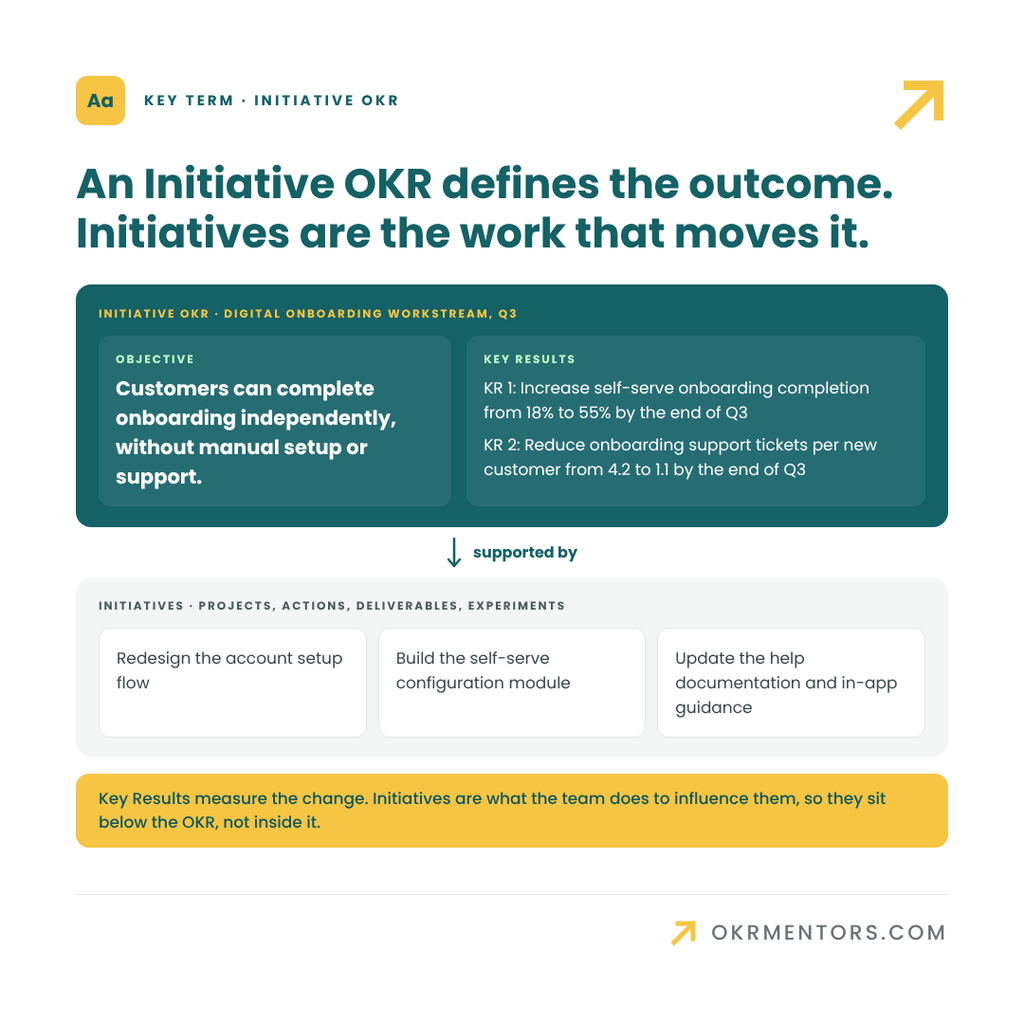
Throughout this guide, an Initiative OKR refers to an OKR attached to a significant delivery initiative such as a program, project, or workstream. This is distinct from the lowercase initiatives listed beneath an OKR, which are the actions undertaken to influence its Key Results.
The architecture question for transformation is different from a simple company-to-team cascade. Transformation work is cross-functional and may span an ongoing portfolio alongside time-bound programs, projects and workstreams. The OKR architecture should therefore reflect the organization’s actual accountability and governance structure rather than force every context into the same hierarchy.
A two-level starting pattern
A practical starting pattern for many transformation contexts uses two connected levels of OKRs. It should be treated as a design pattern rather than a universal hierarchy.
Level 1, Strategic OKRs Set at the organization or transformation portfolio level, or at a major program level depending on where strategic accountability sits. They define the strategic outcomes the transformation is intended to advance. Typically annual or multi-quarter in horizon and reviewed quarterly. Owned by the executive sponsor or transformation leadership.
Level 2, Initiative OKRs Used where a program, project, or workstream needs a distinct outcome layer to connect its delivery to the strategic OKRs above it. They are typically quarterly and owned by the person accountable for the relevant outcome. Not every delivery initiative requires its own OKR.
Below or alongside these levels, delivery continues through the organization’s existing project, program, product, Agile, or other delivery methods. The purpose of the OKR architecture is to create sufficient traceability from strategic outcomes to delivery without creating unnecessary hierarchy.
More complex organizations may require additional levels, while some teams or projects may connect directly to strategic OKRs. The design principle matters more than the number of levels.
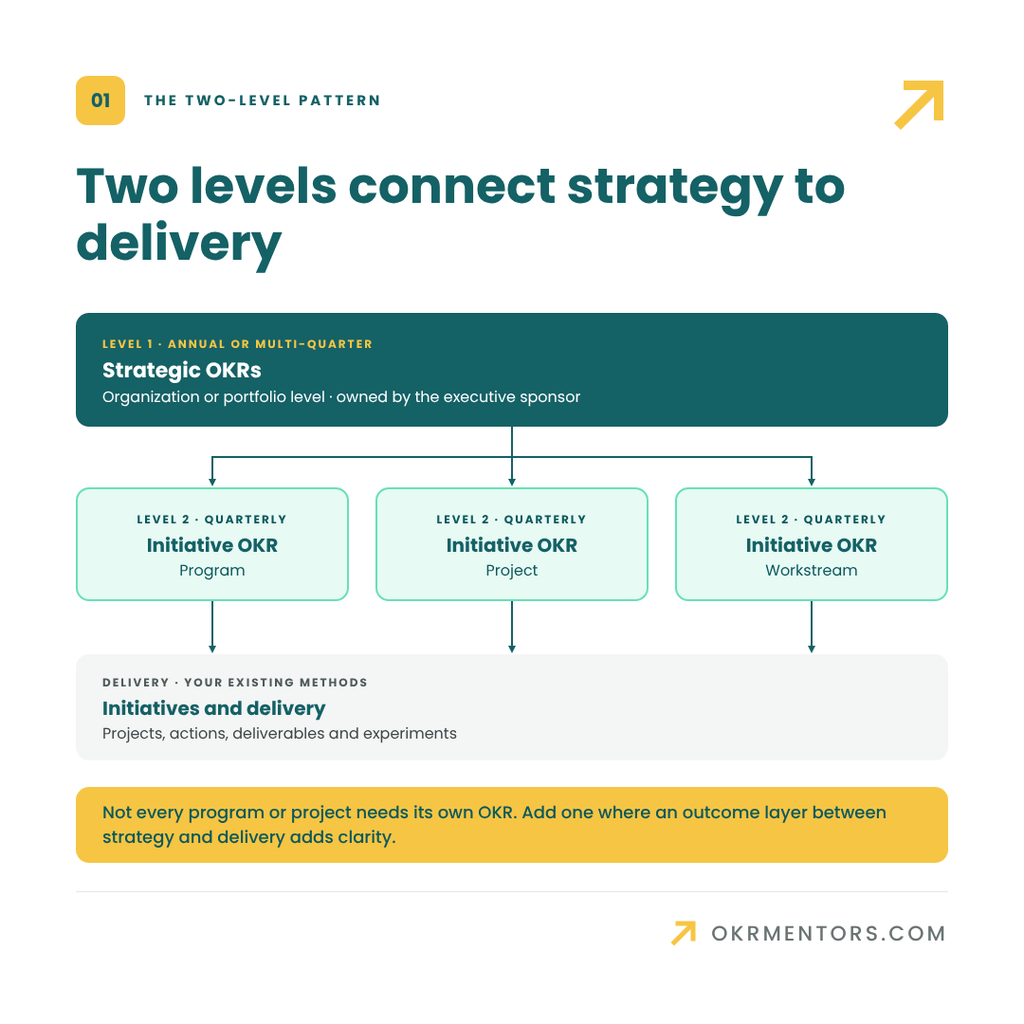
Alt text: The two-level OKR pattern: Strategic OKRs at the top, Initiative OKRs for a program, a project and a workstream below, and initiatives and delivery at the base.
This model keeps strategic goals visible and stable at Level 1 while allowing the Level 2 work to adapt as delivery progresses. A quarterly Initiative OKR can change when the evidence shows the current approach is not moving the Level 1 Key Result. The strategic goal remains. The method of getting there can shift.
There is no one-to-one requirement between Level 1 Key Results and Initiative OKRs. One Initiative OKR may contribute to several Level 1 Key Results, and some Level 1 Key Results may not require a separate Initiative OKR at all.
How many OKRs
The same principle applies in transformation as everywhere else: fewer, well-chosen goals generally create more focus than many partially prioritized goals. For a transformation portfolio using this two-level pattern, useful starting guardrails are:
- Level 1: typically up to 3 strategic OKRs, with 2-4 Key Results each.
- Level 2: a major program, project, or workstream that warrants its own initiative OKRs typically has 1-3, with 2-4 Key Results each.
- If a workstream cannot name the outcome it expects to produce this quarter in one Objective, the scoping conversation is not yet complete.
Linking projects to outcomes
Each initiative OKR should have a clear line of sight to at least one strategic Objective or Key Result above it. Not every project requires its own OKR, but every significant investment should have a clear rationale for how it contributes to strategic outcomes, directly or indirectly.
Example: Transformation OKR structure
Level 1, Strategic OKR (Transformation portfolio)
Objective: Make customer onboarding the fastest, easiest route to first value in our category.
- KR 1: Increase new customer activation rate from 44% to 72% by end of year.
- KR 2: Reduce median time-to-first-value from 28 days to 9 days by end of year.
- KR 3: Achieve a 90-day customer NPS of 52 or above by end of year.
Level 2, Initiative OKR (Digital onboarding workstream, Q3)
Objective: Customers can complete onboarding independently, without manual setup or support.
- KR 1: Increase self-serve onboarding completion rate from 18% to 55% by the end of Q3.
- KR 2: Reduce onboarding support tickets per new customer from 4.2 to 1.1 by the end of Q3.
Initiatives (separate from the OKR): redesign the account setup flow, build the self-serve configuration module, update the help documentation and in-app guidance.
The Initiative OKR: connecting strategic goals to project execution
The Initiative OKR is a useful structural concept for project managers and transformation leads. It is the level at which OKRs become actionable for program teams, and it is the level that most OKR implementations in project contexts either skip or misuse.
What an Initiative OKR is
An Initiative OKR is an OKR set at the program, workstream, or project level. Its Objective describes the measurable outcome the initiative is expected to produce in support of the strategic OKRs above it. Its Key Results are the specific evidence, measured at the initiative level, that will show whether that outcome is being achieved.
The distinction that matters: an Initiative OKR is not a list of deliverables. The projects and workstreams that make up the initiative are the delivery work. They belong in an initiative’s list below the OKR, not inside it.
It should be used where an intermediate outcome layer adds clarity, rather than being created automatically for every program, project, or workstream.
| Weak Key Result (output or milestone) | Strong Key Result (outcome) |
| Deliver the new CRM platform by end of Q2 | Increase sales team data accuracy from 61% to 88% by end of Q2 |
| Complete change management training for 200 staff | Reduce manual process errors by 40% within 60 days of system go-live |
| Launch the new digital onboarding flow | Increase self-serve onboarding completion from 18% to 55% by end of Q3 |
| Submit the transformation program report | Achieve stakeholder confidence score of 7.5 or above at mid-year review |
| Deploy the new operating model | Reduce cross-functional decision cycle time from 14 days to 5 days by Q4 |
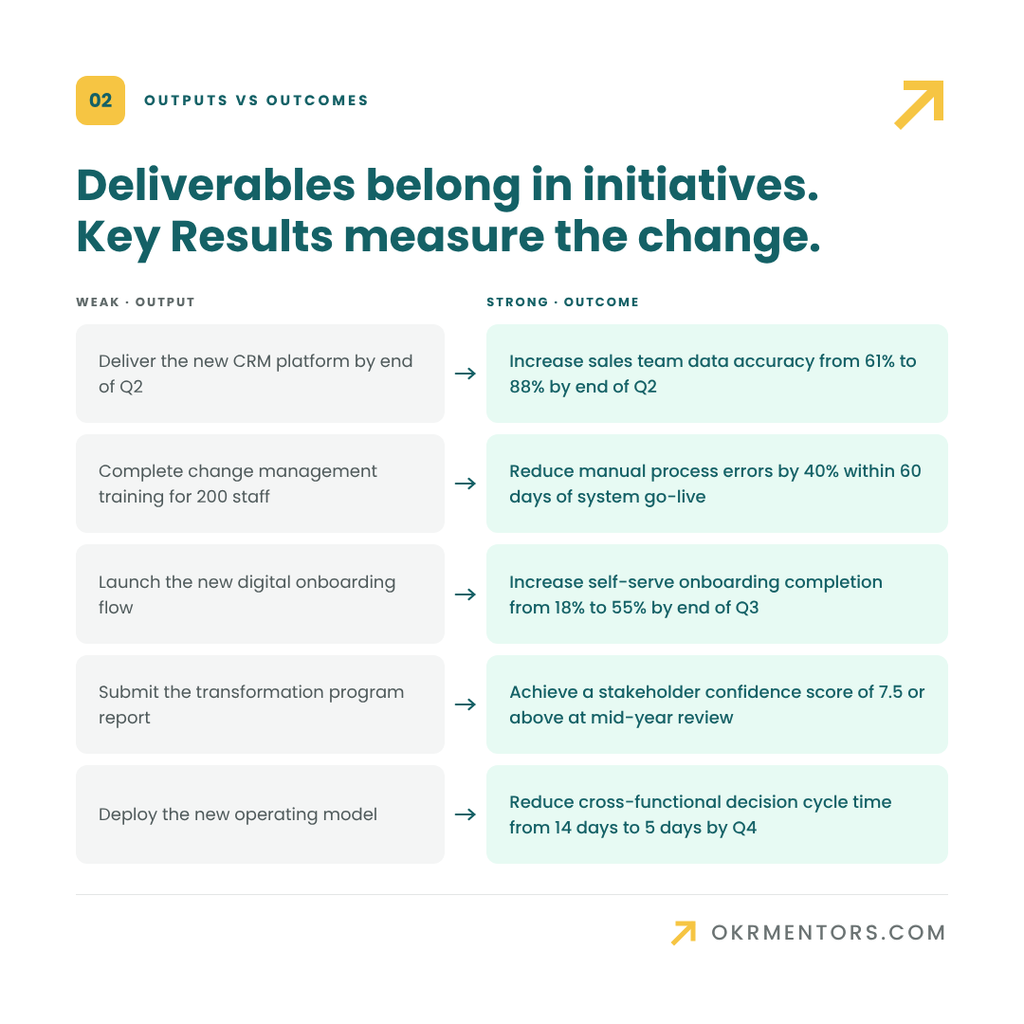
Alt text: Five output-based Key Results paired with outcome-based rewrites, such as Deliver the new CRM platform rewritten as Increase sales team data accuracy from 61% to 88%.
Why this structure matters
Where strategic OKRs are too broad to guide delivery decisions directly, an Initiative OKR can provide an intermediate outcome layer. It gives the relevant team a measurable outcome at the right level of granularity and time horizon while preserving a clear connection to the strategic OKRs above it.
Using shared OKRs for cross-team dependencies
One of the most valuable uses of Initiative OKRs in transformation programs is to create shared OKRs between interdependent projects. When two programs or workstreams share a material outcome, or depend on the same technology platform or business change, a shared OKR makes the dependency explicit and can create a clearer joint accountability for the outcome.
For example: if Program A is developing an API that Program B needs to deliver its own Key Result, a shared Initiative OKR covering the integration outcome prevents both teams from optimizing locally at the expense of the joint goal. This approach turns OKRs from progress indicators into active facilitators of collaboration.
OKRs leading versus following project strategy
The timing question matters. Where organizations have discretion over portfolio choices, strategic OKRs should generally inform which initiatives are selected and prioritized. If large initiatives are already underway when OKRs are introduced, drafting Initiative OKRs retroactively can still provide direction, focus, and a way to measure success for ongoing programs, and can also prompt a reassessment of whether less impactful work should continue.
The PMO’s role and the OKR Champion model
PMOs and Transformation Offices often sit at the center of organizational complexity. They coordinate delivery across programs, support portfolio governance, manage dependencies and risks, and connect multiple functions. Where they have an enterprise, portfolio, or transformation mandate, they are particularly well positioned to sustain a shared cadence across strategy, portfolio, and delivery over time.
Why the PMO is well positioned for outcome-based execution
The PMO’s transversal view gives it visibility that individual projects and functions rarely have on their own: the portfolio of strategic initiatives, dependencies between them, resource allocation, delivery evidence, and the governance forums where investment decisions are made. That makes the PMO a natural orchestrator of the connection between strategic outcomes and delivery, although it does not mean the PMO owns every outcome.
PMI’s 2026 research on PMOs identifies three areas that PMOs need to build beyond operational expertise: a customer-centric approach, strategic alignment and value realization management, and data and technology integration. For OKR-enabled transformation, this translates into capabilities such as outcome-based management, business acumen, stakeholder engagement, evidence-based decision-making, and the ability to turn portfolio data into decisions.
The extent of this role depends on the PMO’s mandate. An enterprise, portfolio, or Transformation Office may orchestrate the model across the organization; a project-level PMO may support it without owning it.
The PMO’s role with OKRs
Introducing OKRs can strengthen the PMO’s evolution from primarily coordinating and assuring delivery toward a broader role in outcome-based execution. Operational governance remains important, but the PMO can also help maintain the integrity of the connection between strategic outcomes, portfolio decisions, and delivery.
In some organizations, this broader mandate is described as a Value Management Office (VMO), particularly where the function is explicitly oriented around portfolio value and Lean/Agile delivery. The label is less important than the shift in mandate.
1. Build a common language across functions. Create a shared vocabulary for objectives, outcomes, and Key Results. Embed OKRs in portfolio templates, steering materials, and funding discussions. When every department uses the same terminology, coordination becomes easier, and progress becomes comparable.
2. Synchronize planning cadences. Quarterly strategy reviews, portfolio prioritization, and delivery planning should operate within a single decision rhythm guided by explicit outcomes and clear decision rights. Leadership can refine direction, reallocate resources, and review evidence of progress without waiting for annual cycles.
3. Integrate OKRs into portfolio governance. Each major initiative should have linked Key Results that define success in measurable terms. Finance and governance reviews evaluate these outcomes alongside budget use and delivery progress. Initiatives without clear, measurable Key Results should not pass portfolio review gates without a conversation about what outcome they are expected to produce.
4. Complement delivery status reporting with evidence-based decision-making. Use evidence reviews alongside delivery status reporting so that governance assesses both execution progress and the value being created. If an initiative is achieving its intended outcomes, funding continues. If an initiative is not delivering the outcomes expected, governance should use the evidence to decide whether to adapt the approach, address capability or dependency gaps, pivot, pause, or stop. Resources should shift when the evidence shows that the current allocation is no longer justified.
5. Steward cadence integrity across the portfolio. The PMO ensures that OKR check-ins happen, that retrospectives produce changes to the next cycle, and that the connection between program-level OKRs and strategic OKRs is maintained. Where the PMO has the appropriate mandate, its stewardship of these rhythms helps turn shared cadence from a leadership preference into an organizational system.
The OKR Champion model in a transformation context
OKR Champions are team-level practitioners who facilitate OKR rituals and support adoption inside their team. In a transformation context, consider integrating an OKR Champion within each major workstream to harmonize workstream-level projects with the Initiative OKRs above them. The PMO, operating at portfolio level, coordinates the Champion network to ensure alignment with the transformation’s strategic OKRs.
The Champion role requires roughly five to ten percent of a person’s time. It is not a full-time position, but it requires genuine commitment and organizational credibility. Champions are the mechanism through which OKR adoption stops being a centrally driven effort and becomes a distributed practice.
Structure: PMO and Champion roles in a transformation program
| Role | Level | Primary OKR responsibility |
| Executive Sponsor | Organization / Transformation program | Owns and models Level 1 strategic OKRs. Removes blockers. Communicates why the transformation matters. |
| OKR Lead | Transformation Office / PMO | Coordinates the end-to-end deployment. Maintains cadence integrity. Runs retrospectives and cycle preparation. Coaches Champions. |
| OKR Champion | Workstream / Program team | Facilitates OKR definition and check-ins at workstream level. Supports adoption and change, and surfaces systemic blockers, dependencies, and cultural friction to the OKR Lead. |
| Program Manager | Project / Delivery | Manages delivery of the work that supports Initiative OKRs. May own or co-own an Initiative OKR where accountability for the relevant outcome sits with the program or project manager. |
These are roles, not necessarily separate jobs. In smaller programs or workstreams, a Program Manager may also act as the OKR Champion, provided the facilitation role remains explicit and delivery status does not crowd out the outcome conversation.
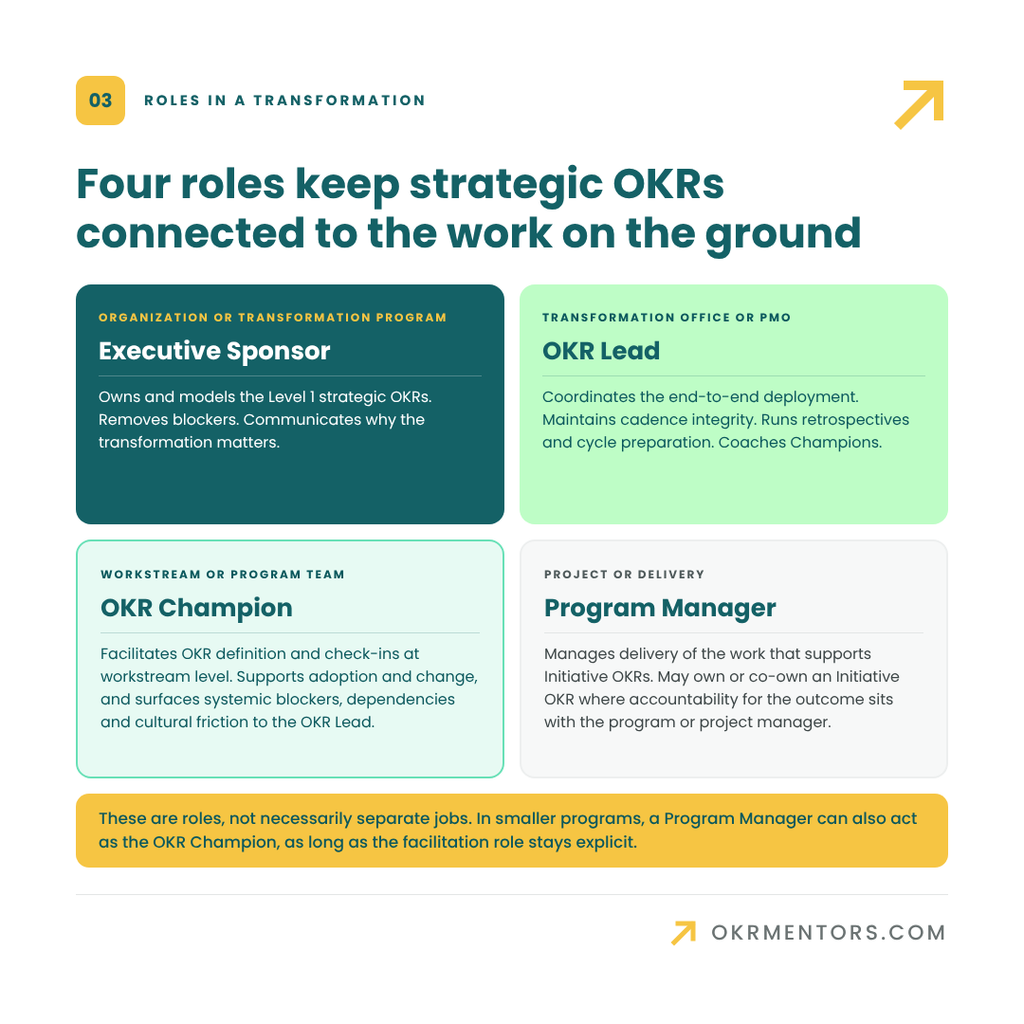
Alt text: The four OKR roles in a transformation program: Executive Sponsor, OKR Lead, OKR Champion and Program Manager, with each role’s level and main responsibility.
Running the cadence in a project environment
OKRs are not a once-a-quarter exercise. The framework only delivers value when it is connected to a regular check-in rhythm that produces decisions. In a project environment, that rhythm needs to fit the existing governance structure rather than add another meeting layer on top of an already full calendar.
The challenge of existing governance rhythms
Most transformation programs have a defined governance calendar: weekly workstream meetings, monthly steering groups, quarterly portfolio reviews. These rhythms are designed for delivery oversight, not for outcome-based learning conversations. OKRs do not replace these meetings, but they change what the conversations in them are for.
The most common failure mode is treating the OKR check-in as a status update rather than a decision-forcing conversation. A check-in that updates the numbers and ends without a decision or a clear request for help when a Key Result is amber or red is not doing the job. The cadence exists to surface drift early, when there is still time to change direction.
A check-in rhythm for transformation
| Check-in type | Purpose and format |
| Weekly OKR check-in (15-20 min) | – Update evidence on each Key Result. – Confidence score per KR. – One decision if any KR is amber or red. – Format: Embedded in the existing workstream or team sync. |
| Mid-cycle / steering review (30–45 min) | – Review Initiative OKR progress alongside project milestones and delivery evidence. – Assess whether the workstream is on track to produce the intended outcome. – Adapt initiatives where evidence suggests the current approach is not working. – Format: embedded as a standing agenda item in the existing steering or mid-cycle review. The exact frequency should follow the governance cadence rather than requiring a separate monthly meeting. |
| Quarterly portfolio review (90-120 min) | – Review Level 1 strategic OKRs against evidence. – Assess whether Level 2 Initiative OKRs are contributing to strategic progress. – Make portfolio-level decisions: continue, pivot, or stop initiatives that are not moving the right metrics. – Format: embedded in the existing quarterly portfolio or strategy review rather than creating a separate OKR forum where an equivalent forum already exists. |
| End-of-cycle retrospective (60-90 min) | – Score each Key Result with evidence. – Capture what the cycle revealed about assumptions. – Set up the next cycle with lessons applied. – Format: a dedicated retrospective for the relevant OKR team/workstream, ideally held before next-cycle planning. |
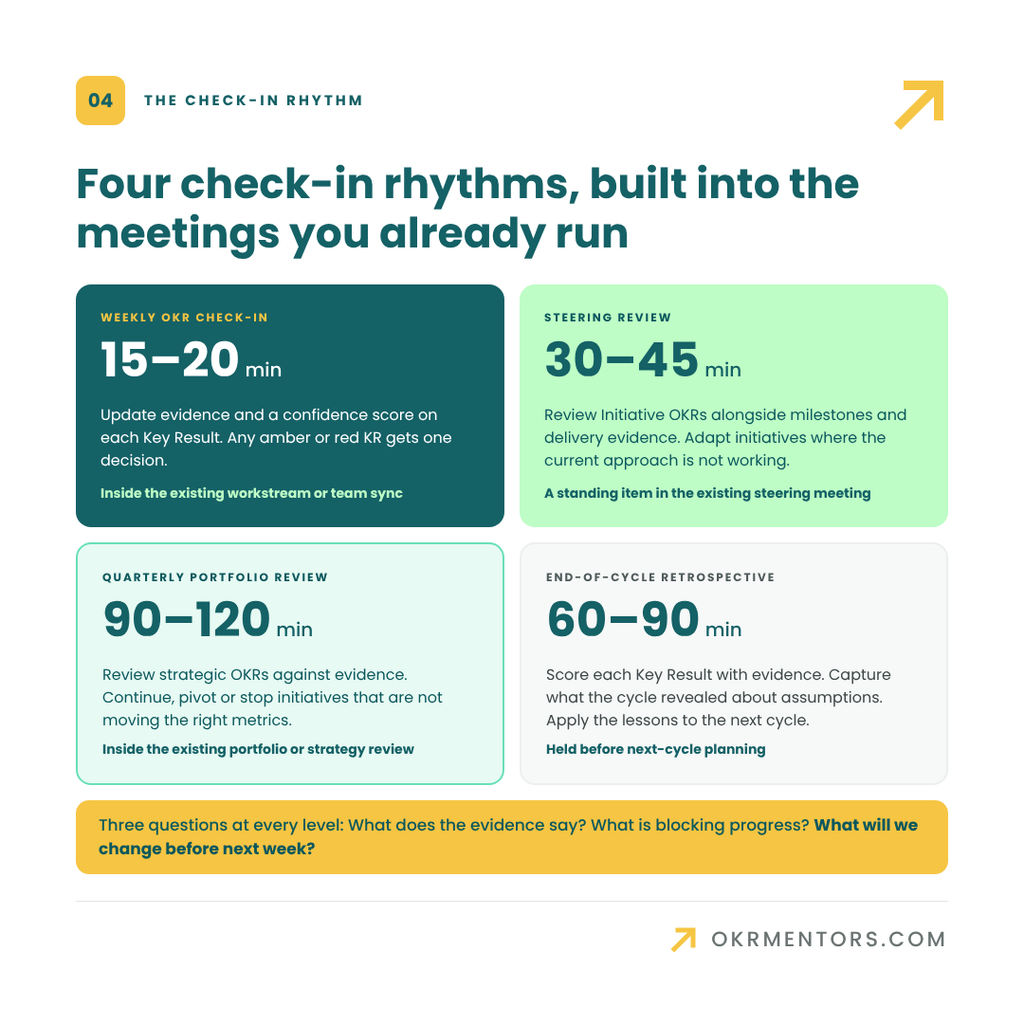
Alt text: The four OKR check-in rhythms and their lengths: weekly check-in 15 to 20 minutes, steering review 30 to 45 minutes, quarterly portfolio review 90 to 120 minutes, end-of-cycle retrospective 60 to 90 minutes.
The three questions that drive an effective check-in are the same at every level:
- What does the evidence say about each Key Result today?
- What is preventing progress and do you need help?
- What will we change before next week?
The third question is the one many program check-ins skip. A conversation that updates the numbers without producing a decision is reporting, not a check-in.
Connecting delivery cadence to OKR cadence
For programs running Agile delivery methods, including scaled frameworks such as SAFe, the cadence integration is practical. Sprint planning sessions should explicitly reference the Initiative OKRs the sprint is supporting. Sprint reviews should assess what the sprint delivered and whether it moved the Key Results. The OKR check-in is not a substitute for the sprint review; it is the outcome lens that makes the sprint review strategically relevant.
For predictive or Waterfall projects, the same principle applies. Use existing status reviews, phase reviews, and stage gates to consider outcome evidence alongside scope, schedule, cost, and risk. The OKR cadence does not need to mirror a sprint cadence; it needs to be frequent enough to surface outcome drift while there is still time to adapt.
Change management: deploying OKRs as a cultural shift
OKR deployment is not a tool rollout. The OKR Mentors OKR Professional Coach (OKRPC) curriculum states it directly: OKR is a cultural transformation. Every initiative that creates organizational change must address three areas together: people, process, and tooling. Ignoring any one of them creates predictable failure modes.
People, process, and tooling
People: concerns who is involved, what roles they play, what skills they need, and how they will acquire those skills. In a transformation context, this means training by role: Practitioners, Leaders, Champions, and Professional Coaches each need different depth, and building a communication plan that explains to each stakeholder group what OKRs are, why they are being introduced, and what will change.
Process: concerns which processes for priority, planning, and performance will change, and how OKRs will integrate into current meetings and rituals. OKRs fail when they run as a parallel universe to the planning, prioritization, and performance conversations already in place. They need to feed and inform those processes, not duplicate them.
Tooling: involves what tools are currently used, how OKRs can integrate with the existing stack, and what new tools may be needed. For transformation work, the single-source-of-truth question is critical: where will OKRs be created, updated, and reviewed, and is that tool visible to everyone working on them?
The six change management conditions
Organization-wide OKR deployment also requires visible executive sponsorship. Leaders need to use the same OKR language and cadence in their own governance. If senior decision forums continue to operate entirely through legacy measures and plans, adoption lower in the organization is unlikely to become sustainable.
The Lippitt-Knoster model, used in the OKR Mentors OKRPC certification program, identifies six conditions that must be present together for any transformation to succeed. When one is missing, predictable problems appear.
| Missing Condition | Symptom | Response |
| Vision (direction) | Confusion: people do not know what OKRs are for or where the program is going. | Communicate clearly and repeatedly: why OKRs, what cultural change is intended, and what it looks like when it is working well. |
| Consensus (buy-in) | Sabotage: active or passive resistance, ironic compliance, or hidden opposition. | Involve people early. Allow teams to shape their own OKRs. Make transparency safe by separating OKR progress from performance management. |
| Skills (capability) | Anxiety: people feel overwhelmed or doubt their ability to do this well. | Provide training and coaching. Normalize imperfect OKRs in the first cycles. Treat the first quarter as a learning exercise. |
| Incentives (motivation) | Resistance: people see no personal benefit and do not engage genuinely. | Name the individual benefits: clarity, fewer competing demands, visible contribution. Do not link OKRs to financial bonuses or performance ratings. |
| Resources (means) | Frustration: people want to engage but cannot because they have no time or capacity. | Protect time for OKR work. Starting OKRs may reduce total workload by forcing prioritization; make this case explicitly. |
| Action plan (structure) | Treadmill: lots of activity, no real progress toward goals. | Create a clear implementation plan. Assign roles. Connect Key Results to daily activities explicitly. Review the plan regularly. |
Project-driven transformation environments face a specific cultural challenge
Project managers in transformation environments often operate under a culture that rewards delivery over outcomes. Completing the deliverable is what gets noticed. Raising a red Key Result early, admitting that the current approach is not working, can feel like reporting failure.
Shifting toward an outcome-driven, learning organization does not happen overnight; it requires time, patience, and iterative practice. In the early cycles of an OKR deployment, the most important cultural signal in a transformation program is how leadership responds when a team flags a Key Result as amber or red honestly. If the response is support and a genuine conversation about what to change, trust compounds. If the response is scrutiny of the team’s competence, other teams quickly learn to stay green. Protect the first team that goes red honestly.
The cultural shift becomes visible when teams can surface an amber or red Key Result early without defensiveness, governance responds by asking what needs to change or what support is required, and decisions follow the evidence rather than the sunk cost of the original plan.
Common mistakes transformation leads and project managers make
Most OKR mistakes in transformation and project-driven environments are not technical. They are cultural and structural. They reflect the habits and incentive structures already embedded in project-driven organizations.
| Mistake | What it looks like | How to fix it |
| Key Results are milestones | KRs list deliverables: ‘Complete phase 2 by end of Q2,’ ‘Deploy the new platform,’ ‘Finish the change management training.’ | Rewrite as outcome evidence. Ask: what do you want to change if this milestone is hit? That change is the KR. |
| OKRs run alongside governance, not inside it | OKRs are updated in a separate tracker. Governance meetings continue to use the same delivery status reports. Two parallel systems, neither of which has full commitment. | Integrate OKRs into existing steering packs and governance templates. OKRs should be the outcome lens on the delivery conversation, not a separate exercise. |
| No explicit bridge between strategic outcomes and delivery | Leadership sets high-level transformation OKRs while delivery teams continue managing to delivery milestones with no explicit line of sight to the outcomes above them | Create an explicit connection between strategic outcomes and delivery. Use Initiative OKRs where an intermediate outcome layer adds value, or another clear linkage where it does not. |
| Too many OKRs | Every workstream, project, and sub-team gets its own OKR set. The portfolio has 40 OKRs. Nothing is prioritized. Everything is tracked and nothing changes. | Cut to the essential few. If Level 1 grows beyond a small set of priorities, revisit whether the transformation has made sufficiently clear strategic choices. The appropriate number depends on context, but focus should remain the design principle. |
| OKRs as reporting, not decision tools | Check-ins update the numbers. Confidence scores stay green. The meeting ends. No decisions are made. The same status continues next week. | Build the decision muscle explicitly. Every check-in should close with: if any KR is amber or red, what changes before next week? If that question is never asked, the check-in is reporting theater. |
| Linking OKR scores to program or individual performance ratings | OKR scores appear in program health reports as a proxy for team performance. Teams sandbag targets. Transparency drops. | Separate OKRs entirely from performance management. OKR scores measure the quality of goal-setting and learning, not personal performance. When they are linked to performance, teams set safe targets and learn nothing. |
| Skipping the diagnostic | OKRs are introduced without understanding the execution challenge they are being used to solve. After two cycles, the practice stalls because it was designed for the wrong problem. | Run the Strategy Execution Quick Check, a structured assessment of strategy execution maturity, before launch. Identify the primary execution challenge OKRs should address. If you cannot name it in one sentence, the design work is not done. |
| Treating outcome accountability as full control | Project managers are treated as solely responsible for Key Results affected by customer behavior, dependencies, market conditions, or other teams. A red outcome is automatically interpreted as delivery failure. | Separate accountability from control. Make dependencies explicit, use shared OKRs where appropriate, track leading indicators the team can influence, and use amber/red reviews to trigger adaptation, support, or escalation rather than blame. |
Practical steps and templates
Transformation OKR quick-start checklist
Use this checklist before the cycle starts and again in week two to catch drift early. For a general version, see our step-by-step OKR checklist.
Before launch
- Run the Strategy Execution Quick Check. Identify the primary strategy execution challenge OKRs will address through the transformation.
- Confirm leadership is ready to treat OKR deployment as a change program, not a framework implementation.
- Name the OKR Lead (typically in the Transformation Office or PMO), the OKR Sponsor, and the first cohort of OKR Champions
- Design the OKR architecture: which levels get OKRs, how many, what cycle length, and how Initiative OKRs connect to strategic OKRs.
- Decide the single source of truth for OKR content and ensure it is visible to everyone who needs to contribute to or govern the OKRs.
Before the first cycle
- Leadership has run an OKR Definition workshop and produced Level 1 strategic OKRs at the agreed strategic level.
- Where an intermediate outcome layer is useful, relevant programs, projects, or workstreams have produced Initiative OKRs that connect to Level 1.
- Each Key Result has a named data source and a person responsible for keeping the evidence current; accountability for the OKR remains with the Objective owner and the team.
- At least one Key Result per Initiative OKR is a leading indicator visible before the final two weeks of the cycle.
- Activities and projects are listed as initiatives below the OKR, not inside it.
- The check-in cadence is in the calendar before the cycle starts.
During the cycle
- Weekly OKR check-ins embedded in existing team or workstream meetings.
- Each check-in closes with a decision if any Key Result is amber or red.
- Initiative OKR review integrated into the appropriate steering cadence, with Level 1 strategic OKRs reviewed through the portfolio governance cycle.
- OKR scores are not connected to any performance management or appraisal process.
End of the cycle
- Score each Key Result using the available evidence.
- Run the retrospective before next-cycle planning.
- Capture what the cycle revealed about assumptions, dependencies, and the effectiveness of current initiatives.
- Decide what should continue, change, or stop.
- Apply those lessons to the next cycle and relevant portfolio decisions.
OKR examples: transformation programs
Example 1: Digital transformation, customer experience
Level 1, Strategic OKR
Objective: Make digital channels the preferred way our customers interact with us.
- KR 1: Increase digital channel adoption from 34% to 65% of all customer interactions by year end.
- KR 2: Reduce average resolution time through digital channels from 3.1 days to 6 hours by year end.
- KR 3: Achieve a digital NPS of 48 or above by year end.
Level 2, Initiative OKR (Self-service portal workstream, Q3)
Objective: Enable customers to resolve common issues independently and effortlessly.
- KR 1: Increase self-service resolution rate from 12% to 38% of support queries by end of Q3.
- KR 2: Reduce portal drop-off rate at authentication step from 61% to 22% by end of Q3.
Initiatives (separate from the OKR): redesign the authentication flow, build the knowledge base search, migrate the top-20 query types to self-serve.
Example 2: Operating model transformation, cross-functional alignment
Level 1, Strategic OKR
Objective: Build a decision-making process that moves at the speed the business needs.
- KR 1: Reduce median cross-functional decision cycle time from 14 days to 5 days by Q4.
- KR 2: Reduce escalations to executive level by 40% by Q4.
- KR 3: Achieve an organizational clarity score of 7.8 or above in the mid-year organizational clarity survey1.
Level 2, Initiative OKR (Governance redesign workstream, Q2)
Objective: Enable frontline teams to make fast decisions within clear boundaries.
- KR 1: Reduce median decision cycle time across the pilot decision types from 14 days to 8 days by end of Q2.
- KR 2: At least 80% of decisions within the pilot workstreams are resolved at the designated decision level without executive escalation by end of Q2.
Initiatives: map current decision flows, design new RACI, run design sprints with pilot workstreams.
- SEM360™ is one example of a diagnostic that can baseline and track strategy execution dimensions such as organizational clarity.
Example 3: Portfolio governance transformation, business and technology alignment
Level 1, Strategic OKR
Objective: Make business value the organizing principle for technology investment and delivery.
- KR 1: Increase the percentage of active initiatives with linked Key Results from 20% to 90% by Q3.
- KR 2: Reduce redundant initiatives identified in portfolio review from current level by 30% by Q3.
- KR 3: Achieve quarterly portfolio decision cycle based on outcome evidence (not only schedule) by Q4.
Level 2, Initiative OKR (PMO governance workstream, Q2)
Objective: Portfolio governance actively shifts funding and resources toward proven strategic value.
- KR 1: At least 90% of steering decisions on strategic initiatives explicitly use outcome evidence alongside delivery status by end of Q2.
- KR 2: 100% of initiatives that remain amber or red across two consecutive reviews receive a documented continue, adapt, pivot, pause, or stop decision by end of Q2.
Initiatives: redesign steering pack template, deliver OKR training program, update portfolio governance charter.
Weekly OKR check-in template for transformation programs
Weekly OKR Check-In (15-20 minutes)
For each Key Result:
- Current value vs. target value
- Confidence: Green / Amber / Red
- What changed since last check-in and why
- What is blocking progress (if anything)
Close with:
- If any KR is Amber or Red: one decision before the meeting ends. A change in initiative, a trade-off, or a specific ask for help.
- Any cross-team dependencies or escalations needed?
- Any program-level blockers to surface to the OKR Lead or PMO?
Note: this check-in is not a delivery status update. It focuses on whether the program is producing the outcomes it committed to, and what decisions need to be made when it is not.
FAQ: OKRs for transformation and project management
An OKR in project management is a goal for one cycle, written as one Objective and two to four Key Results, that states the outcome a project, program or workstream is meant to create. Deliverables and milestones sit underneath it as initiatives. The Key Results show whether those deliverables are producing the intended change.
Deliverables and milestones tell you whether planned work was completed. Benefits and value measures can tell you whether that work produced the intended value. OKRs complement those practices by making a focused set of outcomes explicit for the current cycle and creating a regular rhythm for reviewing whether they are moving.
Agile helps teams plan, deliver, learn, and adapt work iteratively. OKRs provide a cycle-level outcome focus that can guide which work matters most and whether delivery is producing the intended change.
The practical connection: OKRs set the quarterly outcome the Agile team is moving toward; sprints are the mechanism for delivering the initiatives that support those OKRs. Sprint goals are not OKRs. They are the delivery commitments within a sprint, in service of a Key Result. Sprint reviews should assess what was delivered and whether it moved the Key Result; that is the outcome lens that makes the sprint review strategically relevant.
OKRs provide the strategic outcome layer above Agile delivery, connecting product development choices to the outcomes the organization is trying to advance.
Ownership should sit where accountability for the relevant outcome sits. Strategic transformation OKRs are typically owned by an executive sponsor or transformation leader. Initiative OKRs can be owned by a workstream, program, project, or product lead where that person is accountable for the outcomes. Key Result ownership should sit with the person best positioned to maintain the metric and coordinate progress against it.
This is the most common discomfort in project-driven cultures, and it is worth sitting with rather than designed around.
A Key Result that measures a real outcome will often depend on factors beyond the team’s direct control: user behavior, market conditions, other teams’ work. That is not a problem with the OKR. It is a signal to identify the dependencies early, create shared OKRs where two teams are jointly accountable for an outcome, and use the leading indicators, the things the team does control, to see drift before it becomes a miss.
Where a team is creating an organization-wide capability or new way of working, its accountability may extend beyond development to rollout and adoption. Even then, ultimate behavior change will usually depend on other teams and leaders, so those dependencies should remain explicit.
OKR check-ins should replace or integrate into existing meetings, not sit alongside them. The weekly workstream meeting becomes the OKR check-in. The monthly steering update incorporates the Initiative OKR review. The quarterly portfolio review integrates the strategic OKR assessment. What changes is the agenda structure and the quality of the conversation, not the meeting count. A check-in that produces a decision in 15 minutes is more valuable than a two-hour governance meeting that concludes with no change.
Transformation can be continuous even though the programs, projects, and workstreams through which it is delivered are time-bound.
Strategic OKRs can provide a multi-quarter or annual outcome horizon that is reviewed and adapted periodically, while Initiative OKRs operate on shorter cycles where useful. This keeps the broader transformation direction visible while allowing delivery vehicles, priorities, and approaches to change as evidence and context evolve.
The organization is using OKRs well when:
1. A workstream lead changes or stops an initiative mid-cycle because the Key Result evidence shows the current approach is not working;
2. Someone says “that is not in our OKRs this cycle” when a new request arrives and holds the line;
3. A team goes amber in week three and governance responds with “what do you need?” rather than “why are you behind?”; and
4. The retrospective visibly changes how the next cycle is structured.
Those behaviors signal that OKRs have become an operating logic, not an administrative exercise.
In most project-driven transformation contexts, start at the workstream or team level. Individual OKRs in project-driven contexts almost always drift toward activity tracking or performance management, because project managers already have individual delivery accountabilities. Workstream-level OKRs build shared accountability for outcomes and avoid the performance management entanglement that individual OKRs invite. Introduce individual OKRs only in mature implementations where the team level is working well, and only where they are clearly separated from any process that affects performance appraisal.
The first cycle should be treated as a learning cycle. Teams can improve focus and the quality of conversations quickly, but embedding a reliable decision cadence and new behaviors usually takes multiple cycles. The better measure is not elapsed time alone, but whether check-ins are producing decisions, teams can surface red Key Results safely, and lessons from one cycle visibly change the next.
Where to go from here
This deep dive covers OKRs as applied across transformation portfolios, programs, projects, and project-driven organizations. If you are ready to put this operating model into practice, the resources below support different roles and stages of an OKR deployment.
| Resource | What it covers | Best for |
| OKR Practitioner Certification (OKRP) | A practical introduction to OKRs covering core concepts, writing strong Objectives and Key Results, and contributing effectively to team OKR practice. | Project team members and contributors who need a solid foundation in OKRs before the program rolls out. |
| OKR Leader Certification (OKRL) | A hands-on certification for managers and team leaders. Covers team-level OKR design, leadership principles, cycle and rituals, and integration into regular management practice. | Program managers and workstream leads who will run OKRs with their teams. |
| OKR Champion Certification (OKRC) | A practical certification for internal advocates and facilitators. Covers OKR rituals, cross-team alignment, workshop facilitation, and how to build sustainable OKR practice. | OKR Champions embedded in workstreams, or program leads taking on an internal enablement role. |
| OKR Professional Coach Certification (OKRPC) | An advanced certification for professionals deploying OKRs across organizations. Covers strategic OKR design, coaching, change management, and organizational rollout. | Transformation directors, heads of PMO, OKR Leads, and anyone responsible for deploying OKRs across a program or organization. |
| SEM360™ Diagnostic | A structured assessment of strategy execution maturity across the dimensions that drive results. Identifies where OKRs will have the most impact and benchmarks progress over time. | Transformation teams unsure where to start, or programs wanting to measure improvement in execution maturity across cycles. |
| OKR Blueprint™ Implementation Workshop | A facilitated session to design your OKR deployment strategy: levels, cycle length, phasing, roles, tooling, and integration with current processes. | Transformation programs ready to launch and needing a structured deployment plan before the first cycle. |
For OKR fundamentals, see the OKR Mentors Fundamentals Deep Dive.
For implementation mechanics, see How to Implement OKRs Successfully.
For how OKRs fit alongside the full landscape of strategy execution frameworks, see OKRs vs Other Frameworks.
OKR Mentors | OKR Mentors.com