

OKRs and Agile do different jobs in a product team. OKRs set the outcome the team must change this quarter, such as raising 7-day activation from 28 percent to 40 percent. Agile methods like Scrum, Kanban or SAFe run the sprints, experiments and releases meant to move it. The sprint review checks what shipped; the OKR check-in checks whether it moved the result.
Start here
Can OKRs actually connect strategy to Agile and Product delivery, or do they just add another layer teams have to update?
A team can hit every sprint goal for two straight quarters and still walk into a business review where the answer to “did this matter” is no. Velocity was healthy and the backlog moved, yet nothing the business needed actually changed. The delivery system worked; the goals feeding it were never tied to a measurable change, and closing that gap is exactly what OKRs are for.
Most organizations that introduce OKRs into a Product or Agile environment already have a delivery system that works, at least by its own measure. Sprints ship. Releases go out. Velocity is tracked. The problem is not that nothing gets delivered. The problem is that delivery and strategic intent drift apart without anyone deciding that should happen. Teams complete their sprints and still miss the outcome the business needed, because the sprint goals were never anchored to a measurable change in the first place.
OKRs are built to close exactly that gap, but only if two things are true. First, the organization has to be honest about how mature its Product and Agile practice actually is, because OKRs assume a level of team autonomy and value-thinking that immature teams do not yet have. Second, OKRs and Agile have to be given different jobs. OKRs are not a replacement for sprints, backlogs, or PI planning. They are the layer above delivery that defines what outcome the delivery work is supposed to produce.
This guide works through both conditions: how to tell whether your organization is ready, and how to interlock OKRs with the Agile cadence you already run once it is.
Most treatments of OKRs and Agile stop at the observation that the two solve different problems, and leave it there. That observation is necessary but not where rollouts actually fail. This guide goes three steps further: it names the specific maturity level at which OKRs should not be attempted at all, it maps quarterly and weekly cadences literally onto the Agile ceremonies teams already run rather than describing alignment in the abstract, and it treats the roadmap and governance layers, not the OKR-writing exercise itself, as the two places most rollouts quietly come apart.
As AI makes shipping faster and cheaper, the harder question moves upstream: deciding what is worth building at all. For most Product and Agile organizations, that makes a clear, outcome-based operating model a bigger constraint than delivery speed.
If you’re in a hurry
Jump to Product and Agile maturity for the maturity gate and the warning about introducing OKRs too early.
Jump to The cadence interlock for the cadence interlock table.
Jump to Practical steps and templates for practical templates.
Assumptions: the reader has working knowledge of OKR fundamentals, and the organization already runs some form of Agile delivery (Scrum, Kanban, SAFe, or a hybrid).
The strategy-to-delivery disconnect
Strategy and delivery drift apart for structural reasons, not because either side is doing a poor job. Two vantage points make the pattern visible: the technology and product leaders who own delivery and the product definition, and the PMO or Transformation Office that owns portfolio governance.
From a technology and product leadership view
Five recurring disconnects show up wherever business strategy and technology delivery are planned separately.
- Different planning horizons. Strategy is set annually with fixed budgets. Delivery teams plan in quarters and weeks, adjusting as they learn. Business leaders expect stability; engineers need flexibility, and the mismatch creates friction on both sides.
- Language barriers. Executives talk in customer outcomes and revenue impact. Delivery teams talk in velocity, requirements, and technical debt. The same words can describe different realities, and without translation the conversation stays misaligned even when everyone believes they agree.
- Budget rigidity. Annual funding locks in plans that go stale within months. Teams keep executing initiatives that no longer reflect strategic intent, simply because the money was already committed.
- Output focus. Success gets measured by features shipped and milestones hit, not by the outcome those features were meant to produce. This looks productive on paper while quietly leaving the underlying problem unsolved.
- Governance misfit. Portfolio reviews are built for predictability and control, not learning. Decision gates slow adjustments down instead of enabling them, so teams end up escalating for permission rather than escalating insight.
These disconnects reinforce each other. The more rigid the system, the less visibility leadership has into real outcomes, and delivery quietly becomes a compliance exercise.
From a PMO or Transformation Office view
The same gap looks different from the portfolio level, where it shows up as day-to-day friction rather than abstract misalignment. Not every organization hits all of these, or with the same intensity, but the pattern is common enough to name:
- Abstraction gap. A strategic priority like “become digital-first” has to be translated into concrete delivery steps. When that translation is skipped, progress looks slow even though teams are working hard, because strategy never became executable.
- Disconnected cadences. Annual planning funds one priority; by the next quarter, market conditions favor a different one. Teams keep delivering the original priority because funding, commitments, and roadmaps still point there.
- Rigid budgets. Once a business case is approved, it is rarely revisited. Programs continue past the point where a simpler or different solution would serve better, because stopping is politically and financially uncomfortable.
- Fragmented reporting. Every function tracks its own metrics: delivery velocity, spend against plan, campaign performance. Each looks healthy in isolation while the outcomes that matter, like customer experience or revenue, stay flat.
- Superficial governance. Steering committees review timelines, not value delivered. A program can stay green on status while adoption is low and the intended benefit never materializes.
- Portfolio overload. Even with aligned cadences, too many concurrent initiatives split attention and multiply dependencies. Alignment without focus produces synchronized busyness rather than results.
In Strategy Execution Maturity 360™ (SEM360™) terms, this disconnect weakens execution across several dimensions at once, not just one. Misaligned cadence obscures strategic intent (Align), locks teams into conflicting priorities (Execute), shortens the organization’s learning cycles (Improve), and centralizes decisions in ways that undercut ownership at the team level (Empower). That is what makes the gap worth treating as a strategy execution problem, not a Product or Agile tooling problem.
Both views describe the same underlying problem: strategy and delivery are on different clocks, speaking different languages, and being judged by different definitions of success. Closing that gap is what the rest of this guide is about.
A related disconnect runs horizontally rather than vertically: Product and Agile teams that plan well internally still work in silos across each other, discovering dependencies late instead of managing them deliberately. OKRs help here too, a shared definition of success gives otherwise siloed teams something to rally around, which is part of why OKRs pair naturally with value stream-based ways of organizing work.
How do OKRs and Agile work together?
Before drawing the distinction, it’s worth naming what OKRs and Agile actually share: both reject fixed, upfront plans in favor of short cycles and real feedback; both prioritize learning over following a script; and both assume the people closest to the work should have real input into how it happens. The difference isn’t philosophy, it’s which job each one is built to do.
Most “OKRs vs. Agile methods” debates start from a false premise: that the two are competing for the same job. They are not. Agile answers how a team delivers value reliably and adapts to feedback. OKRs bring their own version of agility to the strategic layer, an operating cadence that lets priorities adapt quarter to quarter, without which team-level work quietly disconnects from the organization’s big bets and portfolio initiatives. OKRs answer what outcome the organization needs to achieve this cycle. A team can run ten clean sprints and still miss its OKR if the work delivered did not move the right Key Result. An organization can set a strong OKR and still fail to execute it if delivery has no structured cadence.
It helps to place both inside a simple three-layer job split, alongside the ongoing metrics that monitor business health:
| Layer | Job | Typical tools | Question answered |
| Signals | Monitor ongoing business health | KPIs, North Star Metric, dashboards | What is happening, and is it healthy? |
| Change | Define time-bound outcome targets | OKRs | What must improve this cycle, by how much, and by when? |
| Execution | Build delivery flow and follow-through | Agile (Scrum, Kanban, SAFe), 4DX | How do we deliver and maintain progress week to week? |
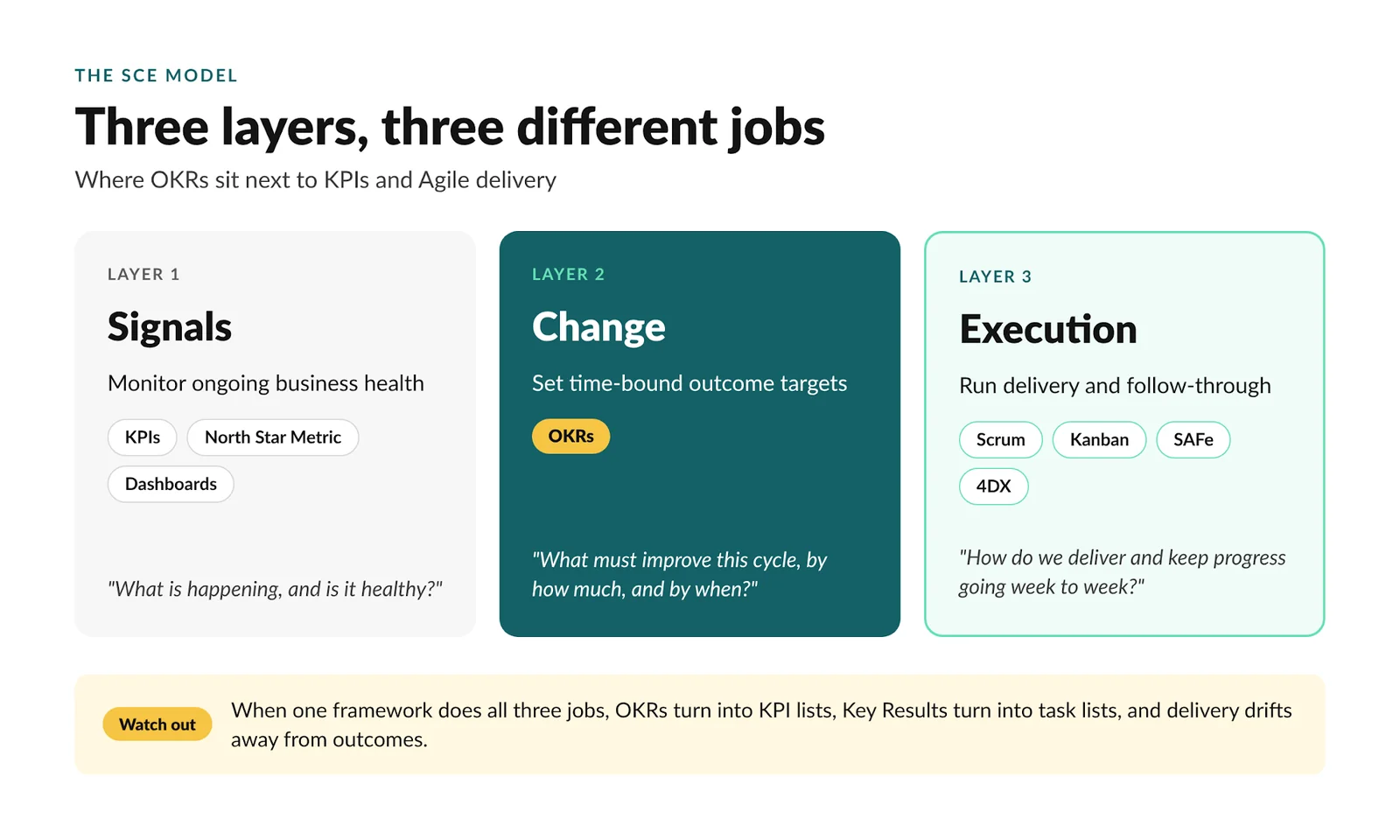
When one framework is forced to do all three jobs, the results are predictable: OKRs turn into KPI lists, Key Results turn into task lists, and delivery quietly disconnects from outcomes. Keeping each layer doing its own job is what makes the combination work.
How Agile and OKRs differ in practice
| Feature | Agile (e.g., Scrum) | OKRs |
| Primary question | How do we deliver value reliably? | What outcomes must we achieve? |
| Unit of focus | Work items and deliverables | Measurable outcomes |
| Cadence | One- to two-week sprints | Quarterly cycles (commonly) |
| Success measure | Features shipped, velocity | Key Result progress |
| Failure mode | OKRs become the backlog (“deliver X”); velocity mistaken for outcome progress | Outcome goals set with no delivery discipline behind them; check-ins become status theater |
Pairing rules
- Do: use OKRs to define quarterly outcomes. Use Agile to run initiatives, experiments, and the learning loop that moves those outcomes.
- Don’t: turn OKRs into a backlog (“deliver X”), and don’t turn sprint goals into strategy.
- Anti-pattern to watch for: using sprint velocity or burndown as evidence of Key Result progress. Activity signals are not outcome evidence.
A Key Result written as “launch onboarding v3” is a task wearing an outcome’s clothing. A stronger version reads as a measurable shift, for example moving activation from 28 percent to 40 percent, with the Agile backlog holding the epics and experiments the team believes will move it. The backlog stays flexible as the team learns. The Key Result stays stable enough to hold the quarter’s focus.
Product OKR examples for Agile teams
Each example below shows an Objective, three Key Results, and the kind of bets an Agile team would put in its backlog to move them. The baselines are illustrative, so replace them with your own numbers. Every Key Result measures a change in customer or system behavior; the features sit in the backlog column as bets.
| Team | Objective | Key Results | Example backlog bets |
| Onboarding | New customers get a real result in their first week | • Raise 7-day activation from 28 percent to 40 percent • Cut median time to first report from 3 days to 1 • Lift trial-to-paid conversion from 9 percent to 12 percent | Guided first report in-session; sample data at signup |
| Platform / API | Partners can build on us without our help | • Raise integrations completed without a support ticket from 45 percent to 70 percent • Cut time from API key to first successful call from 2 days to 2 hours • Lift developer docs rating from 3.4 to 4.2 out of 5 | Interactive API explorer; SDKs for the two most-used languages |
| Reliability | Customers can rely on us at peak times | • Raise peak-hour availability from 99.5 percent to 99.9 percent • Reduce P1 incidents from 6 to 2 a quarter • Cut mean time to recovery from 90 to 30 minutes | Load testing in the delivery pipeline; automated rollback |
| Growth | Customers who get value choose to grow with us | • Raise expansion revenue share from 12 percent to 18 percent • Lift upgrade rate for teams of 10+ seats from 4 percent to 7 percent • Keep monthly logo churn at or below 2 percent | Usage-based upgrade prompts; admin seat dashboard |
| Mobile | Mobile becomes a place where work gets done | • Raise mobile weekly active users from 18 percent to 30 percent of all weekly active users • Lift tasks completed on mobile from 6 percent to 15 percent • Raise app store rating from 3.9 to 4.5 | Offline mode; quick-capture widget |
| Engineering enablement | Teams learn from customers faster | • Cut lead time from commit to production from 9 days to 2 • Raise releases shipped as measured experiments from 20 percent to 60 percent • Lower change failure rate from 18 percent to 10 percent | Feature flags; trunk-based development |
One-slide model
Signals, Change, Execution: OKRs own the Change layer only. Signals (KPIs, North Star) monitor health; Execution (Agile, 4DX) delivers week to week.
Maturity gates the rollout: Non-Agile and Focusing stage organizations should not run OKRs yet. Delivering stage supports a simplified version. Optimizing stage supports full OKRs.
Cadence interlock: annual OKR to roadmap, quarterly OKR to PI planning, OKR check-in to sprint review and retrospective.
Roadmap shift: feature list becomes outcome bets, each tied to a Key Result and a stated hypothesis.
Governance shift: red-amber-green (RAG) status reporting becomes evidence review, ending in continue, pivot, or stop.
Product and Agile maturity: the gate before OKRs
Introducing OKRs into an organization that has not yet developed baseline Product and Agile maturity is one of the most common causes of OKR programs failing quietly. OKRs assume that teams already think in terms of value and outcomes rather than tasks and schedules. Where that assumption does not hold, OKRs add a layer of confusion rather than clarity.
A useful way to map this is by drawing a parallel to the Agile Fluency Model (Diana Larsen and James Shore), applied here as a Product maturity lens rather than a full treatment of the model itself. For the complete model, refer to Larsen and Shore’s own work directly.
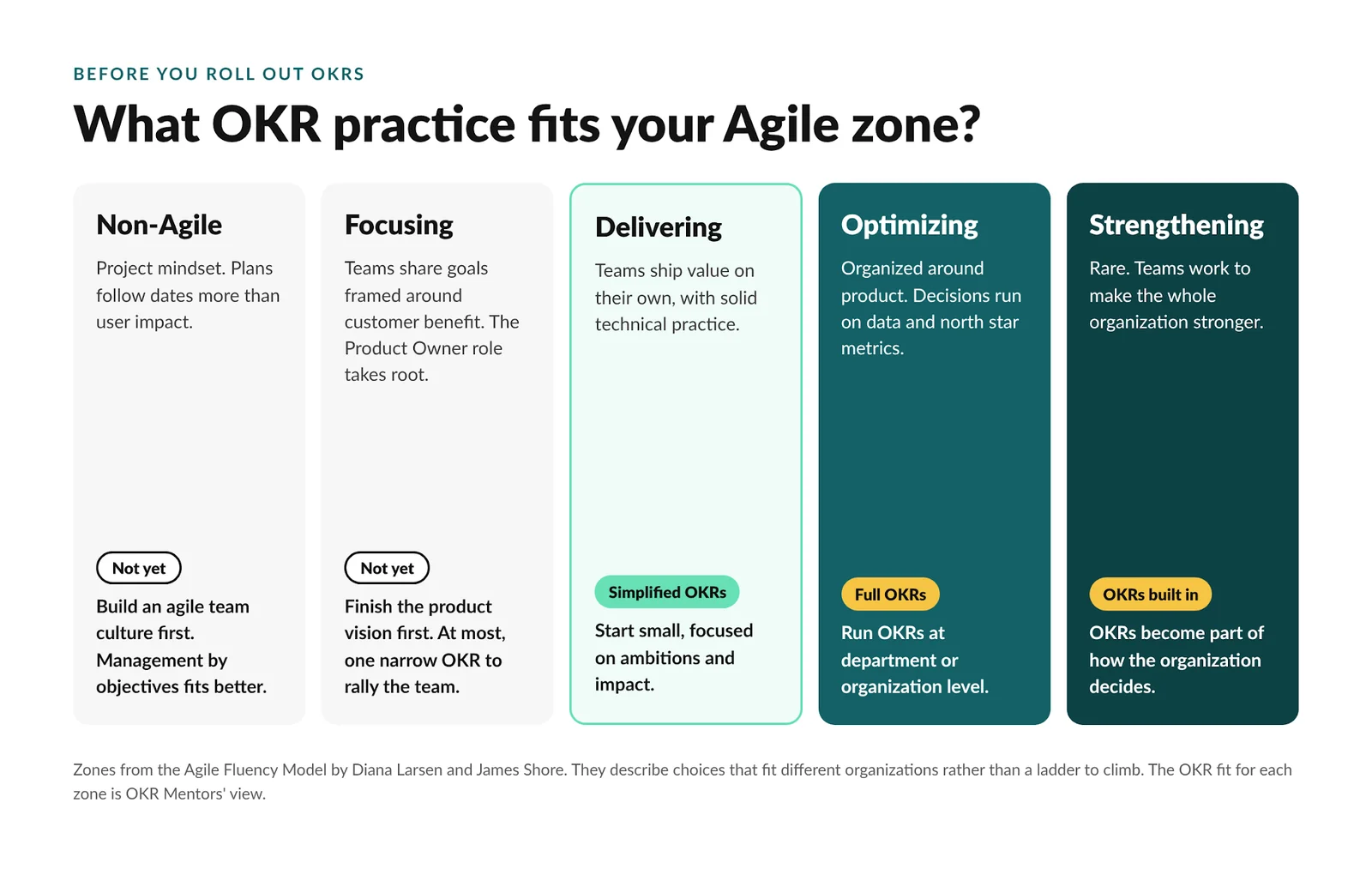
One caution from the model’s authors: the zones are not a maturity ladder where higher is always better. Each is a valid choice that brings its own benefits. Our point is narrower. OKRs depend on specific capabilities, chiefly outcome thinking and autonomous delivery, so the zone a team is fluent in tells you what kind of OKR practice it can sustain.
Agile Fluency zones and the OKR practice each one supports
- Non-Agile. Teams focus on technical layers and work individually, with limited formal alignment between members and no clear visibility into outcomes. The mindset is project-oriented, not product-oriented; plans are driven by arbitrary dates rather than user impact. At this stage, OKRs are the wrong starting point. The organization needs to build an agile team culture first. Management by objectives (MBO), with SMART goals at team level, fits better here, because implementing OKRs at this stage is antithetical to how the organization actually manages work.
- Focusing. This stage is primarily a mindset shift: teams start setting common goals framed around the benefit to sponsors, customers, and users rather than activity. Backlog prioritization by value, retrospectives, and the Product Owner role start to take root. OKRs are still premature here. The priority is establishing a clear, shared Product vision before introducing a goal framework on top of it. Some teams introduce a very narrow OKR, one objective, one or two Key Results, specifically to rally everyone behind the definition of success for an emerging Product vision. Most Focusing-stage organizations still get more value from finishing the vision work first.
- Delivering. Teams can now ship value autonomously and with technical discipline (continuous integration and delivery, refactoring, pairing). Product culture starts asking why, not just how, though delivery still dominates attention. This is where a simplified OKR approach, focused on ambitions and impacts rather than the full framework, can reasonably be introduced as a first step.
- Optimizing. The organization has reorganized around Product at scale: value is delivered when it makes sense for the market, not simply when a team decides to ship. Data-driven decision-making and north star metrics are established. This is where full OKR implementation, run at the department or organization’s strategic level, should work well, because the maturity indicators needed to sustain it are already in place.
- Strengthening. The stage Larsen and Shore describe as the horizon of Agile practice, rare in most organizations. In OKR Mentors’ view, organizations that reach it use OKRs as part of how they think and decide, up to executive committee level.
The practical implication: assess Product and Agile maturity honestly before proposing an OKR rollout. An organization at the Non-Agile or early Focusing stage that adopts OKRs will not get a strategy execution problem solved. It will get a new vocabulary layered on top of an unchanged way of working.
Strong vs. weak: what a maturity mismatch looks like in practice
Weak pattern (anonymized internal case example)
A large enterprise technology organization, several hundred employees across the affected division, introduced OKRs at three cascading levels: company, product, and team. The result was more than ninety OKRs per quarter across the organization, too many to meaningfully track, align, or discuss. Key Results were frequently unquantified and often described how a goal should be achieved rather than what success looked like, effectively functioning as initiatives rather than outcome measures. Teams returned to working in silos, and the OKR structure produced volume without alignment.
Strong pattern (same organization, later iteration)
The organization removed the team-level tier entirely and kept OKRs only at the product level, set quarterly. To populate them, it ran a collaborative objective-setting process that pulled in representatives from every relevant function (sales, marketing, product, engineering, user research, support) rather than cascading objectives down from the top. Cross-functional “OKR squads” formed around each objective, assembled dynamically each cycle based on the goal rather than fixed reporting lines. This reduced OKR volume dramatically and reconnected the framework to genuine cross-team alignment.
The lesson generalizes beyond this example: more OKR structure is not more alignment. A flatter, well-facilitated cadence at the right organizational level consistently outperforms a deep cascade that no one can hold in their head.
Sequencing maturity before OKRs: the TBC Bank example
TBC Bank’s OKR rollout began only after a multi-year Agile transformation, built on SAFe from 2017, had already scaled practices across its technology function through a dedicated Agile transformation office, including tribe- and squad-level structures. Only once that foundation existed did the organization introduce OKRs, piloting first at the tribe level before scaling company-wide. Leadership framed the underlying issues, before OKRs were introduced, as an absence of unified strategy, misaligned effort, and an output-over-outcome focus, precisely the profile of a Delivering-stage organization ready for a simplified OKR approach rather than a full rollout. The full story is in our TBC Bank case study.
The cadence interlock
Even a Product/Agile-mature organization will see OKRs drift from delivery if the cadences involved are not deliberately interlocked. Strategy, OKRs, and Agile delivery each run at a different natural rhythm, and without an explicit mapping between them, each rhythm quietly reverts to running on its own.
| Timeframe | OKR cadence | Agile cadence |
| Year | Annual OKR (strategic) | Roadmap |
| Quarter | Quarterly OKR: definition and review | Program Increment (PI) planning or release plan |
| Fortnight / week | OKR check-in | Sprint plan, sprint review, sprint retrospective |
| Day | – | Daily stand-up |
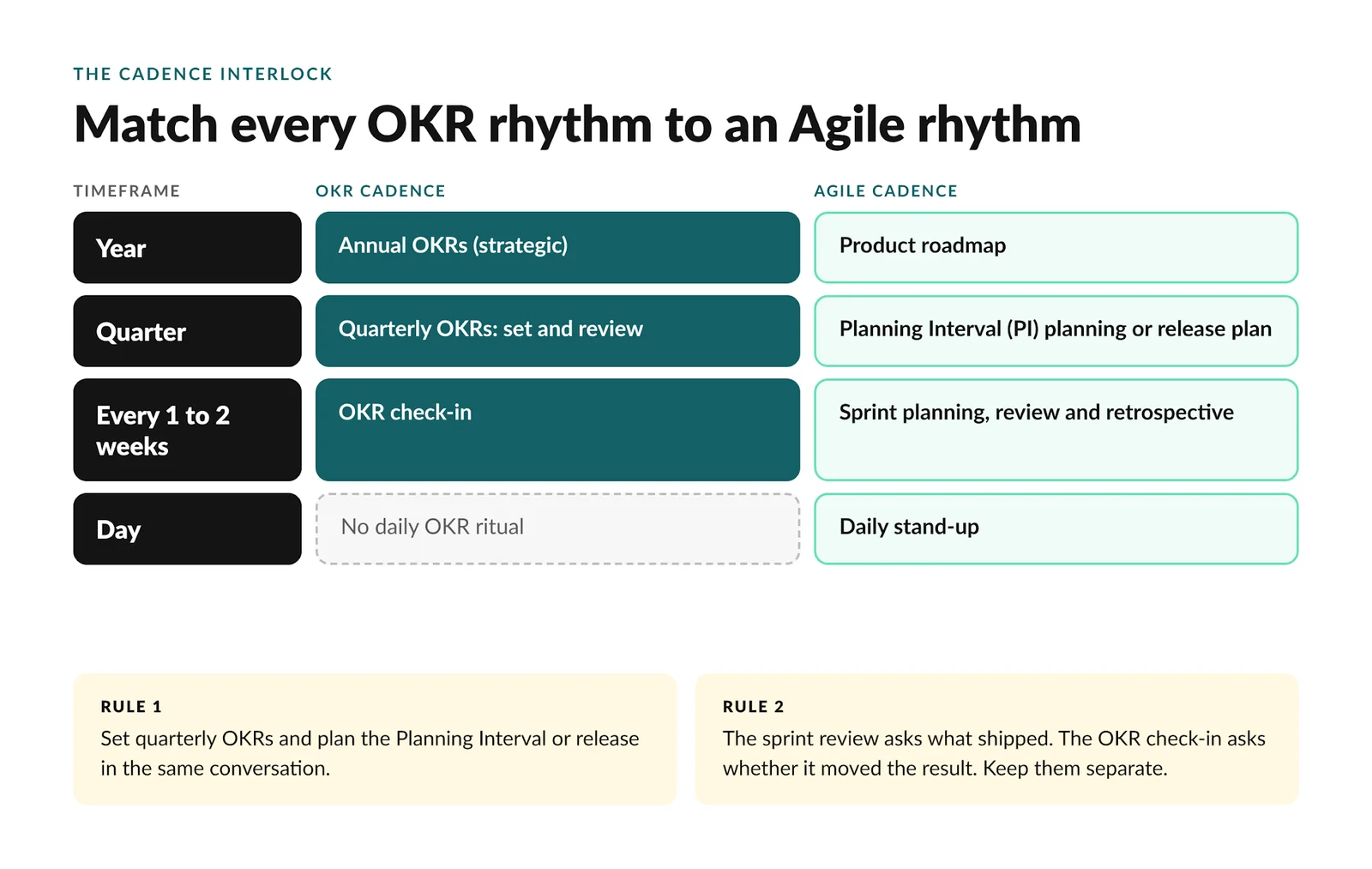
This mapping is a starting point, not a fixed prescription. Organizations running SAFe, Scrum, Kanban, or a hybrid will need to adapt the specific ceremony names, and the right level of interlock depends on team size and delivery model. Two principles hold regardless of the specific Agile flavor in use:
- Quarterly OKRs and Program Increment (PI) planning or release plan should be the same conversation, not two separate ones. If an organization runs SAFe, OKRs are best used to frame the PI’s themes, with PI Objectives written to mirror Key Results rather than restating a feature list.
- The OKR check-in and the sprint review or retrospective should ask different questions even when they happen in the same week. The sprint review asks what shipped. The OKR check-in asks whether what shipped is moving the outcome. Collapsing the two into one conversation is how sprint velocity ends up mistaken for Key Result progress.
Cadence interlock in practice
Worldline, a global payments company, aligned OKRs across its Merchant Services product and technology group of more than 2,000 people by using the same tool for both OKRs and roadmap or backlog management, so that overarching product-level OKRs served as a visible reference point for individual product lines to align their own objectives against. Everyone could see everyone else’s OKRs, which reinforced the cadence interlock by making cross-team dependencies visible rather than something discovered after the fact. The full story is in our Worldline case study.
OKRs and Scrum
Scrum already has a goal hierarchy: the Product Goal describes the future state of the product, and each Sprint Goal is a step toward it. OKRs sit alongside that hierarchy. The quarter’s Objective frames the Product Goal, the Key Results show whether the Product Goal is getting closer, and each Sprint Goal becomes a bet the team places to move a Key Result.
| Scrum element | How it links to OKRs | Question it answers |
| Product Goal | Framed by the quarter’s Objective, often shared with other teams | Where is this product heading this quarter? |
| Key Result | Measures progress toward the Product Goal | How will we know it is working? |
| Sprint Goal | One bet expected to move a Key Result | What will we try in the next sprint? |
| Sprint Review | Shows what shipped | Did we build what we planned? |
| OKR check-in | Shows whether the Key Result moved | Is what we shipped changing the result? |
OKRs in SAFe
SAFe 6.0 renamed the Program Increment to the Planning Interval, so use that term with SAFe readers. At portfolio level, SAFe suggests expressing Strategic Themes as OKRs. Below that, PI Objectives work best when they read like Key Results (“raise checkout completion from 61 percent to 68 percent”) rather than a restated feature list (“deliver the new checkout”). That makes Planning Interval planning the natural moment to set and review quarterly OKRs. TBC Bank, which has run SAFe since 2017, piloted OKRs at tribe level before rolling them out across the bank.
OKRs in Kanban teams
Kanban teams have no sprints, so attach the OKR check-in to the replenishment meeting or a fixed weekly review. Flow metrics such as lead time and throughput stay as health signals; the Key Result is the customer or business result the flow is meant to change. Tag each card that is a bet on a Key Result, so the board shows how much capacity goes to this quarter’s outcomes and how much goes to run work.
Where OKRs live in Jira and Azure DevOps
Keep Objectives and Key Results in one visible place, either a dedicated OKR tool or the goals feature of your work-management platform, and link each epic to the Key Result it is meant to move. Keep Key Results out of the backlog itself: a Key Result stored as a ticket tends to get closed when the work ships, whether or not the number moved. Worldline used the same tool for OKRs and for roadmap and backlog management, so every product line could see the product-level OKRs it was aligning to.
From feature roadmaps to outcome-based roadmaps
A conventional roadmap lists features and target dates. An outcome-based roadmap replaces that list with bets: a hypothesis about what will move a specific Key Result, expressed in terms of the outcome expected rather than the feature being built. This shifts the roadmap conversation from “what should we build next” to “which outcomes matter most, and what is our best bet for moving them.”
This raises a fair question: if the roadmap is already expressed as goals and metrics, do teams still need OKRs? The two do different jobs. The outcome roadmap is the longer-range view of one product: the goals it expects to pursue over several quarters and the bets behind each. OKRs are the time-boxed commitment for this cycle, often set above any single product team, so several roadmaps point at the same Key Result. The near-term roadmap goal is what the quarter’s OKR makes measurable; the bets on each team’s roadmap are how they expect to move it.
For example, an Objective to make new customers successful in their first week carries the Key Result “raise 7-day activation from 28 percent to 40 percent.” The onboarding team’s roadmap bets on guiding users to their first report in-session; the integrations team’s roadmap bets on one-click import from common tools. Two roadmaps, one Key Result.
Two external frameworks are commonly referenced as inspiration for this shift, and both are worth attributing explicitly rather than treating as native OKR vocabulary: the Product Operating Model, associated with Marty Cagan’s writing on empowered product teams, and the GO Product Roadmap approach described by Roman Pichler. Neither originates in OKR practice. Both are useful starting points for teams building their first outcome-based roadmap, and both reward reading in full rather than through a secondhand summary.
In practice, an outcome bet is usually captured as a short card: the bet itself, the hypothesis behind it, the Key Result it is intended to move, and what the team expects to learn regardless of whether the bet succeeds. This format keeps the roadmap honest about the fact that not every bet will pay off, which is the point. A feature-list roadmap implicitly promises delivery. An outcome-bet roadmap explicitly promises learning, with delivery as the mechanism.
Illustrative example
A cybersecurity company linked quarterly OKRs directly to PI planning and product roadmaps, with each Key Result tied to a specific business outcome such as customer retention or product reliability. Within six months, executive reviews shifted from tracking activity completion to tracking progress toward outcomes, and delivery teams gained more autonomy in deciding how to reach them.
The shift rarely happens by relabeling an existing roadmap. It requires the roadmapping conversation itself to change: fewer committed features per cycle, more explicit hypotheses, and comfort with roadmap items that are framed as bets rather than promises.
Governance: from status reporting to evidence review
Cadence interlock and outcome-based roadmapping only hold if portfolio governance rewards the same behavior. A governance layer that still reviews timelines will quietly pull teams back toward output thinking no matter how well the OKR and Agile cadences are interlocked underneath it.
Five levers for evidence-based governance
- Build a common language across functions. A shared vocabulary for objectives, outcomes, and results, embedded in portfolio templates and steering packs, not just used by delivery teams.
- Synchronize planning cadences. Quarterly strategy reviews, portfolio prioritization, and delivery planning operating within a single decision rhythm, anchored in explicit outcomes rather than simply running on the same calendar.
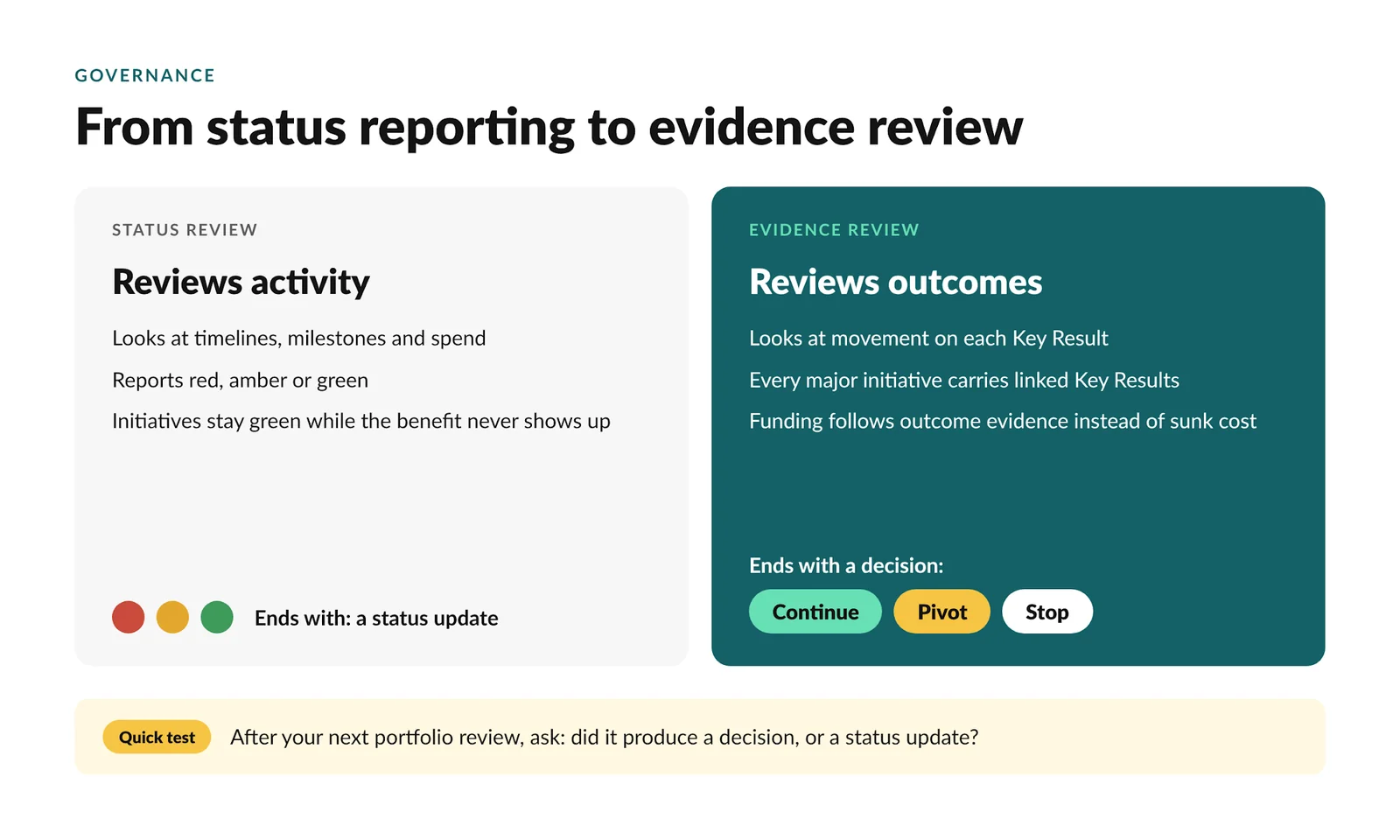
- Integrate OKRs into portfolio governance. Every major initiative carries linked Key Results that define success in measurable terms, and initiatives without them should not pass portfolio review gates.
- Anchor execution ownership in one place. A Transformation Office or equivalent function owns cadence integrity, evidence flow, and escalation paths across the portfolio, so accountability runs as a single thread from strategy to team delivery.
- Shift to evidence-based decisions. Replace red-amber-green status reporting with evidence reviews that explicitly conclude one of three things: continue, pivot, or stop.
The underlying shift is cultural as much as procedural: from approval-heavy decision gates toward evidence-backed autonomy, from milestone tracking toward outcome-based funding conversations, and from fixed annual plans toward explicit portfolio-level learning cycles.
Illustrative example
A financial services organization embedded OKRs into its quarterly portfolio reviews and aligned governance cadence with delivery teams. The change eliminated redundant projects and accelerated time to value, with governance meetings shifting from status reporting to genuine strategic dialogue. The structural change was not delivery speed. It was the organization’s new ability to make consistent quarterly portfolio decisions based on outcome evidence rather than sunk cost.
A useful diagnostic question for any governance meeting: did this review produce a decision, or did it produce a status update? If every initiative stays green regardless of whether its intended benefit is materializing, the governance layer is still reviewing activity, not evidence.
Practical steps and templates
Steps to introduce OKRs into a Product/Agile organization
- Run an honest maturity check first. Use the Agile Fluency-style lens in the maturity section to identify which fluency zone your teams currently operate in before proposing an OKR rollout. If the honest answer is Non-Agile or early Focusing, address team culture and Product vision before introducing OKRs.
- Build a shared glossary before writing a single OKR. Agree what Objective, Key Result, Outcome, Epic, and Initiative mean in your organization, and decide how they map onto whatever delivery tool (Jira, Azure DevOps, or similar) your teams already use. This is also where to make two calls that shape everything downstream: which organizational level OKRs live at, and how many objectives and key results each level is allowed to carry (see the OKR Blueprint model below).
- Map your current cadences onto the interlock table in The cadence interlock. Identify where strategy, quarterly planning, and sprint-level rituals already exist, and where the mapping breaks down.
- Convert one roadmap theme into an outcome bet. Pick a single upcoming roadmap item and rewrite it using the Bet / Hypothesis / Key Result / Learning format from the outcome-based roadmaps section, before applying the format portfolio-wide.
- Replace one governance review with an evidence review. Take the next quarterly steering or portfolio review and restructure it around the continue/pivot/stop decision described in the governance section, rather than a status update.
The OKR Blueprint™ model
Baseline the Level: decide where OKRs live (company, tribe, or squad)
Limit the Count: agree how many objectives and key results each level carries
Update Rhythm: lock in cycle length and review cadence
Embed in Workflow: weave OKRs into existing rituals, boards, and tools
Publish and Platform: choose a single source of truth to create, share, and update OKRs
Reconcile with KPIs: define coexistence rules and shared dashboards
Integrate Alignment: connect vertical and horizontal OKRs, and kill silos
Nurture Adoption: onboard, train, and coach teams toward self-sufficiency
Track the Roll-out: measure deployment progress and OKR adoption
This is the model behind the OKR Blueprint™ Implementation Workshop referenced in the resources at the end of this guide.
Template: outcome bet card
| Field | What to capture | Example |
| Bet | One sentence describing the roadmap bet, framed as an action, not a feature name. | Guide new users to create their first report within the onboarding session. |
| Hypothesis | What we believe will happen if we make this bet, and why. | Most new users drop off because an empty dashboard gives them nothing to act on; a first report in-session gives them a reason to return. |
| Key Result it moves | The specific, measurable Key Result this bet is intended to influence. | Raise 7-day activation from 28 percent to 40 percent this quarter. |
| What we’ll learn | What the team expects to know after this bet plays out, regardless of outcome. | Whether early value, rather than feature depth, is the main activation lever. |
Template: cadence interlock worksheet
Use this blank version of the cadence interlock table to map your own organization’s rhythms before your next planning cycle.
| Timeframe | Our OKR cadence | Our Agile cadence |
| Year | ||
| Quarter | ||
| Fortnight/week | ||
| Day |
FAQ: OKRs and Product/Agile delivery
If your Agile team delivers consistently but struggles to connect that delivery to business outcomes, OKRs help answer the question Agile alone does not: not “are we building things well,” but “are we building the right things.” Many Product teams benefit from running both together.
Not as a first step. Use the maturity lens above honestly. At the Non-Agile or early Focusing stage, OKRs are not the right starting point, and a simpler goal-setting approach such as management by objectives will likely serve better until team culture and a shared Product vision are in place.
OKRs are best used to frame the PI’s themes at a strategic level, with PI Objectives written to mirror Key Results rather than functioning as a restated feature list. PI Planning is a natural moment to align the two.
A conventional roadmap commits to delivering specific features by specific dates. An outcome-based roadmap commits to testing specific hypotheses about what will move a Key Result, with the features themselves treated as bets rather than promises.
Ask whether your last portfolio review produced an explicit continue, pivot, or stop decision grounded in outcome evidence, or whether it produced a status update. If every initiative stayed green regardless of whether its intended benefit was materializing, the governance layer is reviewing activity, not evidence.
OKRs are a goal-setting framework, and Agile is a way of delivering work. They share the same habits (short cycles, real feedback, learning over fixed plans), which is why they pair well, but they do different jobs: OKRs set the outcome for the quarter, and Agile runs the work that moves it.
Set OKRs once a quarter, then let each Sprint Goal be a bet on one Key Result. Review what shipped at the sprint review, and review whether the Key Result moved at a separate OKR check-in every one or two weeks.
Keep Key Results in your OKR tool or goals view, and link each epic to the Key Result it is meant to move. A Key Result stored as a ticket tends to get closed when the work ships, whether or not the number changed.
Good product OKRs measure a change in customer behavior, such as activation, retention or time to value, and leave the features to the backlog. The product OKR examples table above gives six worked examples.
Most product teams do best with one to three Objectives and two to four Key Results each. The enterprise example in the maturity section shows what happens past that point: more than ninety OKRs a quarter and very little real alignment.
Where to go from here
This guide focuses on the intersection of OKRs, Product, and Agile delivery specifically. The resources below help take the next step, whether that is diagnosing where your organization actually stands or building the skills to run this well.
| Resource | What it covers | Best for |
| Strategy Execution Quick Check | A short self-assessment, five questions in under two minutes, that shows how your strategy execution compares and which capability area to fix first, including where Agile and Product delivery are creating friction. | Leaders who want a clear picture of execution gaps before proposing an OKR rollout into a Product/Agile organization. |
| OKR Blueprint™ Implementation Workshop | Facilitated workshop to define the deployment strategy across people, process, and tooling, including how OKRs interlock with existing Agile cadences. | Organizations preparing to roll out OKRs alongside an established Agile or SAFe practice. |
| OKR Definition Workshop | Facilitated session to translate strategy into a focused set of OKRs for the next cycle, including writing outcome-based Key Results from a feature roadmap. | Product and leadership teams setting their first Product-context OKRs. |
| OKR Practitioner (OKRP) / OKR Leader (OKRL) | Foundations and team-leadership training on OKR fundamentals, cadence, and rituals. | Product Managers, Product Owners, and Agile coaches building OKR fluency alongside their existing delivery role. |
| OKR Professional Coach (OKRPC) | Certification for professionals deploying OKRs across an organization, covering coaching and change management. | OKR Leads and consultants running an organization-wide rollout into a Product/Agile environment. |
For OKR fundamentals, see the OKR Mentors Fundamentals Deep Dive.
