

This is an extract from the Global State of Strategy Execution report. You can read the full version for all dimensions, insights, and benchmarks.
Understanding the dimensions of strategy execution is essential before looking at how organisations actually perform. The SEM360 framework outlines five core dimensions, each describing a critical part of how strategy becomes action: Align, Execute, Improve, Scale, and Empower. These dimensions provide a shared structure for assessing maturity, identifying strengths, and uncovering capability gaps across teams and leadership levels. The SEM360 Dimensions guide explains these foundations in detail, and this article builds on that base by exploring how organisations score in practice and what distinguishes the top performers.
Execute: Ensuring strategy is delivered on time, with clear ownership and effective collaboration.
Key drivers: Execution Cadence, Execution Ownership, Cross-Team Delivery.
Execute covers Execution Cadence, Execution Ownership, and Cross-Team Delivery. High maturity means clear roles, regular check-ins, rapid removal of blockers, and seamless collaboration between teams. Without strong execution discipline, even well-aligned strategies stall in delivery.
Key Insights
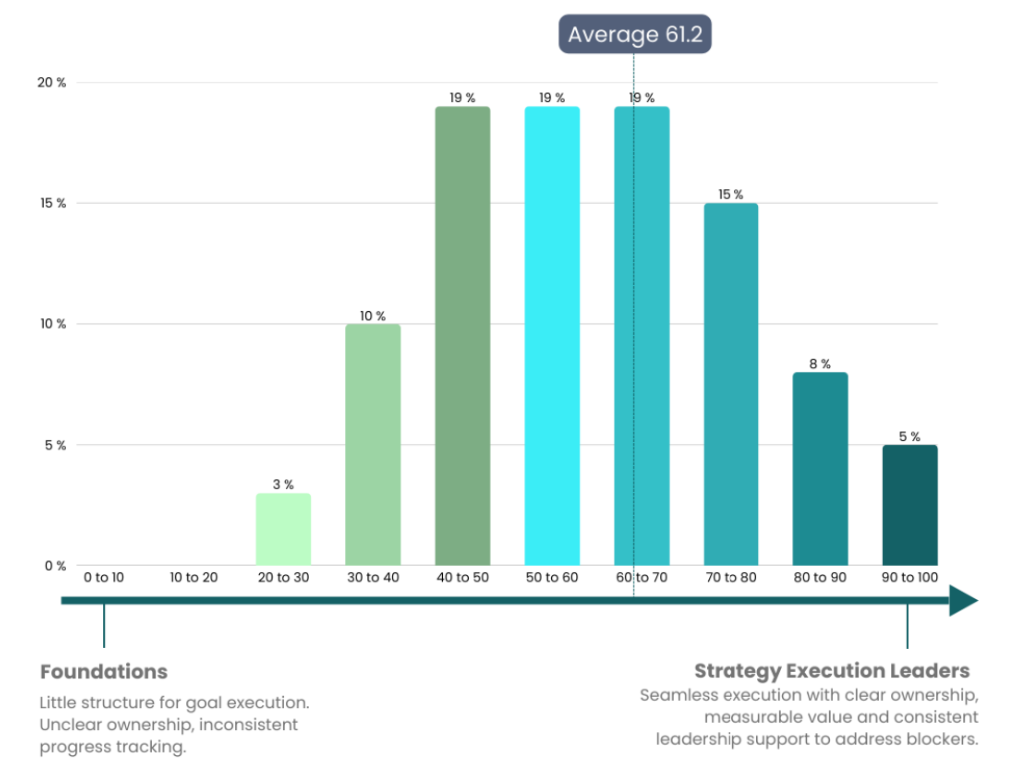
- Execute has an average global score of 61.2, making it weaker than Align but still a core strength for some sectors.
- By industry, Retail and FMCG firms lead execution discipline at 66.3, while Automotive companies trail at 58.2, highlighting sectoral contrasts in operational rigor and complexity.
- Strategy Execution Leaders outperform the global average in Execute by +27.3 points (88.5 vs 61.2), showing their ability to turn plans into results.
What Strategy Execution Leaders Do
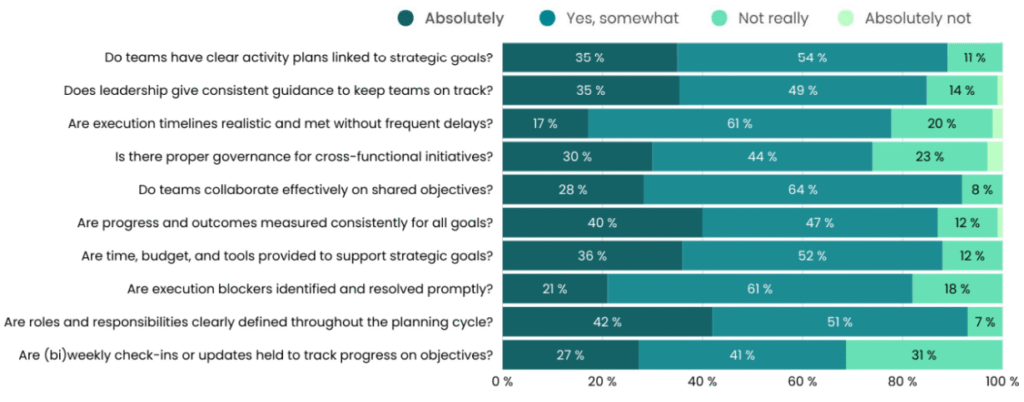
- Hold weekly or biweekly check-ins to keep delivery on track, they are 3.5× more likely to do this than peers (96% vs 27%).
- Remove execution blockers quickly, often within days, they are 3.52× more likely to clear obstacles promptly (74% vs 21%).
- Provide sufficient time, budget, and tools to deliver on goals, 2.31× more likely than others (83% vs 36%).
- Define clear roles and responsibilities at every stage of the planning cycle, avoiding “floating” accountabilities.
- Allocate resources deliberately to align with strategic priorities, preventing under-resourced commitments.
- They are 1.29× more likely to run structured monthly or quarterly planning sessions (96% vs 74%), shortening feedback cycles and limiting drift.