
When selecting OKR Champions, it’s important to consider diversity. They should represent a cross-section of the organization, spanning different teams, levels, and functions. This diversity ensures that the champion community can effectively support the varied needs and perspectives across the organization.
OKR champions are essential for driving successful adoption and sustained practice. The next step is learning how to identify, select, and develop the right individuals. The last step is to unite them into a strong, cohesive community.
Building a strong coalition of champions starts with identifying the right candidates. While the specific criteria may vary depending on the organization’s culture and context, there are some key characteristics to look for.
What is the Ideal Profile?
Ideal champions are individuals who are respected and influential within their teams and the broader organization. They have a track record of driving results and are known for their ability to collaborate effectively with others. They are strong communicators, able to articulate complex ideas in simple, relatable terms. Importantly, champions should also be individuals who are passionate about the power of OKRs and committed to their success.
OKR Champions should be lifelong learners, eager to deepen their understanding of the methodology and to share their knowledge with others.
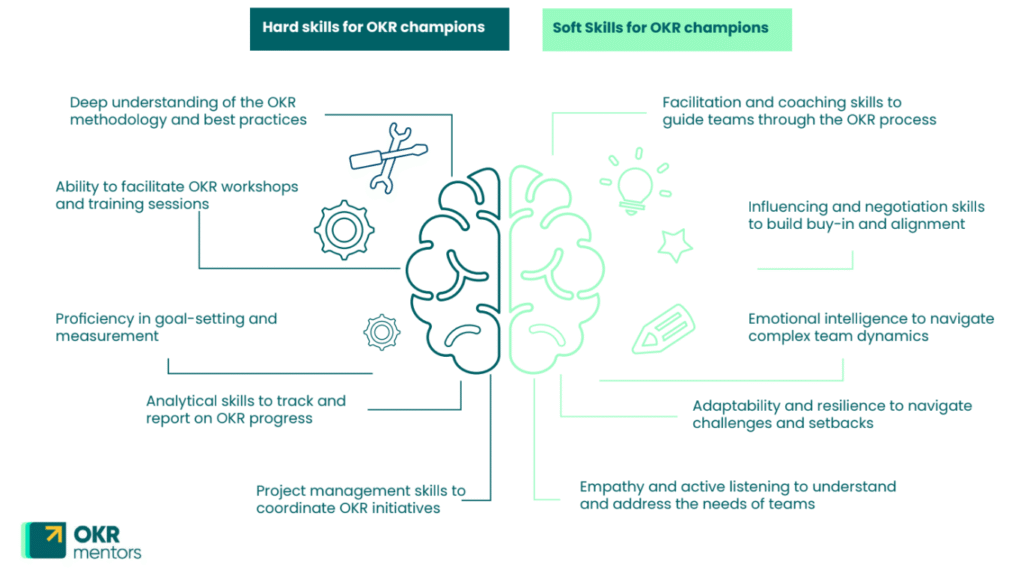
In addition to these general qualities, it is important to consider the specific skills that will enable champions to fulfil their role.We can categorise these skills into two main areas: hard skills and soft skills. It is the combination of these hard and soft skills that sets OKR champions apart and enables them to effectively drive the adoption and sustainment of OKRs.
Once potential champions have been identified, the next step is to clearly articulate the mission and objectives of the champion role. This includes outlining the key responsibilities of champions. Such as facilitating OKR check-ins, providing team-level training and support, and surfacing feedback and insights to the OKR lead.
It is also important to convey the benefits of being a champion. Both for the individuals themselves and for the organization as a whole. For individuals, serving as a champion provides an opportunity to develop their leadership skills, gain cross-functional exposure, and play a key role in shaping the culture and performance. For the organization, a strong network of champions drives better OKR adoption, alignment, and results.
Support from Top to Bottom
When inviting individuals to become champions, it is crucial to secure the support of their direct managers. Managers need to understand the importance of the champion role and be willing to allocate the necessary time and resources for their team members to fulfil this responsibility effectively.
Once you select the OKR champions, you focus on training them and bringing them together into a strong community. A strong champion community amplifies the impact of individual champions, providing a platform for continuous learning, collaboration, and mutual support.