

This is an extract from the Global State of Strategy Execution report. You can read the full version for all dimensions, insights, and benchmarks.
Understanding the dimensions of strategy execution is essential before looking at how organisations actually perform. The SEM360 framework outlines five core dimensions, each describing a critical part of how strategy becomes action: Align, Execute, Improve, Scale, and Empower. These dimensions provide a shared structure for assessing maturity, identifying strengths, and uncovering capability gaps across teams and leadership levels. The SEM360 Dimensions guide explains these foundations in detail. This article builds on that base by exploring how organisations score in practice and what distinguishes the top performers.
Extending good execution practices across the organization
Key drivers: Strategy Execution Governance, Capability Building, Tooling & Systems
The Scale dimension focuses on extending effective execution practices consistently across the organization. It includes Strategy Execution Governance, Capability Building, and Tooling & Systems. High maturity in Scale means governance processes are embedded, execution skills are deliberately developed, and integrated systems link plans, budgets, and tracking across all teams.
Without effective scaling, execution practices remain heterogeneous across the organization, limiting synergies and preventing the sharing of best practices.
Key insights
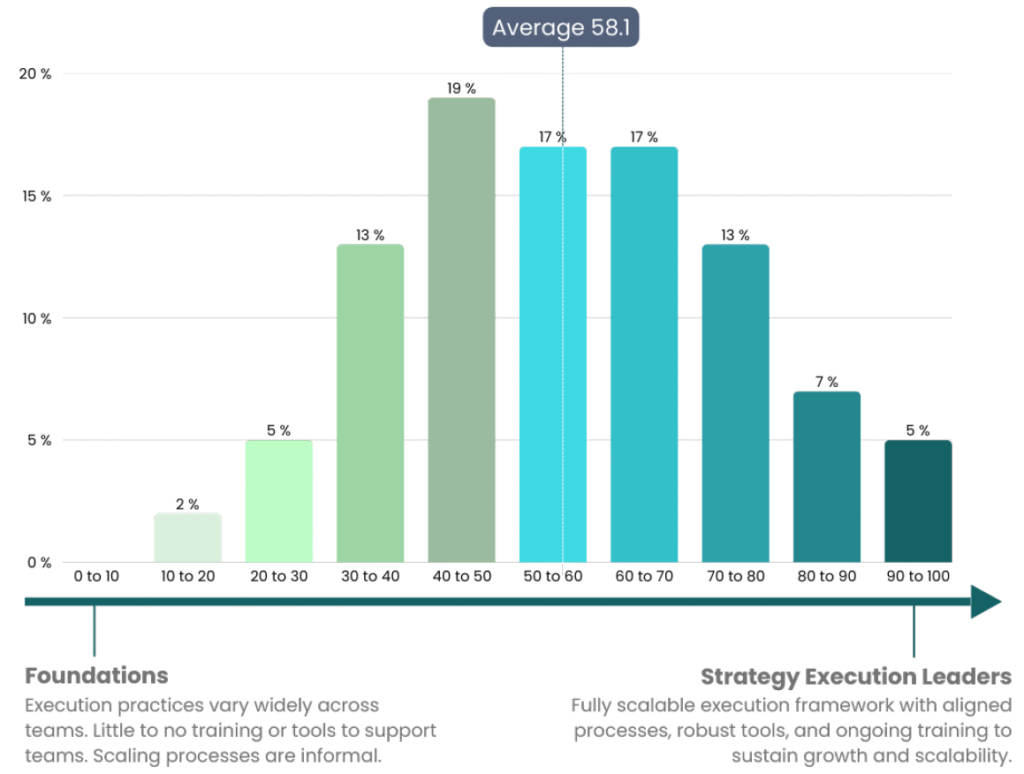
- Scale has an average global score of 58.1, making it one of the weakest dimensions. This highlights how difficult organizations find it to replicate execution practices enterprise-wide.
- By industry, Telecom companies lead in Scale with an average score of 63.9, while Business & Professional Services trail at 52.5, pointing to uneven adoption of governance and tooling.
- Strategy Execution Leaders outperform the global average in Scale by +30.5 points (88.6 vs. 58.1), demonstrating their ability to replicate execution excellence at scale.
What Strategy Execution Leaders Do
- Use a consistent planning and execution process across all teams, embedding shared routines.
- Build execution skills and leadership capabilities systematically at every level of the organization.
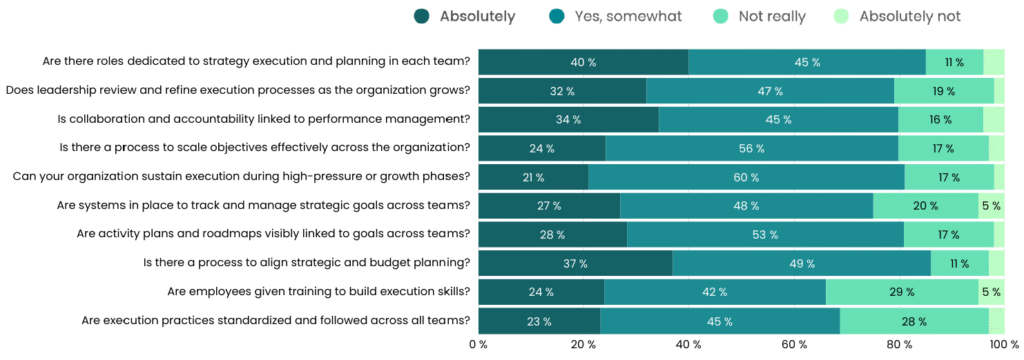
- Align strategic planning with budget allocation far more often, being 2.46× more likely to connect these processes (91% vs. 37%).
- Link activity plans and roadmaps visibly to strategic goals, being 2.96× more likely to ensure this connection (83% vs. 28%).
- Provide structured training and resources to staff, with Leaders being 2.25× more likely to institutionalize this capability (70% vs. 31%).
- Invest in integrated systems to track and manage execution across teams, with Leaders being 2.41× more likely to have such systems in place (65% vs. 27%).
- Standardize reporting mechanisms and decision rights across the enterprise, being 2.46× more likely than peers to do so (74% vs. 23%).
- Automate repetitive tasks in planning and execution, being 1.66× more likely to do so (39% vs. 24%), freeing time for higher-value reflection and decision-making.