

This is an extract from the Global State of Strategy Execution report. You can read the full version for all dimensions, insights, and benchmarks.
Understanding the dimensions of strategy execution is essential before looking at how organisations actually perform. The SEM360 framework outlines five core dimensions, each describing a critical part of how strategy becomes action: Align, Execute, Improve, Scale, and Empower. These dimensions provide a shared structure for assessing maturity, identifying strengths, and uncovering capability gaps across teams and leadership levels. The SEM360 Dimensions guide explains these foundations in detail, and this article builds on that base by exploring how organisations score in practice and what distinguishes the top performers.
Turning past results into better future execution
Key drivers: Learning Loops, Goal Reset
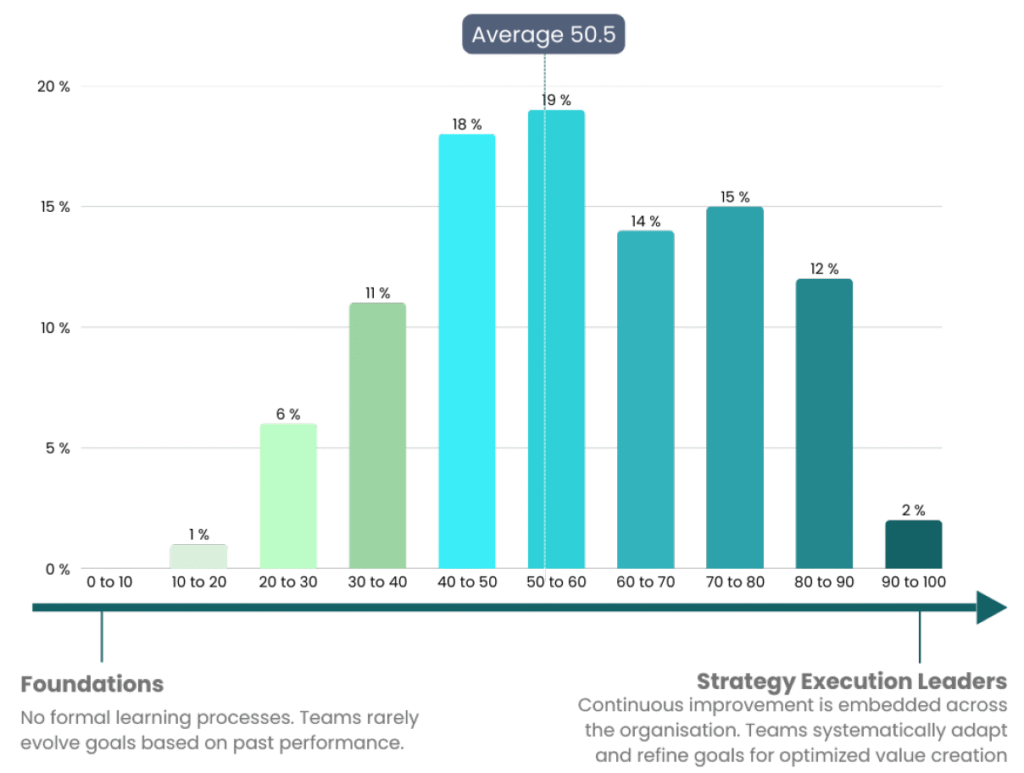
The Improve dimension focuses on systematically learning from execution and turning insight into better future performance. It includes Learning Loops and the Goal Reset process. High-maturity organizations run structured retrospectives, act on lessons learned, and regularly refresh or retire outdated goals. Without these feedback loops, mistakes are repeated and opportunities for innovation and resilience are lost.
Key insights
- Improve has an average global score of 60.6, making it one of the weaker dimensions, despite its central role in building organizational resilience and innovation.
- By industry, Telecom firms score highest in Improve at 66.9, while Automotive companies lag at 52.3, reflecting sector-level differences in how effectively lessons are captured and reapplied.
- Strategy Execution Leaders outperform the global average in Improve by +28.5 points (89.1 vs. 60.6), demonstrating that disciplined learning loops are a defining differentiator.
What Strategy Execution Leaders Do
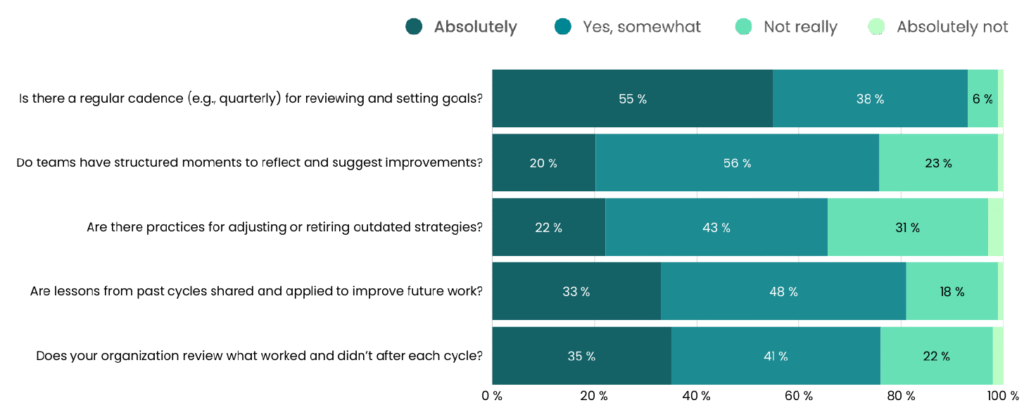
- Run structured retrospectives after every cycle, being 2.24× more likely to do so (78% vs. 35%).
- Share and apply lessons learned across the organization, not just within leadership teams. Leaders are 2.36× more likely to institutionalize this behavior (78% vs. 33%).
- Retire outdated strategies promptly and replace them with relevant goals, being 3.55× more likely than peers to do so (78% vs. 22%).
- Maintain a regular quarterly cadence for goal setting, being 1.65× more likely to review and reset objectives (91% vs. 55%).
- Encourage teams to suggest improvements and share best practices, turning reflection into collective ownership.
- Coordinate cross-team work through clear governance, named owners, and regular progress reviews.
- Adopt flexible planning frameworks to accommodate change, with Leaders being 2.14× more likely to do so (57% vs. 26%).