

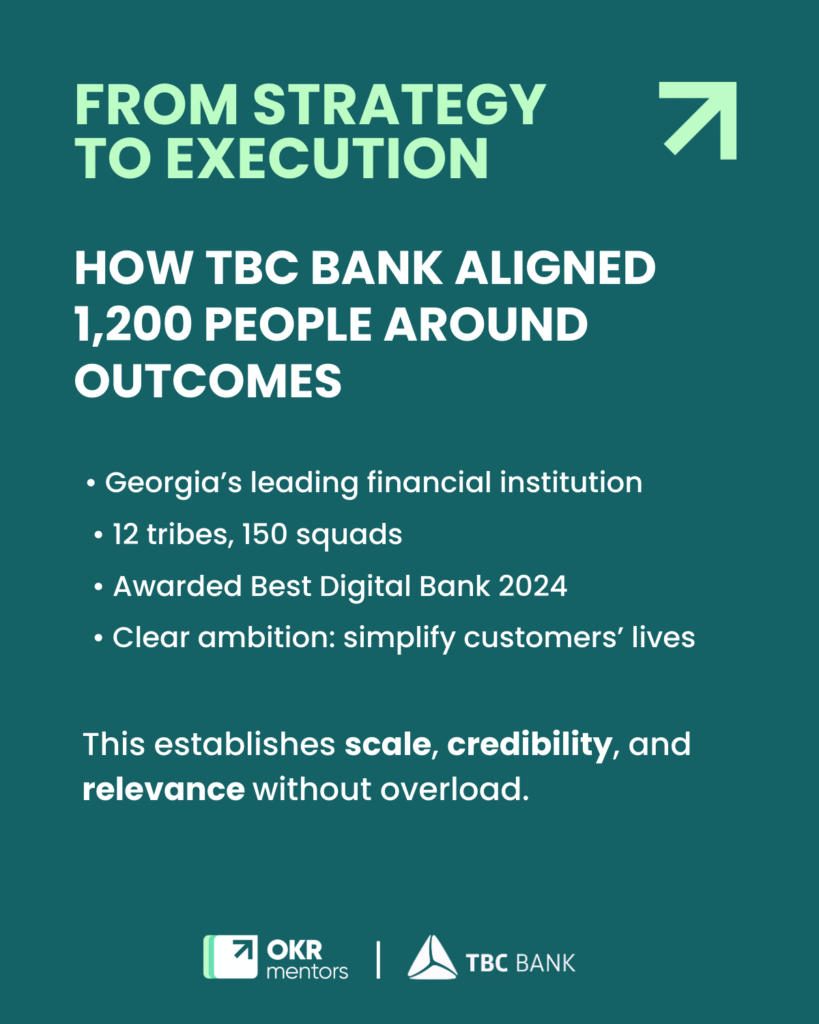
Organizations around the world search for ways to translate strategy into meaningful action. For TBC Bank, Georgia’s leading financial institution, this pursuit led to a profound transformation through Objectives and Key Results (OKRs). This case study explores how TBC Bank used OKRs to bridge the gap between strategic vision and effective execution across an organization of 1,200 people organized into 12 tribes and 150 squads.
About TBC Bank
TBC Bank stands as Georgia’s premier financial services provider with an impressive footprint:
- 1.6 million monthly active customers
- 69% of newly registered businesses in Georgia choose TBC as their financial partner
- Recognized as Georgia’s best digital bank for 2024
- Winner of the Agile Business Award
The bank’s core mission centers on a simple yet powerful question: “How can we truly simplify the lives of our customers?” This customer-centric philosophy drives their technology-focused approach.
The Need for Transformation
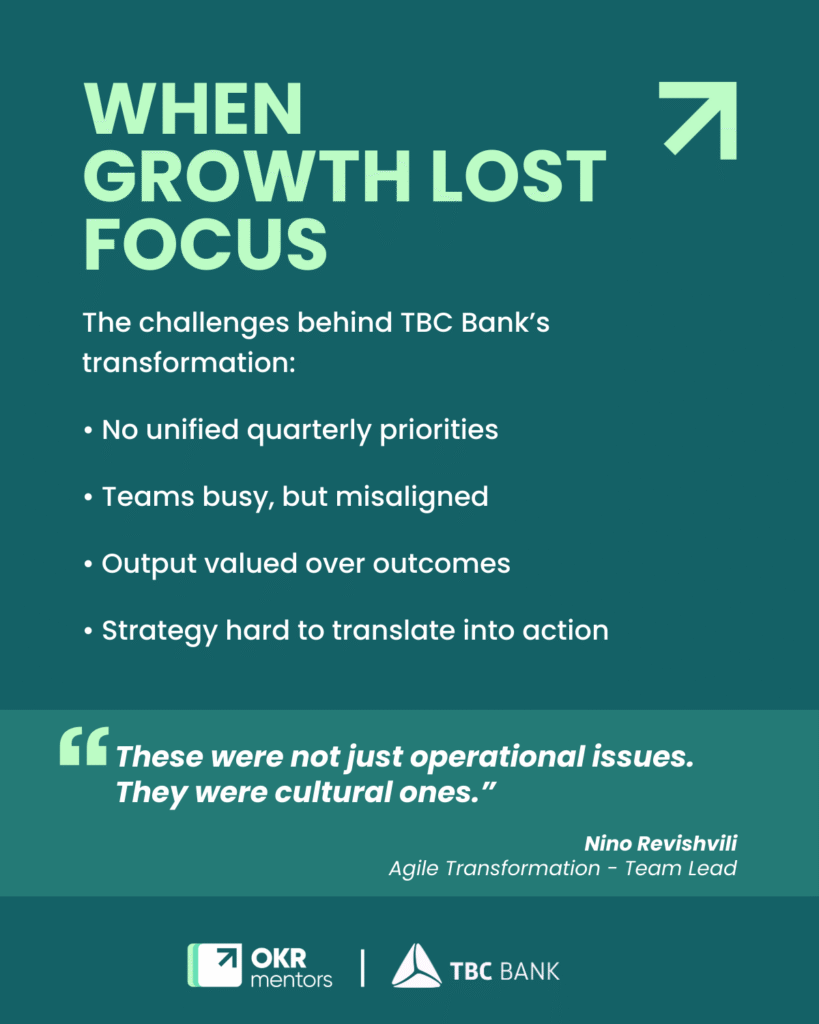
By 2021, TBC Bank had grown significantly, but this growth brought substantial challenges that threatened to hold the organization back:
- Lack of unified strategy: The absence of clear quarterly goals made it difficult to establish focus areas and priorities.
- Misaligned efforts: Teams worked diligently but without clarity on what they were aiming to achieve or why it mattered.
- Output over outcome focus: Too often, teams concentrated on completing tasks or building features without asking if their work was making a meaningful difference.
“These were not just operational issues. They were cultural ones,” explains Nino Revishvili, Agile Transformation Office Team Lead. “They reflected a need for us to rethink how we work, how we set our goals, and how we collaborate as a team.”
The OKR Implementation Journey
TBC’s OKR adoption was part of a broader agile transformation that began in 2017. As Inga Kelauradze, Head of Agile Center of Excellence, explains: “Our journey started back in 2017 when we decided to implement the scaled agile framework, which set the stage for scaling agile practices mainly within IT.”
The transformation unfolded in several phases:
1. Leadership Commitment
The first critical step was securing leadership buy-in. “The process would be led by the leadership team. The decision marked a turning point in how we operate, and strong support from senior management was critical in making it a success,” notes Kelauradze.
2. Establishing a Dedicated Team
TBC formed a specialized team from the Agile Transformation Office to drive OKR implementation, ensuring accountability, focus, and seamless rollout across the organization.
3. Building Alignment Through Communication
The team conducted over 20 workshops with senior management, tribe leads, and team members to promote alignment and build a common understanding of OKRs.
4. Piloting at the Tribe Level
Before full-scale implementation, TBC piloted OKRs at the tribe level. This phase established the foundation, allowing tribes to define their objectives and key results while aligning around shared priorities and measurable outcomes.
5. Scaling Across the Organization
To enable company-wide adoption, TBC deployed a dedicated OKR tool providing transparency, tracking, and alignment. “Teams can now set objectives, monitor key results, and ensure alignment with organizational goals,” explains Kelauradze.

Want to learn directly from stories like this?
The OKR Forum is where these real-world journeys are shared first—by the leaders who lived them. Join us in 2026 to get firsthand insights, ask your questions live, and connect with practitioners who are driving real strategy execution and transformation across industries.
Creating Company-Level OKRs
TBC Bank developed a structured approach to crafting company-level OKRs through three key steps:
- Reviewing Insights: During OKR workshops, management analyzed critical information, including overall strategy, challenges, and competitive landscape gaps.
- Prioritizing Challenges: The executive board identified and narrowed down the top five challenges, creating focus and clarity.
- Setting Objectives and Defining Key Results: Company-wide OKRs were formalized, and objective owners were identified to drive implementation.
After establishing company-level OKRs, directors met personally with tribal business leaders to share these goals and ensure alignment throughout the organization.
The OKR Cycle
TBC Bank established a clear process for their OKR cycle:
- Setting clear objectives and key results at the beginning of each cycle
- Conducting bi-weekly or monthly check-ins to track progress
- Registering all OKRs (company, tribe, and team level) in their OKR tool
- Holding mid-term reviews to assess progress and adjust activities
- Conducting end-of-cycle retrospectives to learn and improve
“This approach ensures a culture of accountability and collaboration where teams work together to drive shared success,” notes Revishvili.
Challenges and Solutions
TBC Bank’s OKR journey wasn’t without obstacles. The team faced several significant challenges:
1. Balancing OKRs with Performance Management
Initially, OKR fulfillment was tied to performance evaluation. This approach undermined the true transformative potential of OKRs as teams set easily achievable goals rather than ambitious objectives.
Solution: TBC Bank decoupled OKRs from performance management entirely, allowing teams to see OKRs as a tool for focus and alignment rather than as a measure of their worth.
2. Differentiating Between Business-as-Usual and Stretch Goals
Some teams played it safe by setting comfortable, manageable goals that essentially reflected what they were already doing.
Solution: The organization encouraged teams to aim higher and embrace ambitious, innovative targets that required effort and risk but promised meaningful impact.
3. Alignment Issues
Teams sometimes set key results that didn’t directly tie back to meaningful business outcomes.
Solution: TBC established clear criteria for high-quality OKRs and focused on ensuring direct connections to business strategy.
4. Mindset Shift
Moving from a task-focused to an outcome-driven culture required fundamental changes in thinking and working methods.
Solution: The bank invested in education, communication, and coaching to help teams embrace this new approach.
Impact and Results
TBC Bank’s implementation of OKRs has yielded significant benefits:
- Improved OKR Quality: By establishing clear criteria and focusing on improvements, TBC increased its OKR quality score from 63 to 80.
- Outcome-Driven Culture: The organization successfully shifted to an outcome-driven approach where objectives and key results are directly tied to business results.
- Enhanced Collaboration and Transparency: All tribes now align their objectives and key results with the company’s overarching goals, strengthening the ability to track strategy execution.
- Clarity and Purpose: Employees gained a clear understanding of what success looks like, enabling them to align their efforts with organizational priorities.
Key Recommendations
Based on their experience, TBC Bank offers five key recommendations for organizations implementing OKRs:
- Secure Leadership Involvement: Strong leadership involvement sets the tone and drives alignment across the organization.
- Start with Piloting: Test and refine the OKR process with pilot teams before rolling it out across the organization.
- Separate Business-as-Usual from OKRs: Distinguish between routine activities and ambitious goals, and decouple OKRs from performance management.
- Share Inspirational OKRs: Challenge teams to dream big and drive outstanding outcomes.
- Empower OKR Evangelists: Identify individuals who can guide teams, promote the framework, and drive adoption across the company.
Conclusion
TBC Bank’s OKR journey represents more than just a goal-setting exercise—it marks a fundamental shift in organizational culture and mindset.
“Looking back, OKR was one of the most important turning points for us,” reflects Kelauradze. “This was not just about setting goals. It was about redefining our way of working, our culture, and mindset. For the first time, we had a way to align everyone from the executive level to the individual.”
By embracing OKRs, TBC Bank has successfully transformed how they translate strategy into action, creating a more focused, aligned, and united organization in pursuit of their mission to simplify the lives of their customers.
“OKRs are not just a goal-setting process, they reshaped our culture and way of working. They made us more focused, more aligned, and more united in our mission.” – Inga Kelauradze, Head of Agile Center of Excellence, TBC Bank