

When Virgin Media O2 set out to fix strategy execution across its digital functions, the problem was never the strategy. It was what happened when the plan met reality.
What separates strong execution cultures from weak ones is not the quality of the plan, but how quickly organizations adapt when the plan collides with reality.
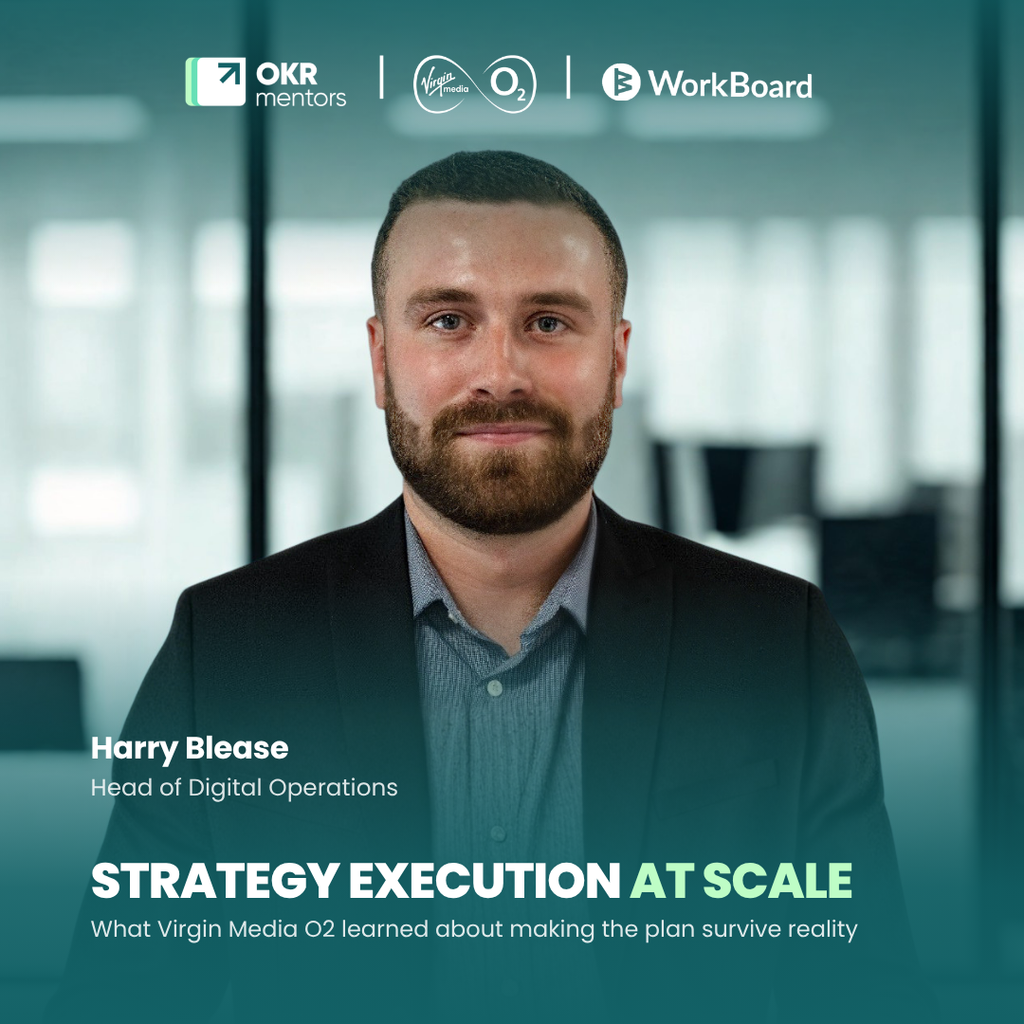
At the OKR Forum 2026, a panel on leveraging data and AI to supercharge strategy execution brought together two practitioners with different but complementary vantage points. Harry Blease, Head of Digital Operations at Virgin Media O2, shared how his team transformed execution across a 300-to-400-person digital function at one of the UK’s largest telecommunications companies, using WorkBoard, one of OKR Mentors’ technology partners, as their strategy execution platform.
This session featured Francesco Redolfi, COO of OKR Mentors, who drew on his experience working with large organizations to close the gap between strategic intent and real outcomes, and Sameera Moinpour, Head of Customer Success and Services at WorkBoard, who moderated the panel.
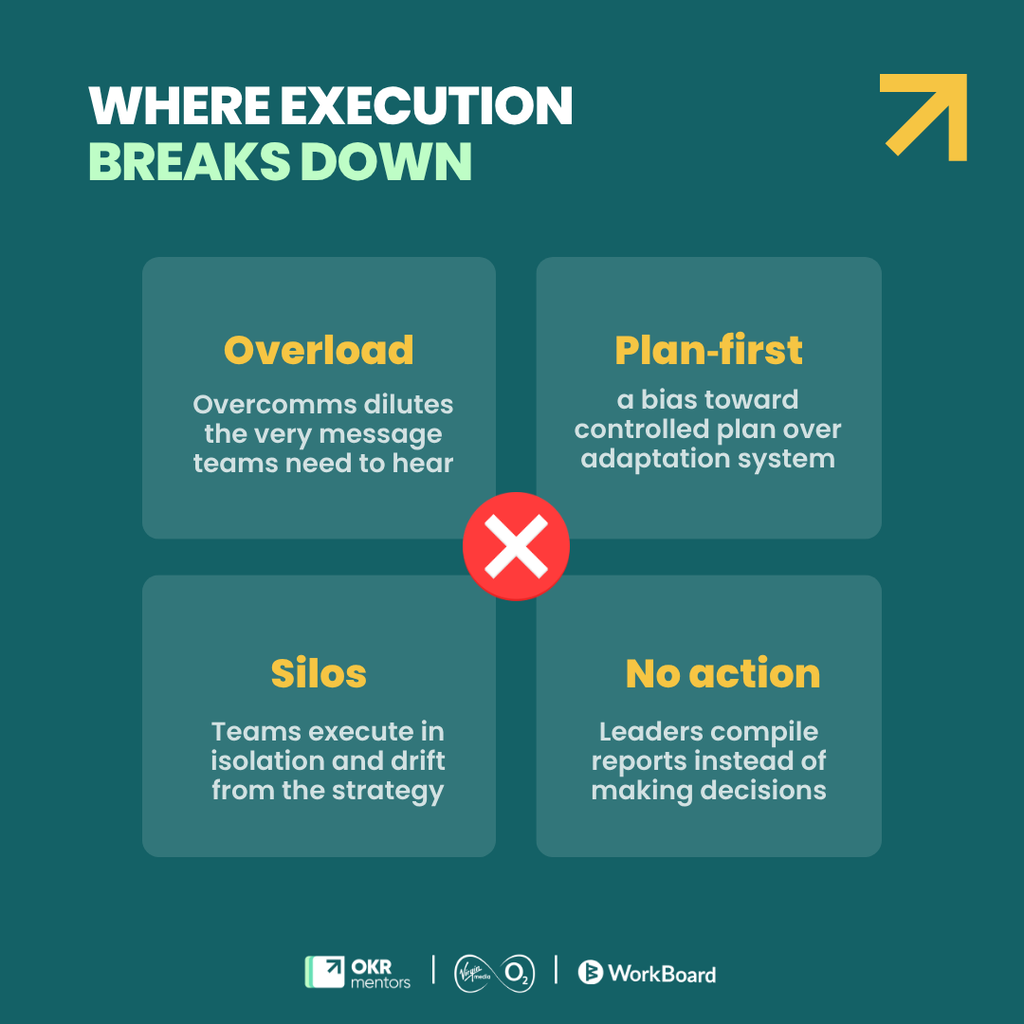
Where Execution Breaks Down
Both panelists agreed that execution problems rarely start with bad strategy. They start with how organizations respond when things don’t go according to plan.
Harry’s diagnosis is grounded in what he observed at Virgin Media O2. When teams are overloaded with information and under-equipped with clarity, they disengage from the strategy entirely.

If we overcommunicate and overpopulate people with information, it actually just dilutes what we’re trying to say.
Harry Blease, Virgin Media O2
Francesco sees the same pattern from the outside, and traces it to something deeper: an organizational bias toward control.
There is a disproportionate amount of time spent in trying to come up with the plan that doesn’t fail, versus building a system that allows you to deal with the failures that inevitably come along the way.
Francesco Redolfi, OKR Mentors
The result is predictable. Teams execute in isolation. Leaders compile reports instead of making decisions. And the strategy, however well crafted, quietly loses its grip on what people do day to day.
The Hidden Cost of Not Letting Go
Francesco identifies another pattern that most leaders will recognize, even if they rarely name it directly. Teams lose momentum not because the strategy is wrong, but because they cannot let go of approaches that are no longer working.
It is very hard to abandon ideas, especially the ones that you had yourself, when you see that they don’t work in reality. You tend to spend a lot more time trying to make it work versus contemplating that there may be better solutions.
The sunk cost is not just financial. It is emotional. And without a system that continuously surfaces what the data is actually showing, teams drift further down the wrong path long after the signs were there to course correct.
This is where structured data stops being reporting overhead and starts becoming a strategy execution tool. It gives leaders a way to challenge assumptions earlier, before teams spend another quarter pushing initiatives that are no longer delivering results. When you can see the impact of your work clearly and consistently, it forces the honest question: is this still the right thing to be doing?
How Virgin Media O2 Rebuilt Its Execution Rhythm
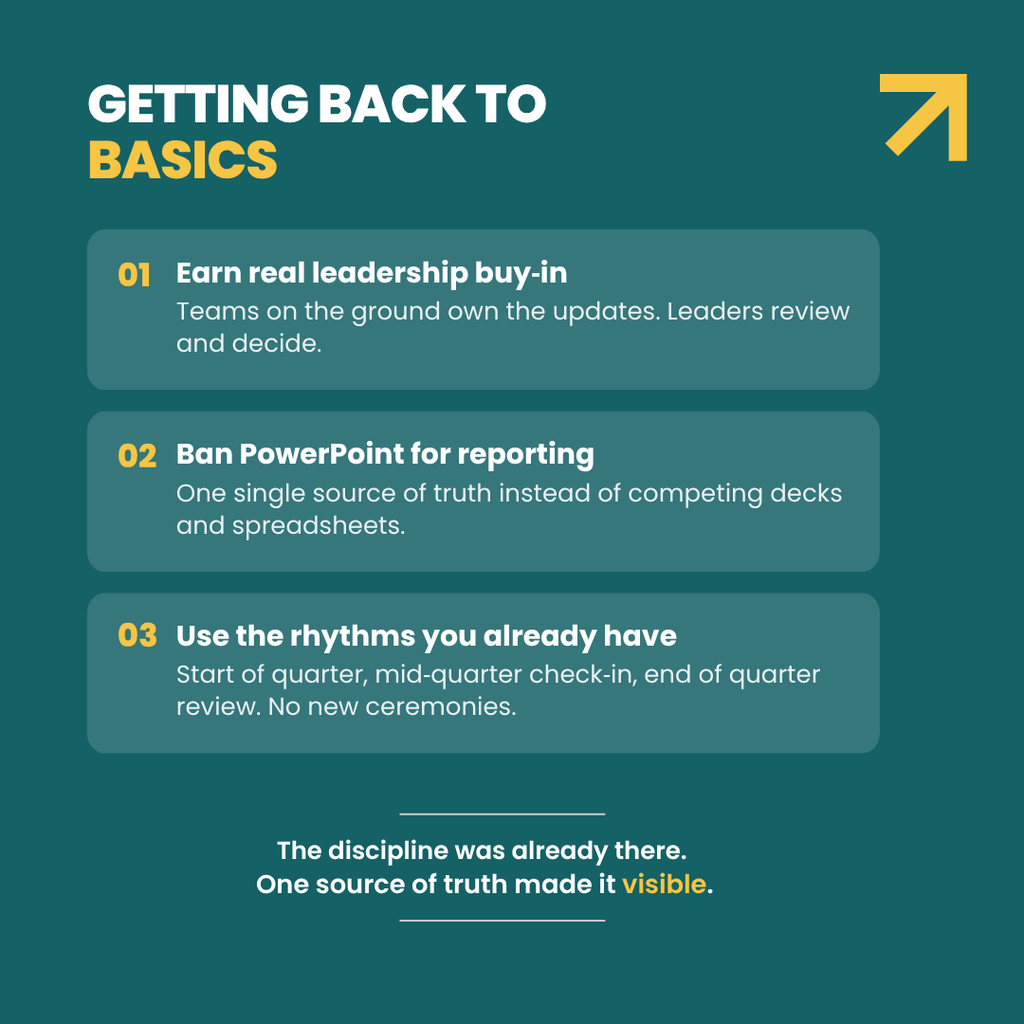
Harry’s response to Virgin Media O2’s execution challenges was deliberately simple. Rather than adding new processes, he stripped things back.
The first move was securing genuine leadership buy-in, not ceremonial support, but a design that made it easy for senior leaders to stay engaged without being buried in administrative work. At Virgin Media O2, the teams on the ground own the progress updates. Leaders come together to review and decide. That distinction, between who tracks and who decides, removed friction at the top and put accountability where it belongs.
The second move was banning PowerPoint for strategy reporting entirely.
We essentially made a rule that we banned PowerPoint. We have to have a single source of truth.
No more competing spreadsheet versions. No more reformatting slides for every review meeting. It became that single source of truth, replacing the version-controlled chaos that had been passing for reporting. The discipline of the framework was already in place. The platform gave everyone, from the teams on the ground to the senior leadership team, one place to see it clearly.
The third move was embedding OKRs into the rhythms that already existed: start of quarter, mid-quarter check-ins, end of quarter reviews. No new ceremonies, no parallel system. Just a clear cadence, kept consistently.
Francesco recognizes this balance as one of the hardest things for growing organizations to get right. The temptation is always to go to one of two extremes: either oversimplify into a visual asset that cannot support real decision-making, or try to federate every project for thousands of people into a single planning tool that collapses under its own weight. The goal is something in between: a source of truth that shows you the forest from the trees, but still lets you click down a level or two when something is broken and you need to find the bottleneck.
Why the Best Leaders Worry When Everything Is Green
One of the richest parts of the conversation was about what a red status indicator actually means, and how hard it is to get organizations to treat it as useful information rather than evidence of failure.
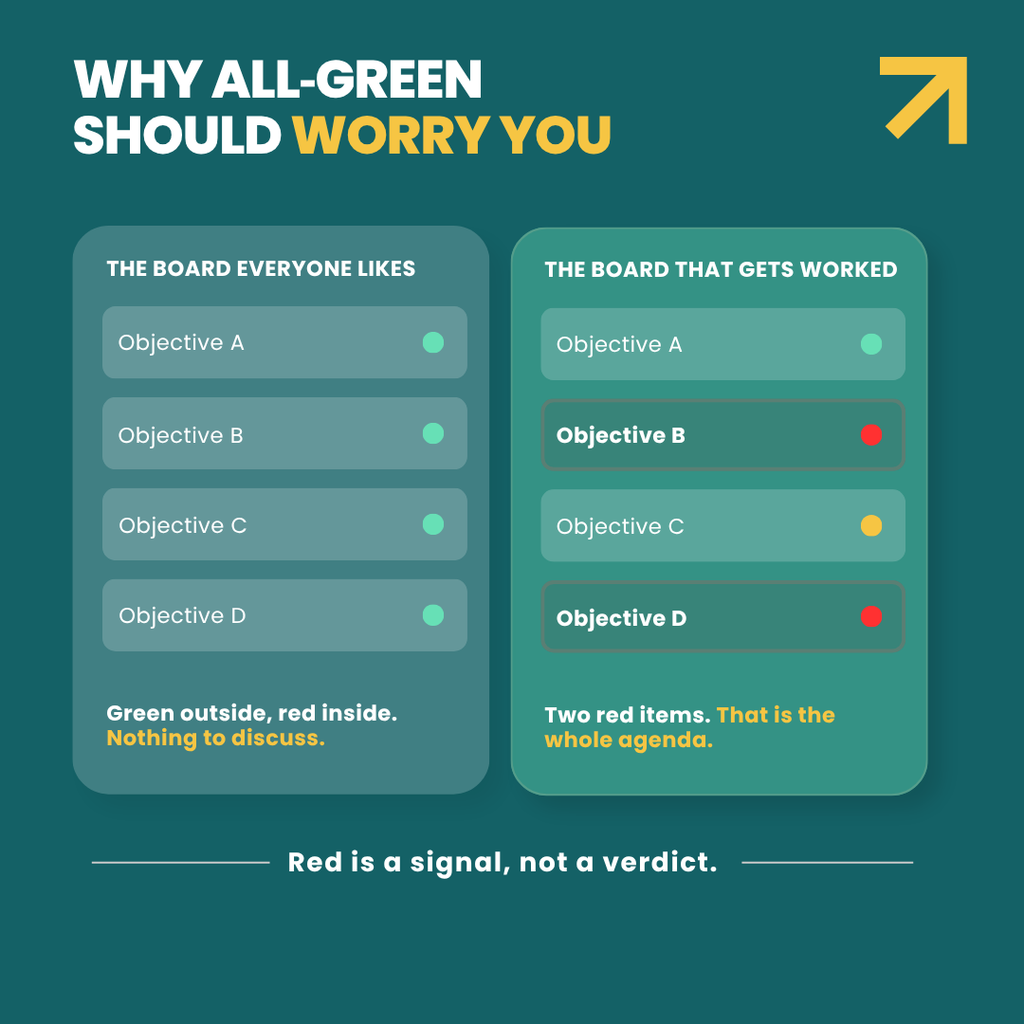
At Virgin Media O2, the early instinct was predictable. Teams saw red and avoided honest reporting to protect themselves. Harry worked consistently to reframe it: red is not a verdict, it is a signal. It tells you where a team needs support, where a conversation needs to happen, where leadership attention will actually make a difference.
Today, the leadership team at Virgin Media O2 focuses review sessions almost exclusively on items flagged red in WorkBoard. Green means things are on track. Red means this is where we work.
When I see everything that’s green, I have to panic a bit, because surely that’s not the case.
Francesco adds that making this cultural shift stick requires leaders to actively tell the before-and-after story. When something moves from red to green, that transition needs to be narrated: what was tried, what was learned, what changed. That story, grounded in real data, is what teaches the organization that honest reporting is safe and that learning matters more than looking good.
Without that narrative, the instinct to “watermelon”, green on the outside, red on the inside, never fully goes away.
Looking Ahead: What AI Changes
Both panelists see AI as the next meaningful lever for strategy execution, but they frame its value differently.
For Harry, the immediate opportunity is in removing manual effort. At Virgin Media O2, AI capabilities within WorkBoard are already acting as a chief of staff, automating the checking, notifying, and surfacing of insights that used to consume significant time. The foundation has to come first: structured data, a single source of truth, a consistent operating rhythm. AI is what amplifies that foundation.
Francesco takes a longer view. The shift he sees coming is from descriptive data to predictive data: moving from a system that tells you what happened to one that helps you anticipate what is coming.
AI is going to really allow us to extract insights from complex data systems and turn them into action that allows us to anticipate outcomes.
For organizations still managing strategy in flat files and disconnected tools, the message is the same from both perspectives. Get the structure right first. Then use AI to make it faster, sharper, and harder to ignore.
Both panelists treated AI as an amplifier of strategy execution discipline rather than a replacement for it. In both cases, its value depended on already having clear operating rhythms, structured data, and accountability embedded into the organization.
Key Takeaways
- Build for learning, not perfection. The plan will not survive contact with reality. Build the system that helps you adapt when it doesn’t.
- Simplicity is a design choice. Overengineered frameworks lose people. Clarity is what keeps teams connected to the strategy.
- Create a single source of truth. Competing slide decks and spreadsheet versions do not just waste time; they actively undermine alignment.
- Embed OKRs into existing rhythms. The framework should fit the cadences that already exist, not create a parallel system nobody sustains.
- Lean into the red. Surface problems early, reward honesty, and tell the story of how red becomes green. That narrative is what makes psychological safety real.
- Challenge your assumptions with data. Use what you can see to continuously ask whether you are still doing the right thing, not just doing the thing right.