

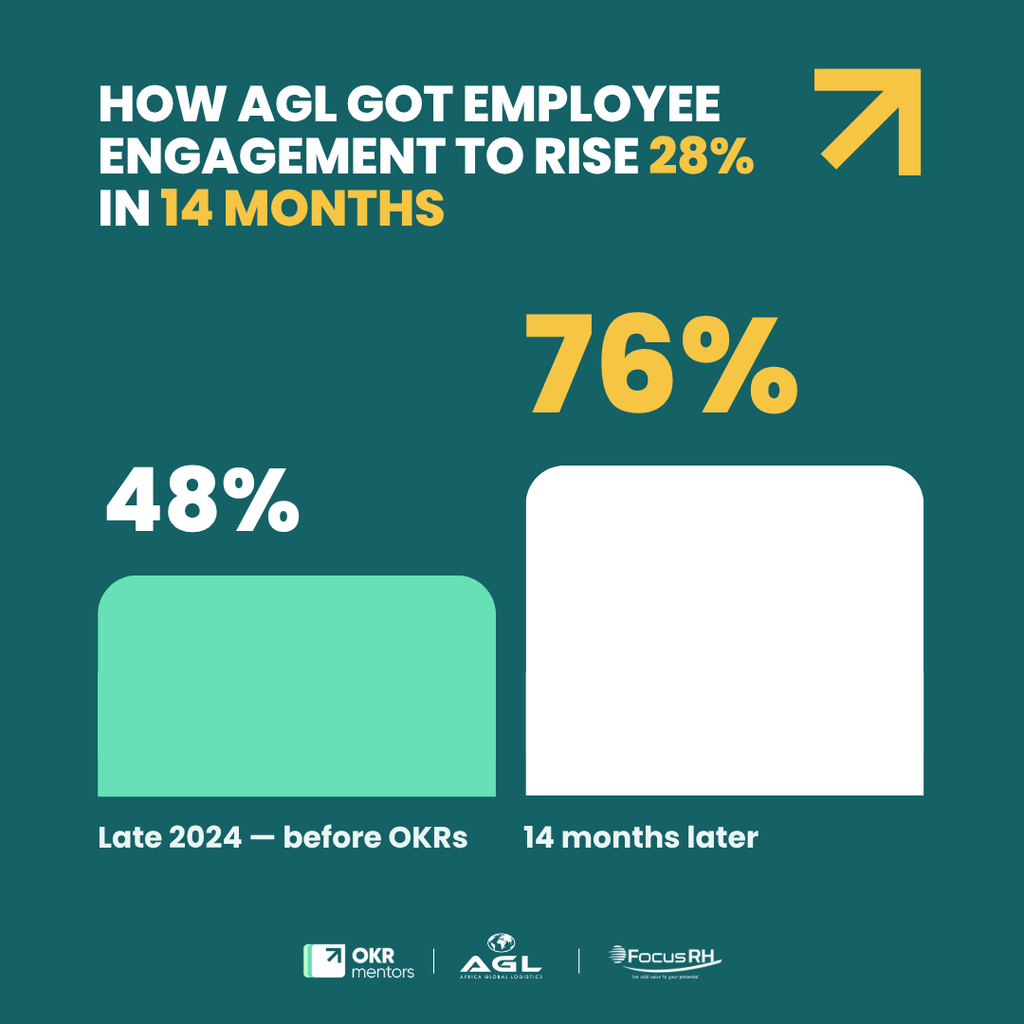
In late 2024, Africa Global Logistics (AGL) Côte d’Ivoire faced a moment that demanded honesty. Employee engagement sat at 48%. Customer satisfaction was falling. A leadership model built on top-down authority had stopped working, and across the organization, people had quietly stopped taking initiative.
The question wasn’t whether something needed to change. It was whether the organization had the courage to change it.
This is the story of how AGL Côte d’Ivoire, part of the MSC Group operating across 47 African countries, used OKRs not simply as a performance management tool, but as a practical framework to align strategy, shift behaviors, and help reshape the culture over time. In fourteen months, employee engagement climbed from 48% to 76%, reaching over 1,000 people across the organization. The journey was supported by Raphael Tchomnou Ngantchop, CEO and Founder of Focus RH, an OKR Mentors partner firm.
Why AGL needed an organizational culture change
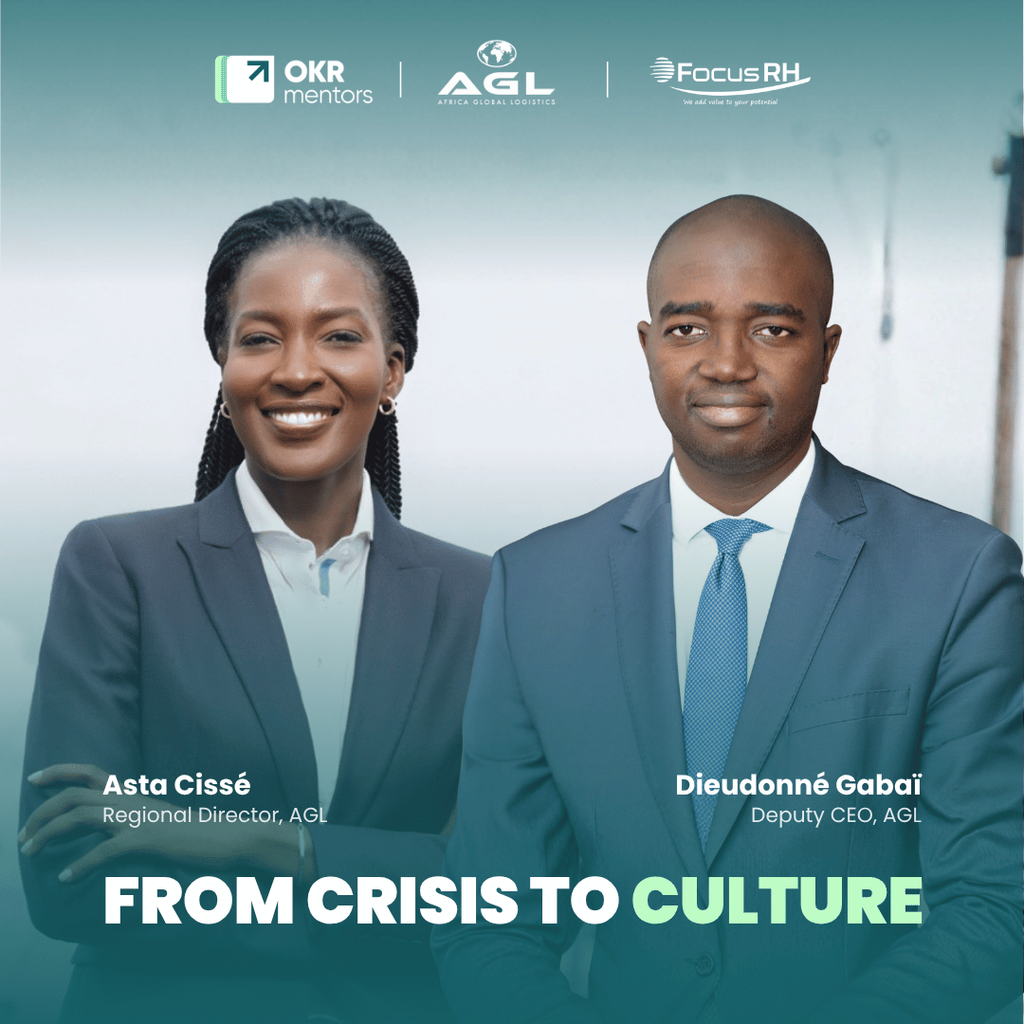
The 48% engagement score was striking. But as Regional Director, Asta Cissé had enough context to recognize it was only a symptom.
“Almost half of our people were not motivated or disconnected from the company. And this score was only a symptom.”
Behind the number was a deeper problem. Customer satisfaction was declining. Decision-making was too centralized. People across the organization had stopped contributing ideas or taking initiative. Teams were working hard, but largely in silos.
“Our main challenge was strategy clarity, but also the mindset we needed to change. We had a culture problem.”
AGL needed more than a new goal-setting framework. They needed a way to translate strategy into daily action while fundamentally shifting how people worked together.
How AGL chose OKRs as its strategic operating system
In 2024, AGL created a strategic plan called Drive 2030. The vision was focused: help clients by removing their logistics worries. The ambition was bold, double revenue and multiply profitability by five within five years.
But ambition without execution infrastructure is just intention. What AGL needed, in Asta’s words, was “a simple and powerful way to turn strategy into actions.”
They chose OKRs.
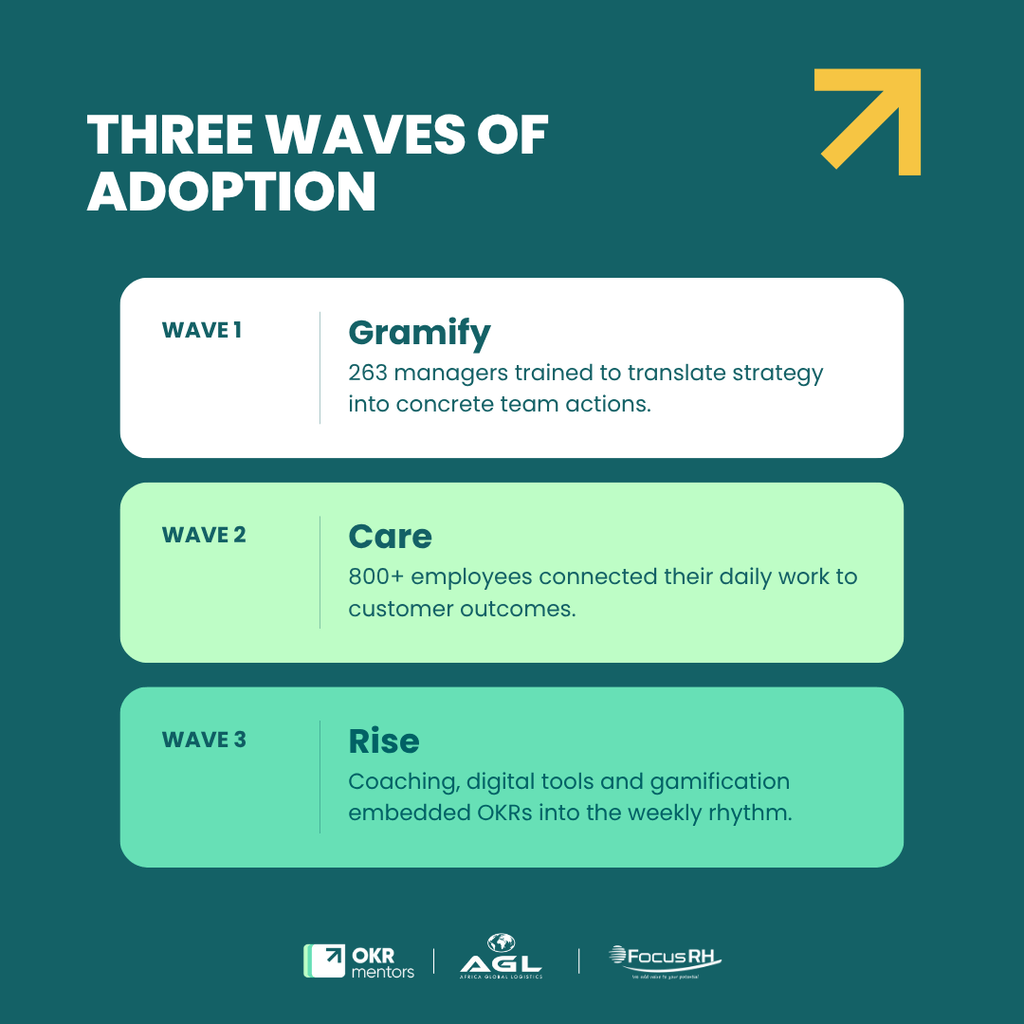
The transformation was structured around three sequential waves of training and adoption:
Wave 1: Gramify: 263 managers were trained on OKRs and how to translate organizational strategy into concrete team actions.
Wave 2: Care: Over 800 employees were supported in adopting a more customer-focused mindset, connecting their day-to-day work to client outcomes.
Wave 3: Rise: The acceleration phase brought in coaching, digital tools, and gamification to embed OKRs into the rhythm of everyday work.
The result of these three waves was something that had previously been missing: a shared language across the organization.
“Today, all departments follow the same strategy. We now speak the same language.”
The biggest challenge in AGL’s OKR transformation
Progress, however, is rarely linear. Six months into the transformation, the leadership team gathered to review the first pulse survey results. For Managing Director Dieudonné Gabaï, the moment was one he would not easily forget.
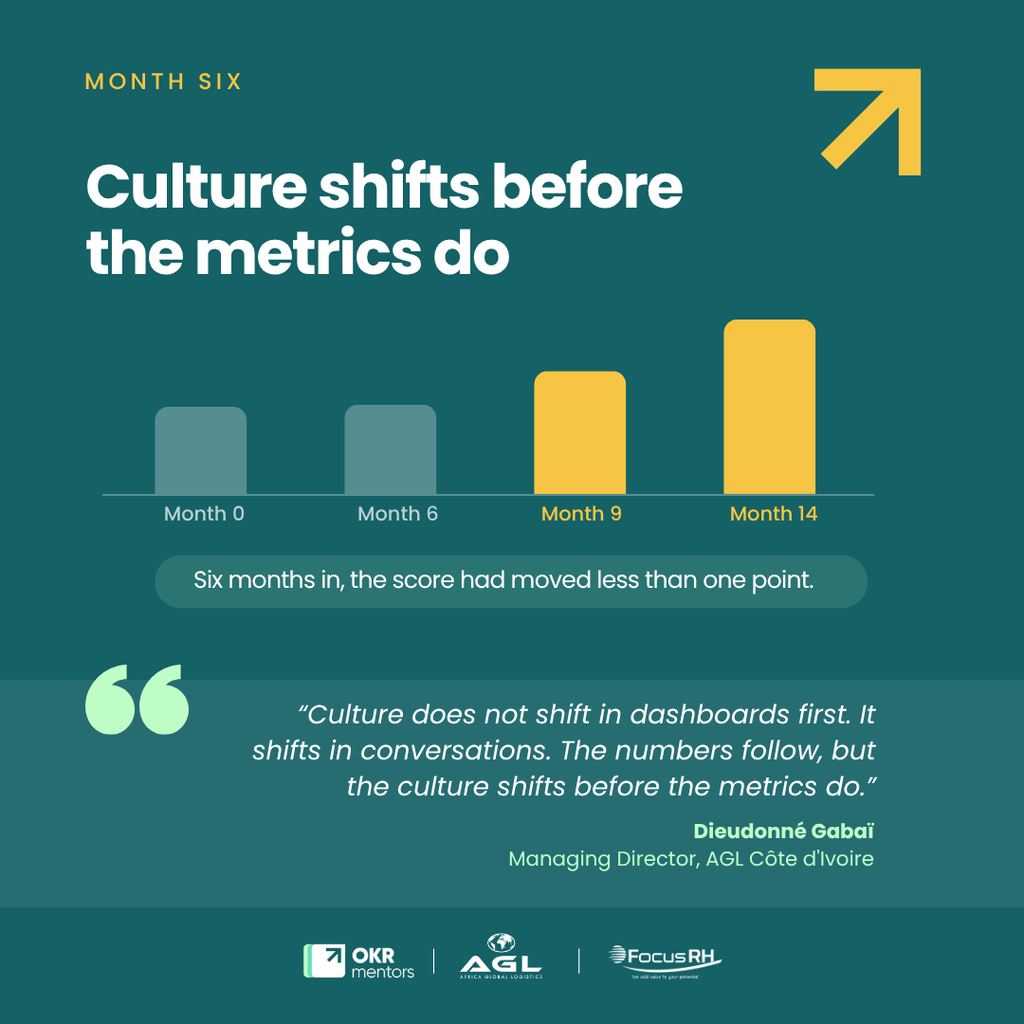
“The engagement score had moved by less than one point. We had trained 263 managers. We had mobilized the entire leadership team. We had redesigned rituals, introduced feedback loops, and invested time, credibility, and political capital, and yet the data was almost flat.”
The numbers were hard to sit with. After the meeting, a board member raised a question that cut to the heart of the matter: was this transformation genuinely different, or had it become another well-intentioned initiative that looked better on paper than in practice?
That question stayed with Dieudonné. He went home asking whether the resistance was simply too established, whether they had moved too fast, or not fast enough.
“I remember sitting in my office later, looking at the dashboard and thinking: have we just created a beautiful framework that nobody actually uses?”
Why culture change happens before performance metrics improve
What kept the transformation moving wasn’t data. It was a conversation.
The following day, a frontline manager from import operations stopped Dieudonné in the hallway and said something that changed the frame entirely.
“I don’t know if you realize this, but my team now talks about key results every Monday morning. We have never done that before.”
Then, more quietly: “For the first time, my team feels like their voice matters. It is small, but it is real.”
That observation reoriented everything. As Dieudonné reflects:
“Culture does not shift in dashboards first. It shifts in conversations. The survey numbers had not moved yet, but behaviors were starting to change. Language was changing. Ownership was emerging. The numbers follow, but the culture shifts before the metrics do.”
Instead of changing direction, the team chose consistency. Coaching was reinforced, leadership visibility increased, and the message held steady. Three months later, the second pulse survey showed meaningful movement. More importantly, trust had begun to build.
The lesson Dieudonné drew from that period was one of the most important of the entire journey:
“It is not about believing when the numbers are good. It is about holding conviction when they are not.”
How middle managers became their key to OKR success
If the hallway conversation was the emotional turning point, the middle management crisis was the structural one.
Three months into cascading OKRs across the organization, Dieudonné walked into a review meeting with middle managers. On paper, the rollout looked sound. Dashboards were populated, structures were in place, templates had been built. But the energy in the room told a different story.
One manager crossed his arms and said: “So basically, our job is just to execute what has already been decided.”
The sentence landed hard. Structurally, the leadership team had done everything right. Strategic OKRs had been defined at executive level, cascaded logically downward, and supported by training and tooling. But emotionally, it had failed.
“They felt like executors, not architects. And people don’t fight for something they didn’t help build.”
Two options were on the table: push harder, or change the design. The team chose to change the design.
Rather than continuing to cascade OKRs top-down, AGL introduced structured OKR co-creation sessions. Middle managers sat with their teams, with a member of the leadership present, and worked through one question together:
“What does success look like for us this quarter, and how does it connect to where the company is going?”
The strategic direction remained fixed. But the translation into departmental OKRs became something built together, not handed down.
The shift showed quickly. Two quarters later, Dieudonné watched a manager present his team’s OKRs to the executive committee.
“His tone had changed completely. He wasn’t defending them. He was proud of them. That’s when I knew something had shifted.”
The principle that emerged from this phase became one of AGL’s clearest learnings:
“Ownership is not a training problem. It is a design problem. If your middle managers are resisting, it is rarely because of a lack of competence. It is because of a lack of authorship. Don’t push them harder; involve them earlier. That’s what moved the needle for us.”
How AGL increased transparency during the transformation
The human moments were essential, but so was the operational discipline to sustain them. In the early months, routines had been inconsistent. Some reviews happened, some did not. Middle managers were under pressure, teams still defaulted to siloed working, and after months of sustained effort, change fatigue began to set in.
The leadership team responded with three deliberate actions.
A Transformation Pact. The leadership team made a public commitment to lead by example, not as a declaration of intent, but as a visible, signed commitment that the people driving the change were also living it.
Transparent communication. Monthly updates went out across the organization explaining plainly what was working and what was not. There were no polished progress reports, just honest accounts of where things stood.
Visible progress. Dashboards, internal communications, and clear messaging made the transformation something people could see and track, not just hear about in all-hands meetings.
Slowly, the dynamic shifted. Teams began collaborating across boundaries. People started to see how their work connected to others. And initiatives began appearing without being requested.
“We learned that transformation is not accomplished in a day. It is a journey, and a process that requires patience.”
What global organizations can learn from Africa’s approach to OKRs
AGL’s story carries a dimension that sets it apart from most OKR case studies. As the first African organization to reach the finals of the OKR Forum, their experience brings something genuinely distinct to a predominantly Western body of practice.
Dieudonné speaks to this directly:
“In many of our organizations, hierarchy is not just structural; it is relational. Leaders are expected to have answers. Authority is associated with certainty. And publicly disagreeing, even respectfully, can feel risky.”
Introducing OKRs in this context meant more than teaching a new framework. It meant asking people to change their relationship with authority itself.
The shift became visible during the first OKR cycle, when a usually reserved manager paused in a review meeting and said, carefully but clearly: “I’m not sure this key result is realistic if we don’t change the process upstream.”
The room went quiet. Six months earlier, that sentence would not have been said aloud. The senior leader present leaned forward and responded: “Good. Let us unpack that.”
That exchange was small in one sense and significant in another. Speaking up had stopped being an act of defiance and had become an act of ownership.
It also pointed to something that AGL believes the global OKR community would benefit from understanding. African organizational culture carries a concept that maps naturally onto what OKRs are designed to do.
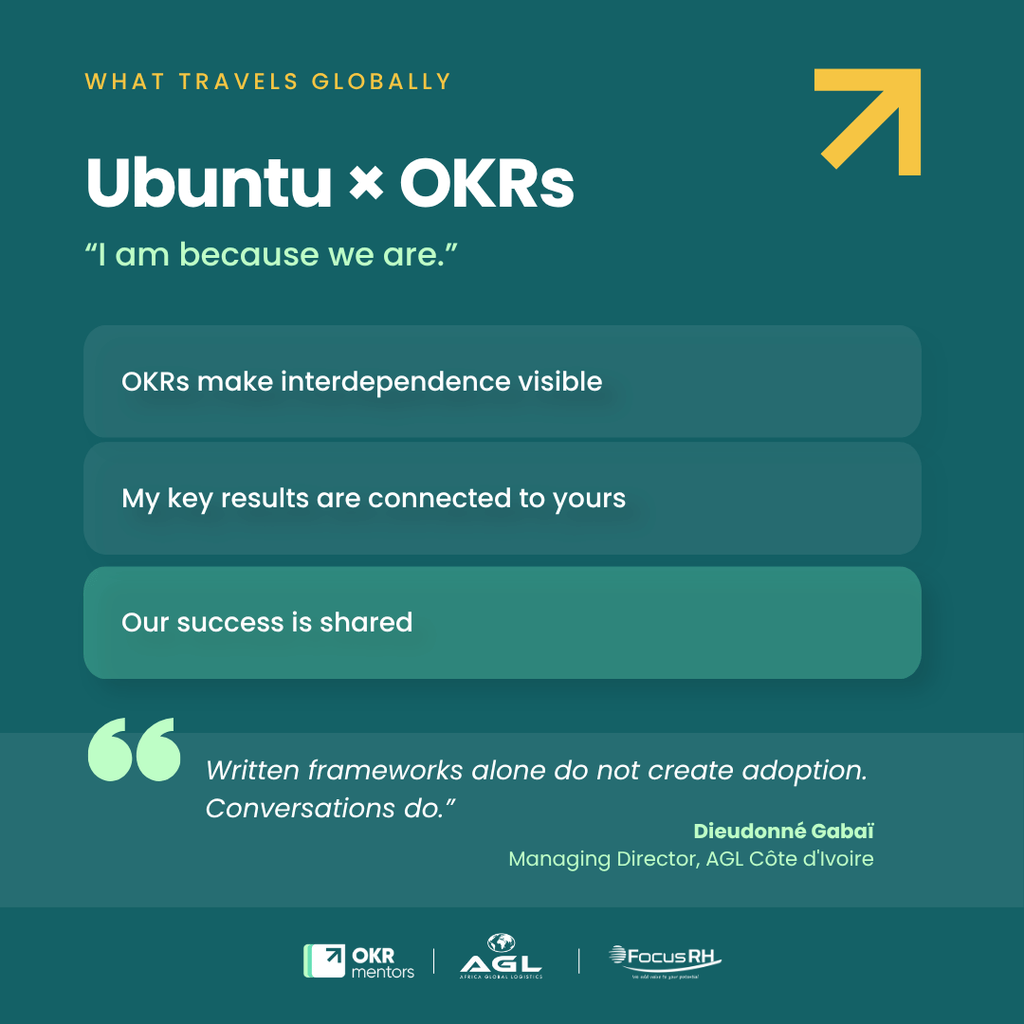
“We have a concept called Ubuntu: I am because we are. At their best, OKRs are deeply aligned with Ubuntu. They make interdependence visible. My key results are connected to yours. Our success is shared.”
There is also a practical insight that travels well beyond the African context:
“Written frameworks alone do not create adoption. Conversations do. In many Western organizations, OKRs may be deployed through software, dashboards, and documentation platforms. In our case, the most powerful deployment tool was something much simpler: dialogue.”
6 Key Lessons from AGL’s Transformation Journey
1. Start with culture, not just the framework. AGL didn’t implement OKRs to manage performance. They used them to rebuild how people work together. The engagement crisis was the catalyst, but the mindset shift was the real transformation.
2. Hold conviction when the numbers aren’t there yet. Six months in, the data was flat. But behaviors were changing in hallways and Monday morning meetings. Believing in the direction before the metrics confirm it is what separates transformations that last from initiatives that stall.
3. Ownership is a design problem, not a training problem. When middle managers felt like executors, the response wasn’t more pressure or more training. It was a redesign of the process to include co-creation. Involvement has to come before buy-in, not after.
4. Make the transformation visible and honest. Monthly updates that shared what was working and what wasn’t built more trust than polished presentations ever could. Transparency about difficulty is itself a form of leadership.
5. Dialogue is the most powerful deployment tool. Especially in high-context cultures, conversations drive adoption more reliably than software or templates. This is a lesson that applies well beyond the African context.
6. Transformation takes patience. “We learned that transformation is not accomplished in a day. It is a journey, and a process that requires patience.”
Asta closes with a saying that shaped her team’s approach from the beginning: “If you want to go fast, go alone. If you want to go far, go together. At AGL Côte d’Ivoire, we chose to go far, and OKRs are helping us stay on the path.”
Final Thoughts on Building a Sustainable OKR Culture
Conclusion
AGL Côte d’Ivoire’s story is not about a flawless rollout. It is about an organization that held its conviction when the data wasn’t moving, and redesigned its approach when the first version wasn’t working. The jump from 48% to 76% engagement in fourteen months is real, but it is the result, not the explanation. The explanation is what happened in the spaces between the dashboards: a leadership team that signed a pact and kept it, managers who stopped being handed goals and started building them, and an organization that learned, conversation by conversation, that strategy doesn’t live in documents. It lives in what people say to each other on a Monday morning.