

Making strategy land in a traditional, hierarchical organization is hard enough in a single location. Now imagine doing it across a global business where employees start every month with an empty sales pipeline, annual objectives are set once and reviewed a year later, and multiple layers of management sit between leadership direction and the people responsible for delivering it.
That is the challenge SThree took on when it introduced OKRs to make strategy more visible, actionable, and connected to day-to-day execution. Scott McKenzie, Global Strategy Director at SThree, and Claire Bonenfant, former Country Director for SThree France, shared their story at the OKR Forum 2026. Together, they described two distinct entry points into the same methodology, one top-down from the global executive level, the other bottom-up from the French organization, showing how OKRs can work even in an environment not built for agility.
Strategy Execution Problems Before OKR Implementation
SThree was not short on strategy. What it lacked was a way to make that strategy clear and meaningful to the people responsible for delivering it.
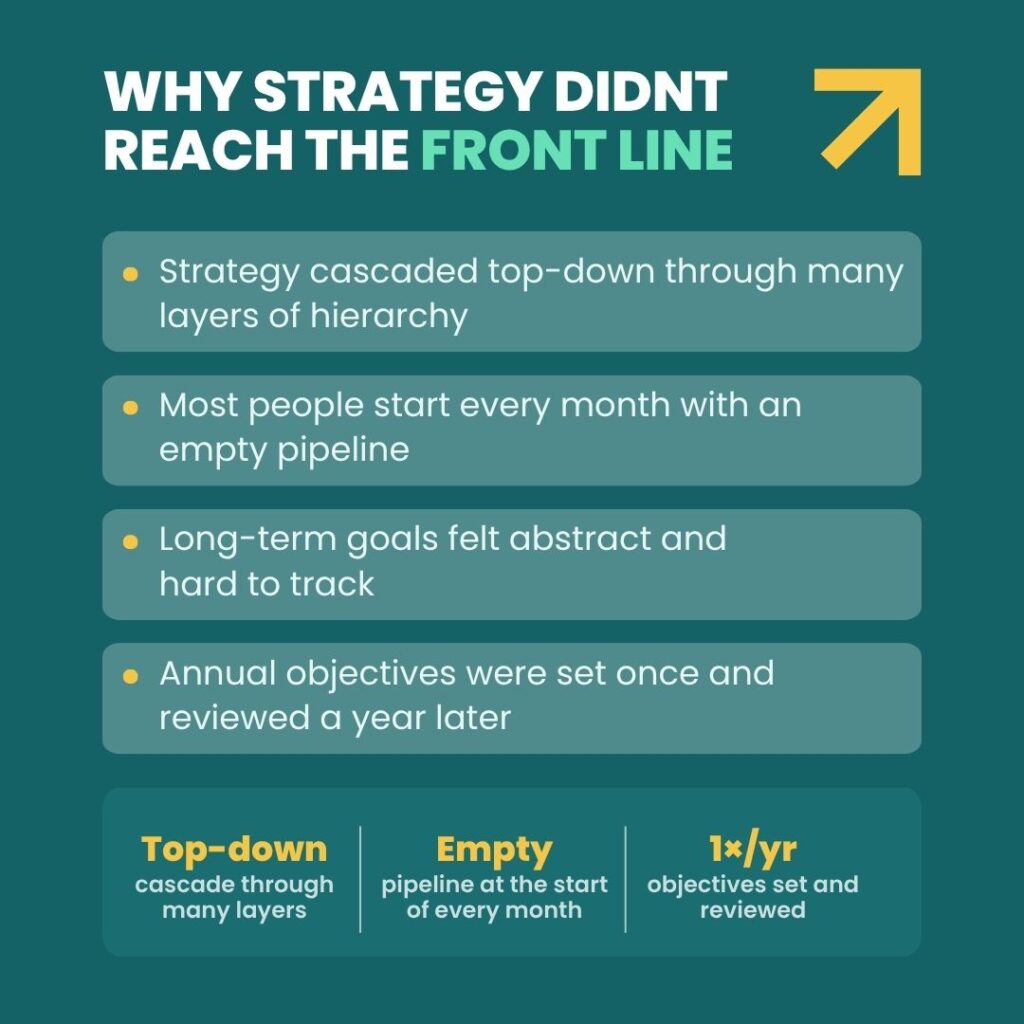
With multiple layers of hierarchy and a traditional top-down approach to cascading objectives, the connection between company direction and day-to-day work was difficult to maintain. As Claire describes it: “Strategy and objectives were very much cascaded top-down. With multiple layers of hierarchy, it became complicated for employees to connect their daily activities with the company’s long-term direction and to track progress against it.”
A compounding factor was the nature of SThree’s sales environment. Most employees begin each month with an empty pipeline, which creates constant pressure to focus on short-term delivery. Long-term objectives can feel abstract against that backdrop, making it harder still to sustain attention on what matters strategically.
From the global level, Scott observed a parallel gap. The company set annual objectives with twelve-month review windows – goals established at the start of the year and formally assessed more than a year later. “We needed something more dynamic,” he explains. “Something that drove the strategy forward and gave us more than a one-and-done approach to objectives.”
Two Approaches to OKR Implementation with one goal
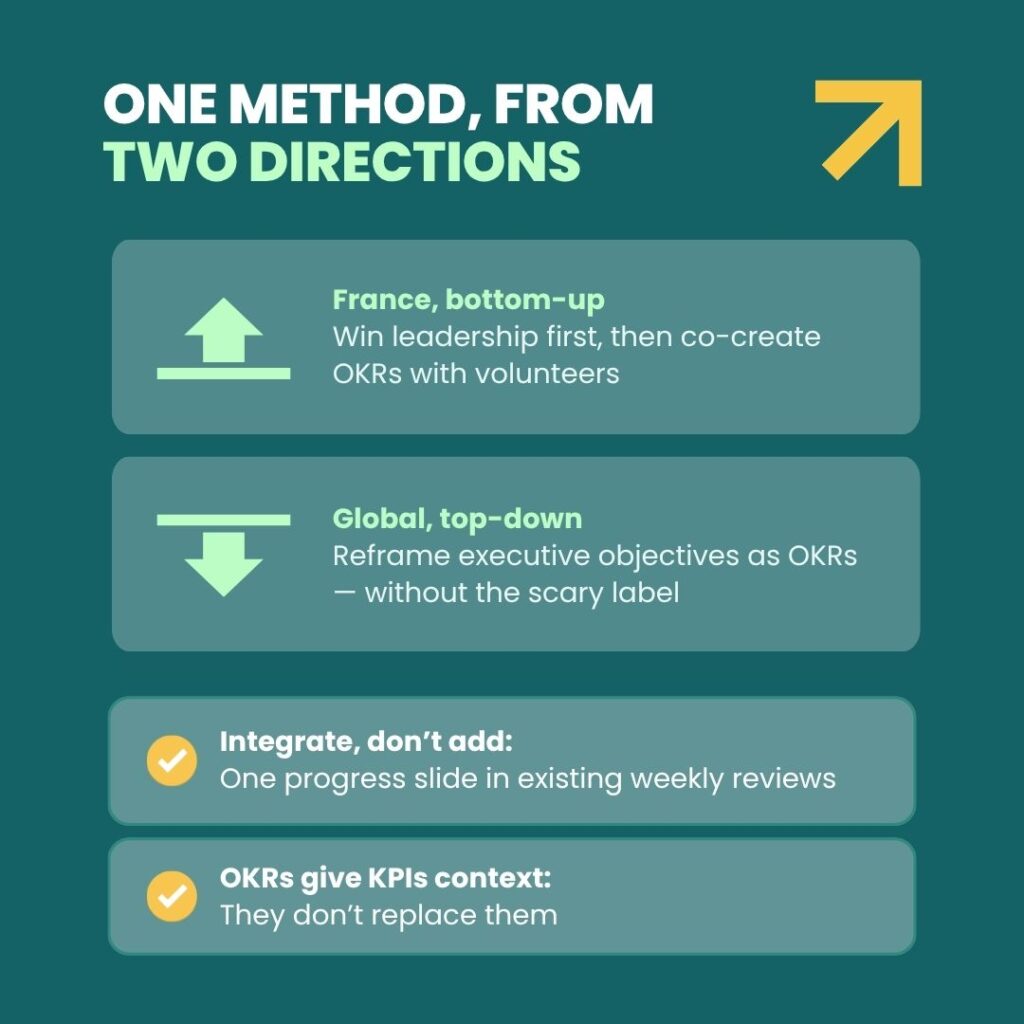
What makes SThree’s story instructive is that OKRs entered the organization from two directions at once, without either team knowing about the other until later.
Bottom-Up OKR Implementation in France
Claire began exploring OKRs in late 2021 in preparation for the 2022 cycle. Her primary objective was employee engagement, and she believed that required a bottom-up approach. But she also knew that no bottom-up initiative survives without leadership commitment, so she started there.
The French management team was brought in first. They built familiarity with the methodology through events, reading, and conversations with organizations already using OKRs. Only once leadership was genuinely on board did the work of setting the organization’s first OKRs begin, in close collaboration with a small, self-selected group of volunteer employees who wanted to shape the process from the start.
The 2022 rollout was deliberately low-friction. Online learning helped teams understand what OKRs were, how they differed from KPIs, and what the benefits looked like in practice. To keep adoption as easy as possible, the team tracked OKRs using a simple spreadsheet and added a single slide to existing weekly reviews rather than introducing new meetings or new systems. “We decided to make it as simple as possible and integrate it into the weekly routine, so it had as limited an impact as possible on daily workloads,” Claire explains.
Executive-Led OKR Adoption Across the Global Teams
When Scott joined SThree roughly three years after Claire started in France, he was pleased to discover an active OKR practice already running in the business. His own approach, however, began from the opposite end.
Scott worked with the executive committee to reframe their personal objectives closer to an OKR format – not a purist implementation, but consistent with the core principles. This gave functional and regional leaders clear sight lines into what executive committee members were trying to achieve and why, making cascading more meaningful.
He was also intentional about introducing the methodology without triggering resistance. “I did not call them OKRs when I launched them. It was simply an objective-setting process. Although the template I built did say ‘objectives and key results.’ By presenting people with a familiar-looking PowerPoint template rather than a named framework, he removed the fear factor before it had a chance to form.
SThree settled on half-year cycles, which Scott describes as giving the business enough rhythm to track progress meaningfully as strategy moved into action.
Overcoming Resistance to OKRs
Both Claire and Scott encountered the classic obstacles. Neither treated them as reasons to slow down.
Understanding the Difference Between OKRs and KPIs
In France, the most consistent pushback came from leaders who were comfortable with KPIs and uncertain about what OKRs added. The answer was not to replace KPIs, but to position them differently. “OKRs do not replace KPIs. They give them context. Once people understood how to use the two together, resistance dropped quickly.”
Addressing Employee Concerns About OKR Workloads
Both teams faced the assumption that OKRs would add overhead to already full workloads. The response was integration, not addition. Instead of standalone OKR reviews, Claire embedded a single progress slide into existing weekly and monthly meetings. Scott positioned the shared OKR template as a tool that served multiple purposes across objective-setting, performance reviews, and strategy sessions – framing it as a time-saver rather than an addition to the calendar.
Showing Employees the Value of OKRs
Employees wanted to understand what OKRs offered them, not just the organization. Claire found that once people understood how OKRs could bring more focus, clearer priorities, and a reduction in the pressure to do everything at once, adoption accelerated.
Building Internal OKR Champions Across Teams
A bottom-up approach also revealed something a top-down rollout often misses: some of the strongest advocates sit outside the management layer. “Some of our most effective champions were not managers. That is one of the most powerful ways to drive change in an organization – when it comes from every level.” People with an appetite for novelty or a naturally structured mindset tend to connect with OKRs early, and their enthusiasm becomes contagious.
How OKRs Improved Team and Leadership Conversations
One of the clearest changes OKRs brought to SThree was not just in the metrics, but in the quality of the conversations. KPI reviews are quantitative by design: you either hit the number or you did not. OKR reviews open up different questions.
As Claire explains: “KPIs are quantity-driven. The conversation becomes: you reached 50, you should have reached 75, what happened? With OKRs, you can ask very different questions: how might we approach this differently? What is this result telling us? That shift brings a more coaching-oriented style into management conversations, and that adds genuine value beyond what KPIs alone can offer.”
Results of the OKR Implementation
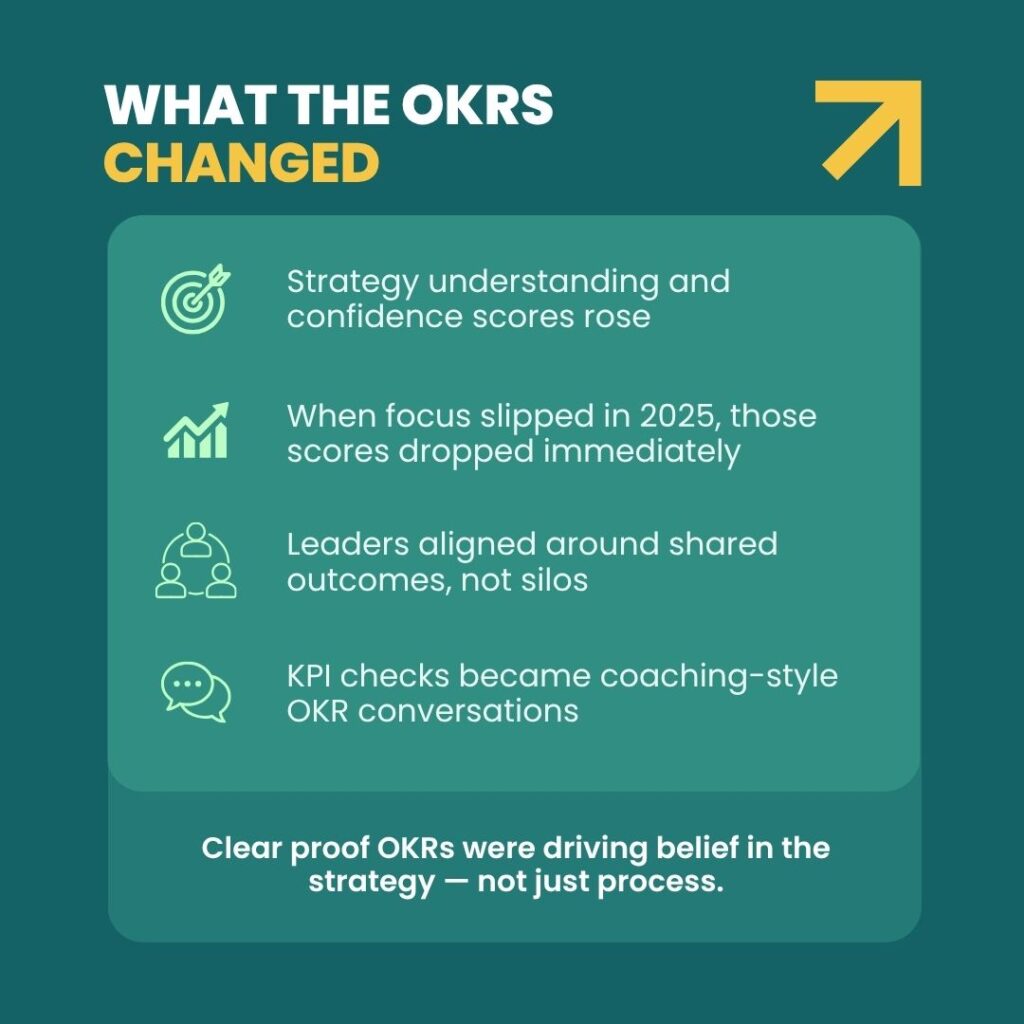
In France, the impact was measurable and direct. SThree runs engagement surveys twice a year, and scores around strategy understanding and confidence had been low before OKRs were introduced. As the program developed, those scores improved significantly.
What brought the connection into even sharper focus was what happened in 2025. A period of shifting market conditions drew organizational attention away from OKRs, and the program lost momentum in France as teams responded to external pressures. The drop in engagement scores was immediate and clear. “We saw much lower scores on strategy understanding and confidence as soon as we stepped back from OKRs,” Claire notes. The clarity OKRs had built did not sustain itself without active reinforcement.
For 2026, the French management team has renewed its commitment. The 2025 experience, though unwelcome, became the clearest evidence yet that OKRs were not a process exercise. They were directly linked to how well employees understood and believed in the direction of the business.
At the global level, Scott observed OKRs creating better alignment across functions, encouraging executive committee members to move beyond individual functional priorities toward shared outcomes. “OKRs are a vital link between the strategy, the plan, and what people’s actual activities are,” he notes.
Onboarding Employees Into the OKR Framework
With any methodology, bringing new joiners up to speed is critical. In France, Claire integrated OKRs into the onboarding process through a dedicated learning module, giving new employees a grounding in the methodology and a clear connection between their daily work and the team’s active OKRs.
From the global level, Scott takes a more graduated approach, establishing clarity at the senior leadership level and expecting that clarity to cascade downward, while remaining conscious of the existing norms and processes each region or function has developed. “It is about building trust gradually, winning people over over time, and creating more clarity across the organization” he reflects.
Key Lessons from SThree’s Journey
Simplicity is not the easy option. A PowerPoint template and a spreadsheet were enough to get SThree started. But as Scott notes, quoting Churchill: writing something short always takes more effort than writing something long. Getting to simple takes real thought.
OKRs and KPIs are not in competition. They serve different purposes. KPIs measure performance; OKRs give that performance strategic context. Organizations that understand this distinction sidestep a significant source of resistance.
When focus slips, clarity slips with it. France’s 2025 experience is a clear-eyed reminder that OKRs require ongoing commitment. They are not a system you install and leave running. “It is not a sprint. It is a marathon, and it requires constant reinforcement,” Claire emphasizes.
Champions come from everywhere. Do not design your champion network around the org chart. Some of the most effective advocates are individual contributors who connect with the methodology personally.
Start wherever you can gain traction. Bottom-up in France. Top-down at the global level. Neither approach was wrong. Both created momentum. The best starting point is wherever people are ready to move.
OKRs change the conversation, not just the goals. The shift from purely quantitative KPI reviews to coaching-oriented OKR discussions was one of the clearest ways SThree saw value beyond the framework itself.
SThree’s experience challenges the idea that OKRs only belong in fast-moving, agile organisations. They took root in a traditional, hierarchical, sales-driven environment, without sophisticated tooling, without a coordinated rollout, and without the luxury of organizational agility. What made them work was sustained commitment, practical simplicity, and the discipline to keep going even when the rollout was uneven.
To learn more about how OKR Mentors works with organizations on strategy execution and OKR implementation, visit www.OKR Mentors.com.