

Groupe Rocher, a global beauty company with $2.4 billion in revenue and 16,000 employees worldwide, embarked on an ambitious OKR transformation journey that has yielded impressive results. This case study explores how they successfully implemented OKRs throughout their organization and the impact it has had on their business.
Why Group Rocher Adopted OKRs to Drive Strategic Focus
When a new CEO took the helm at Groupe Rocher in June 2023, he immediately identified the need to develop a stronger results-oriented culture. While employees throughout the company were working hard, there was insufficient focus on outcomes. The CEO saw OKRs as the perfect methodology to:
- Develop a results-oriented culture
- Create better organizational focus
- Strengthen alignment across the company
What’s notable is that from the outset, the CEO didn’t want to pilot OKRs in just one department or business unit. Instead, he aimed for company-wide implementation starting from the executive level.
Lionel Quenet, Head of Organization and HR Development at Groupe Rocher, led this transformation initiative, bringing expertise in organizational change and a deep understanding of how to embed new methodologies into company culture and day-to-day operations.
Group Rocher’s OKR Implementation Journey
Groupe Rocher’s OKR rollout was carefully orchestrated to ensure sustainability and acceptance throughout the organization. Let’s examine this journey in greater detail:
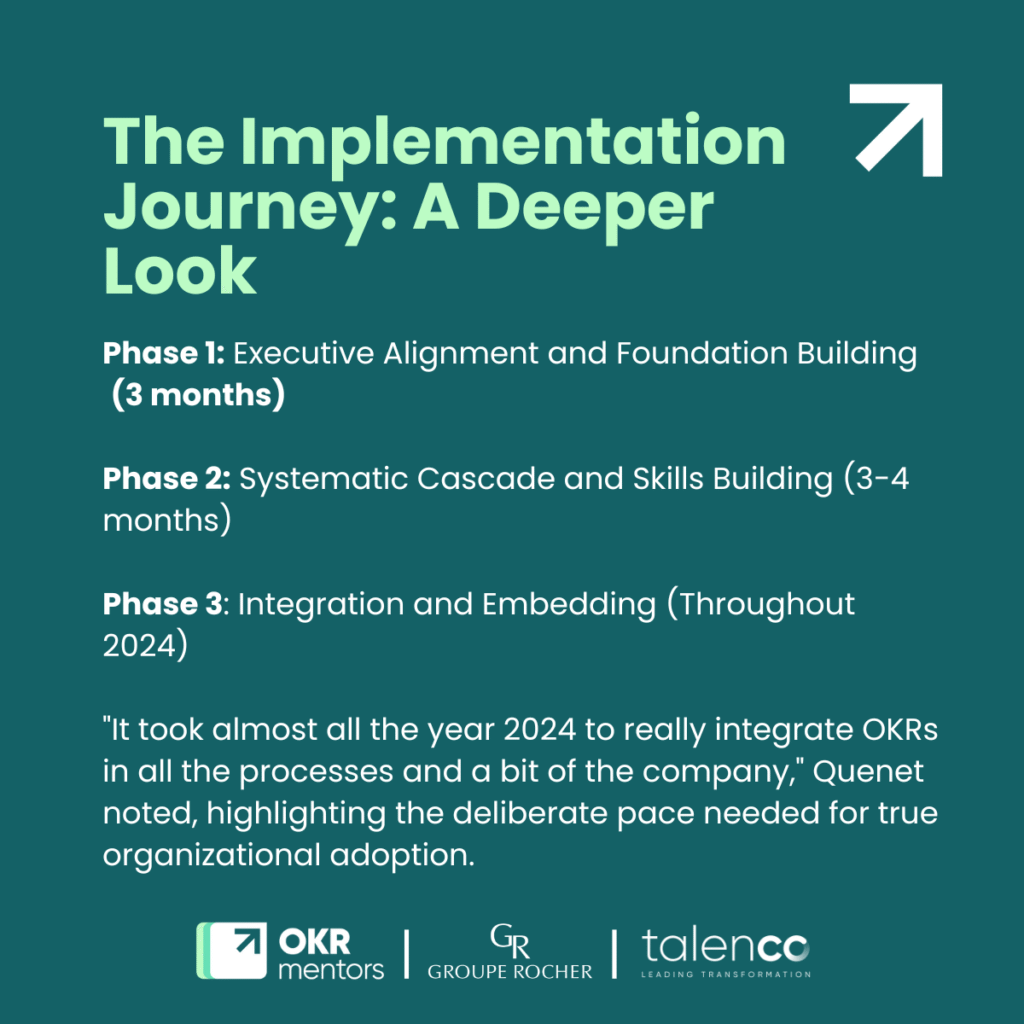
Phase 1 – Building Strategic Alignment Through OKRs
The first three months (June-September 2023) were critical for establishing a solid foundation for OKRs within Groupe Rocher:
- Leadership Immersion: The CEO and executive committee underwent comprehensive OKR training to understand not just the mechanics but the mindset shift required.
- Strategic Priorities Mapping: Executives worked to translate the company’s strategy into clear, actionable objectives with measurable key results.
- Co-creation Process: Rather than imposing OKRs from above, executives were involved in collaborative workshops to define the company’s first set of OKRs.
- Practical Application: Leadership practiced working with OKRs themselves before asking others to adopt the methodology.
This deliberate start ensured the executives weren’t just sponsors but true practitioners of the OKR methodology. As Lionel Quenet explained: “We trained and defined the OKRs at the Exco level to be sure that all the Exco members are embarked in the approach.”
Phase 2 – Scaling OKRs Across Teams and Functions
With executive commitment secured, Groupe Rocher launched an ambitious training and implementation phase:
- Widespread Training: A massive skills development program targeted approximately 800-1,000 employees across 80 teams, reaching the first and second levels of the organization.
- Learn-by-Doing Approach: Training wasn’t theoretical—each session combined methodology instruction with hands-on application.
- Workshop-Based Development: Facilitated sessions helped teams craft their own OKRs that aligned with higher-level objectives while addressing their specific mandates.
- Alignment Reviews: After teams created their OKRs, they underwent reviews to ensure proper alignment with the company’s strategic priorities.
- Practical Application Support: Teams received guidance on implementing their first quarterly OKR cycles, including setting up tracking mechanisms.
Lionel Quenet highlighted the practical nature of their approach: “The first part of the session was training and then immediately go to action to build the OKRs for each team… to be sure that they immediately put in practice what they’ve learned.”
Phase 3 – Embedding OKRs into Strategy Execution
The true test of any methodology is how well it becomes part of the organization’s fabric. Groupe Rocher focused heavily on this integration phase:
- Multi-Channel Communication: The company created videos, internal website content, and other materials to explain the methodology and its benefits.
- Transparency Initiative: Executive OKRs were published and made accessible to all employees, modeling openness and clarity.
- Meeting Redesign: Team meetings and business reviews were restructured to incorporate OKR discussions and progress tracking.
- Process Integration: OKRs became central to planning cycles, performance discussions, and strategic reviews.
- Ritualization: Regular OKR check-ins became standard practice, creating a rhythm of accountability.
- Feedback Loops: The company established mechanisms to gather input on implementation challenges and success stories.
“It took almost all the year 2024 to really integrate OKRs in all the processes and a bit of the company,” Quenet noted, highlighting the deliberate pace needed for true organizational adoption.
How Groupe Rocher Built Long-Term OKR Support
Groupe Rocher recognized that successful OKR implementation requires ongoing support, not just initial training. They developed a multi-faceted support structure:
OKR Champion Network
The cornerstone of their support strategy was a network of dedicated OKR Champions:
- Strategic Selection: 12 Champions were carefully chosen across different brands and functions to ensure comprehensive coverage.
- Span of Influence: Each Champion supported 8-10 teams, providing guidance on OKR development, tracking, and refinement.
- Expertise Development: Champions received specialized training beyond what general employees received, enabling them to address specific challenges.
- Community of Practice: Regular Champion meetings facilitated knowledge sharing, problem-solving, and consistency across the organization.
- Direct Leadership Connection: Champions had access to leadership to escalate systemic issues or highlight success stories.

Want to learn directly from stories like this?
The OKR Forum is where these real-world journeys are shared first—by the leaders who lived them. Join us in 2026 to get firsthand insights, ask your questions live, and connect with practitioners who are driving real strategy execution and transformation across industries.
Collaboration with OKR Partners and Teams
Groupe Rocher leveraged both internal resources and external expertise:
- Partnership with Talenco: A training and consulting partner (Talenco) provided specialized OKR implementation expertise for large organizations.
- Hybrid Training Approach: “Both internally and with some external support on the methodology,” as Quenet described, ensured quality and consistency in the training rollout.
- Knowledge Transfer: The external partners progressively transferred capabilities to the internal champions.
Governance for Effective OKR Implementation
To ensure quality and consistency, Groupe Rocher established:
- Regular Check-ins: The champions met weekly to discuss progress and challenges.
- Quality Assurance Reviews: OKRs were regularly assessed for proper structure, results orientation, and alignment.
- Corrective Coaching: When teams reverted to activity-based metrics rather than outcome-focused key results, champions would intervene with guidance.
- Cross-Functional Alignment Checks: Special attention was paid to identifying overlapping or conflicting OKRs between departments.
Maintaining a Results-Driven OKR Culture
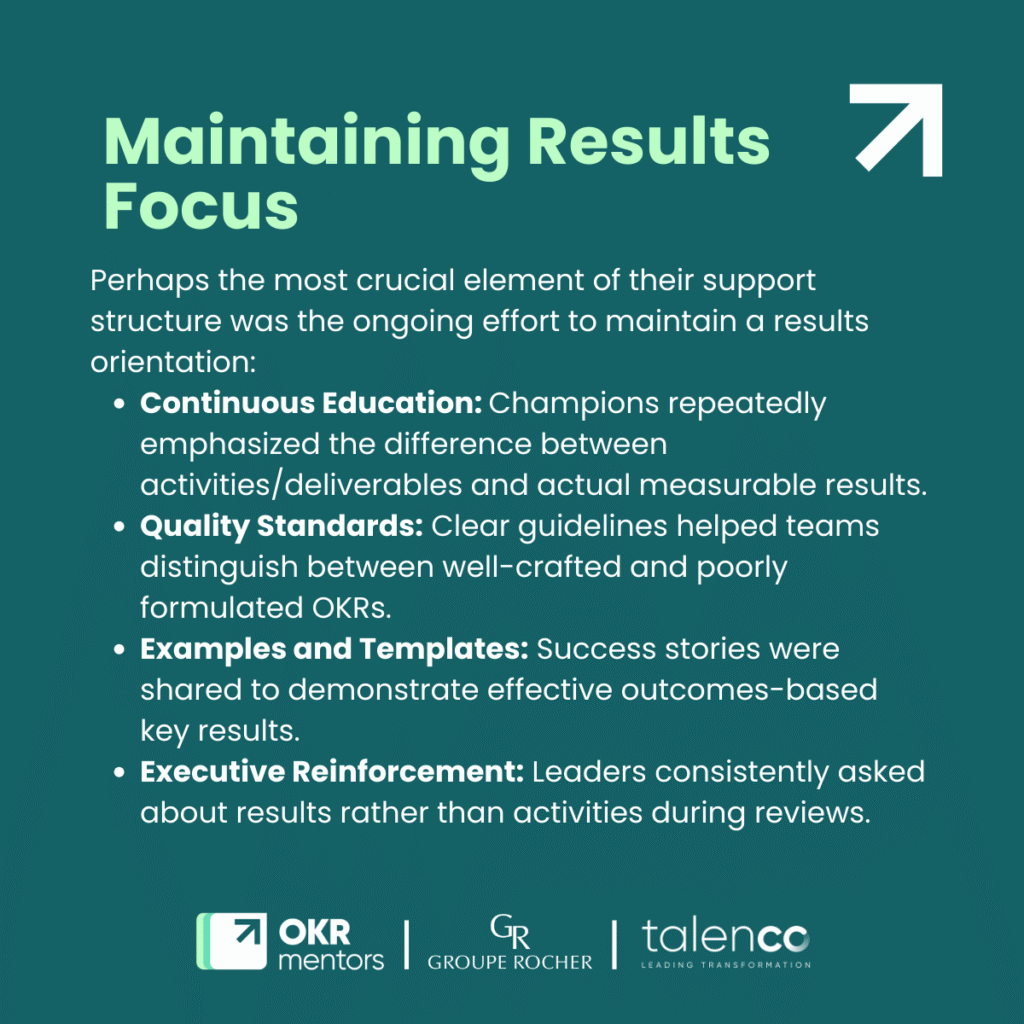
Perhaps the most crucial element of their support structure was the ongoing effort to maintain a results orientation:
- Continuous Education: Champions repeatedly emphasized the difference between activities/deliverables and actual measurable results.
- Quality Standards: Clear guidelines helped teams distinguish between well-crafted and poorly formulated OKRs.
- Examples and Templates: Success stories were shared to demonstrate effective outcomes-based key results.
- Executive Reinforcement: Leaders consistently asked about results rather than activities during reviews.
As Quenet explained: “We need to check again and again, repeat, push a little bit the teams to be sure that they apply properly and they go for this culture of results and not only means.”
Cross-Team Collaboration
A particularly powerful element of Groupe Rocher’s approach was their focus on shared key results between teams:
- Intentional Overlap: While not artificially forced, teams were encouraged to identify where their objectives naturally intersected.
- Joint Accountability: When multiple teams shared responsibility for a key result, they developed joint action plans.
- Transparency Tools: All teams could see other teams’ OKRs, facilitating identification of potential collaborations.
- Future Focus: For 2025, Groupe Rocher plans to further strengthen this area: “That’s going to be one of the improvements – to be sure that when we look at on a transversal point of view, some teams share the same objectives and OKRs.”
By expanding the implementation journey details and support structure, we can see that Groupe Rocher’s success wasn’t accidental but the result of thoughtful design, persistent reinforcement, and systematic support – providing valuable lessons for other large organizations undertaking similar transformations.