

Objectives and Key Results (OKRs) have become mainstream, yet outcomes still vary widely. Many teams try OKRs but struggle when practice is inconsistent, language is unclear, or adoption fades after the first few cycles. An OKR Certification is not a badge for LinkedIn. It’s a way to learn proven patterns, avoid common traps, and signal that you can connect strategy to measurable outcomes.
Three shifts make OKR mastery especially important today. First, strategy cycles are shorter, and leaders need a method that translates direction into weekly action without adding heavy governance. Second, most work now happens across functions, so teams need a shared language to focus on outcomes rather than tasks. Third, the job market rewards professionals who can guide change confidently and show results with evidence.
If you want more context on how leadership and capability building are evolving, explore Business Strategy Training Trends and Business Strategy Trends 2025.
What Great OKR Practice Looks Like
Strong OKR practice is calm, clear, and repeatable. Objectives are few and directly tied to strategy. Key Results describe measurable outcomes rather than lists of activities. Cadence is steady, with short weekly check-ins, honest monthly reviews, and quarterly resets that maintain focus. Dependencies are visible, and leaders coach for clarity instead of inspecting for compliance. Tools support the process, they don’t drive it.
High-quality OKR certification programs teach you how to design this operating rhythm. They show you how to write effective OKRs, facilitate productive reviews, coach teams through adoption, and connect OKRs to KPIs and financial planning. The goal is to make ambition measurable and grounded.
How OKR Certification Creates Impact
For individuals
An OKR certification gives hiring managers a quick way to assess capability, but more importantly, it gives you a practical method to lead change. You’ll learn how to translate strategy into outcomes that span teams, facilitate reviews that drive decisions, and demonstrate progress with reliable data. These skills are valuable across functions such as product, operations, finance, HR, and PMO, and are essential for roles like Strategy Ops or Chief of Staff, where influence matters more than authority.
For organizations
Organizations that invest in certification gain shared standards and discipline. Teams learn to articulate intent clearly, reduce goal clutter, and measure results consistently. Leaders benefit from a predictable cadence that surfaces trade-offs early, making governance lighter and more adaptive. Over time, this creates a culture of focus, learning, and scalable success.
Choosing a Credible OKR Certification Program
Not all certifications are equal. Look for four signals that indicate real value:
- Comprehensive curriculum: It should connect strategy, OKR design, and execution rhythms, not just the syntax of writing OKRs.
- Applied learning: The program should include feedback on your real OKRs so you learn by doing.
- Rigorous assessment: Evaluation should test your ability to apply concepts, not just attend sessions.
- Sustained support: Strong programs offer templates, office hours, or communities of practice that continue after the course.
If a provider can demonstrate success in diverse industries beyond software, that’s a sign the method travels well.
The ROI of OKR Certification in Plain Terms
You don’t need a complex model to understand the return. When teams halve their number of priorities, clarity rises and context switching drops. If leaders agree on outcomes before execution, rework decreases. When check-ins are short and reviews are honest, you reclaim weeks of productive time each quarter. Even conservative estimates show most organizations recover the training investment within a single OKR cycle.
OKR Certification Quality Checklist
1) Program Foundations and Credibility
- Clear ownership, accreditation, or recognized industry standing.
- Transparent learning objectives mapped to job roles and seniority levels.
- Published syllabus with contact hours and workload expectations.
- Instructor bios show real implementation experience across multiple contexts.
- Conflicts of interest disclosed when the provider also sells software.
2) Curriculum and Learning Design
- Covers strategy linkage, portfolio alignment, OKR design, and execution cadence.
- Includes integration with KPIs, financial planning, and governance practices.
- Balances concepts with practice, case discussions, and real examples.
- Designed for transfer, with job aids, templates, and checklists.
- Addresses common failure modes and adoption patterns, not only syntax.
3) Practice, Coaching, and Feedback
- Hands-on exercises using your real goals or realistic scenarios.
- Incorporates real-life case studies from diverse industries showing how implementation challenges are resolved in practice.
- Structured feedback on draft OKRs and facilitation practice.
- Opportunities to rehearse weekly check-ins and monthly reviews.
- Rubrics used for feedback are shared in advance.
4) Assessment and Certification Standard
- Assessment tests application, not attendance, with clear pass criteria.
- Multiple methods, such as written submission, facilitation demo, and quiz.
- Independent grading or moderation to avoid bias.
- Credential level is explicit, for example practitioner, leader, or coach.
5) Transfer to the Workplace
- Tool-agnostic methods that work with any software or spreadsheets.
- Starter kit including templates for cadences, review agendas, and rollout plans.
- Guidance for change management and stakeholder alignment.
- Manager enablement materials to scale beyond the first team.
6) Post-Course Support and Community
- Office hours, mentor access, or cohort community for at least three months.
- Access to in-depth playbooks that provide step-by-step guidance for rollout, review cadences, and leadership enablement.
- Updates to templates and guidance as practices evolve.
- Pathways to advanced credentials or specializations.
7) Evidence and Outcomes
- Case studies from multiple industries and company sizes.
- Documented learner outcomes such as promotion or deployment success rates.
- Employer testimonials and repeat enrollments.
8) Logistics, Accessibility, and Ethics
- Flexible delivery options, captioning, and accessible materials.
- Transparent pricing, group rates, and refund policy.
- Code of conduct and data privacy standards for participant work.
- Recertification requirements that are clear and reasonable.
Why Organizations Believe OKRmentors Deliver the Gold Standard in OKR Certification
What sets OKRmentors apart is the blend of academic rigor, hands-on expertise, and community learning. Each instructor is an active practitioner involved in real strategy execution projects, not just a trainer. Our certification combines design, cadence, and leadership coaching so participants can translate OKRs into measurable impact from day one.
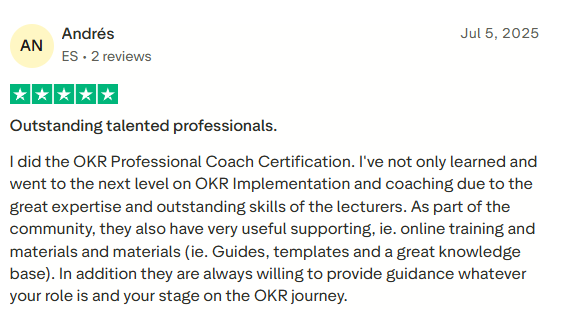
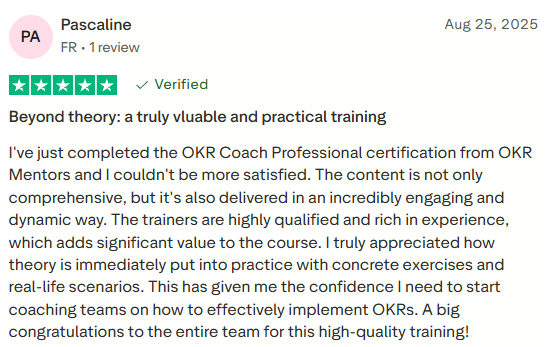
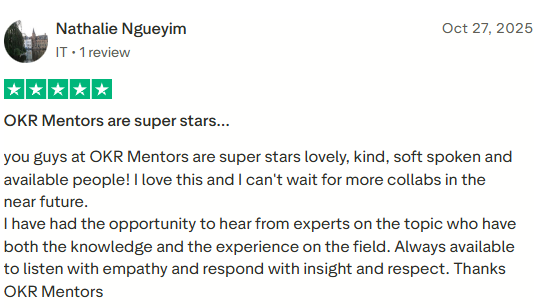
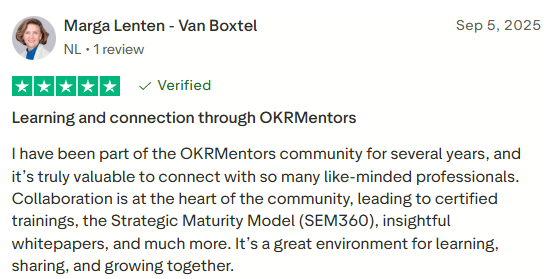
Unlike generic courses, the OKRmentors program integrates field-tested playbooks, executive-level case studies, and diagnostic tools such as the Strategy Execution Maturity 360 model (SEM360™). As evidenced by Trustpilot, organizations trust us because our graduates consistently deliver higher adoption rates and measurable business outcomes.
Where to Go Next
If you want data on how leaders invest in skill development, read Business Strategy Training Trends.
If you want to see where execution practices are heading, read Business Strategy Trends 2025.
For hands-on learning, select an OKR certification that teaches OKR design, cadence, and coaching: Use the checklist above to evaluate the quality before you commit.
Each cohort brings together practitioners who shape how OKRs evolve in real organizations. That’s why OKRmentors certifications have become the benchmark for professional excellence in strategy execution.