
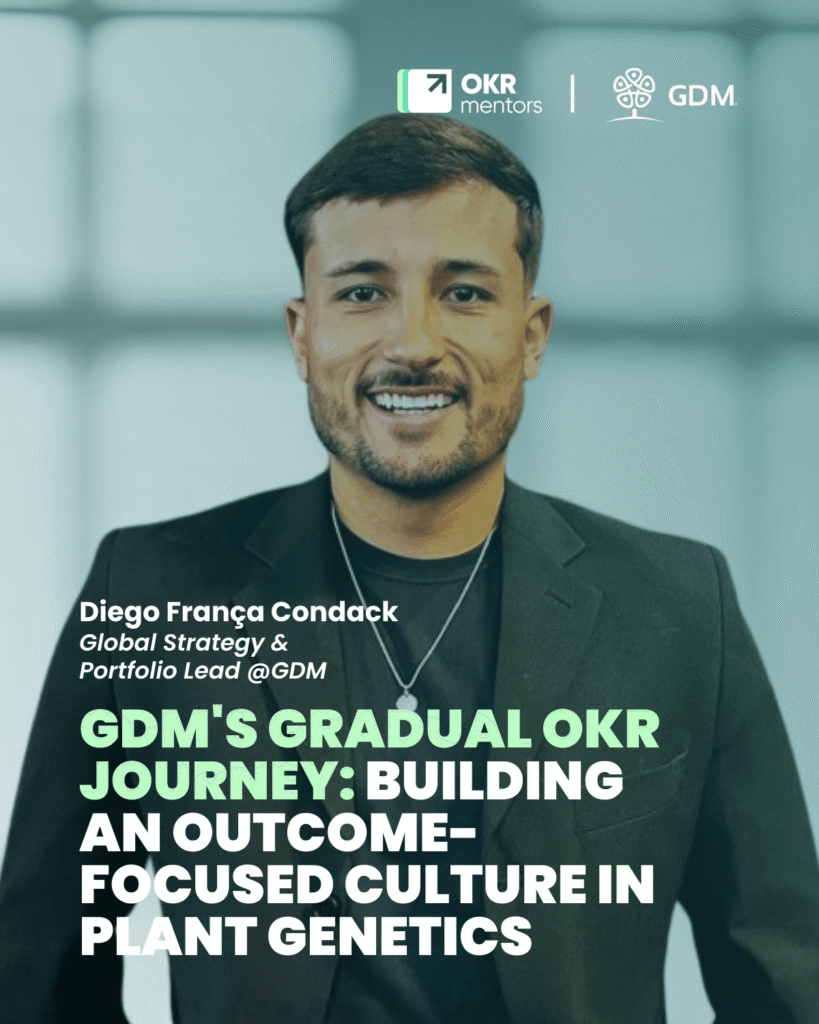
Navigating change in a science-driven industry requires patience and precision. For GDM, a global leader in plant genetics with over 40 years of experience, implementing OKRs wasn’t just about adopting a new management framework – it was about carefully evolving their company culture while respecting their scientific DNA of curiosity and innovation.
This transformation was made possible through a strategic partnership with Oboard, the OKR software platform that became the backbone of GDM’s success, enabling them to build a scalable, integrated system that connected thousands of employees and external vendors to strategic objectives.
The Company: Global Impact in Agriculture
GDM stands as a powerhouse in the plant genetics industry, specializing in genetic inclusion and seed development for crops like soybeans, corn, wheat, sunflowers, and sorghum. Operating in 15 countries with 700 hours for testing plots and analyzing 1.8 million soy plots yearly, their work adapts crop varieties to different climatic conditions and regional needs.
What makes GDM particularly impactful is their global reach: 45% of the world’s soybeans are produced with GDM genetics. Their work directly contributes to agricultural efficiency and sustainability worldwide.
The Challenge: From Project Delivery to Strategic Outcomes
As GDM expanded rapidly in 2023, they encountered several roadblocks:
- Coordination challenges across teams: With 60 internal team members and 200 external vendors each using different tools to manage projects, coordination became chaotic
- Resistance to tracking and accountability: Teams were hesitant to adopt new tracking methods
- Misalignment between departments: Different teams worked in silos
- Difficulty communicating company strategy: Conveying strategic objectives to employees at all levels proved challenging
These challenges prompted GDM to seek a solution that would provide greater transparency across projects and create a dedicated strategy layer above portfolio management.

A Gentle Approach: Building the OKR Muscle Gradually
Rather than implementing a complete OKR framework overnight, GDM took a unique, incremental approach:
Year 1: Focus on Objectives Only
- Started by simply connecting projects to strategic objectives
- No specific metrics attached to objectives initially
- This helped develop a habit of linking daily work to strategic goals
- Employees weren’t pressured with exact numbers or complex processes
“We knew that with such a big change, it would be far from perfect in the beginning. But getting alignment and ownership was critical,” noted Diego França, Global Delivery Manager at GDM.
GDM consciously chose not to label this as an “OKR implementation” for their broader audience of thousands of employees. Instead, management introduced it simply as “working with objectives” and linking projects to them. This approach reduced resistance and helped teams adapt gradually.
Manual Start, Digital Transformation
In the beginning, tracking OKRs was highly manual, consuming approximately 260 hours per year just updating progress. As the process matured, GDM integrated their OKR system with their project management tools, using Jira and Oboard to create a more efficient process.
By integrating with Jira, GDM created a unique solution where even external vendors could contribute to the scoring of objectives automatically without seeing the strategic goals themselves. This innovation allowed external teams to work alongside internal teams while maintaining strategic confidentiality.

Want to learn directly from stories like this?
The OKR Forum is where these real-world journeys are shared first—by the leaders who lived them. Join us in 2026 to get firsthand insights, ask your questions live, and connect with practitioners who are driving real strategy execution and transformation across industries.
Year 2: Adding Key Results
After a year of working with objectives, GDM began introducing key results to measure their impact. For example:
- Objective: Deliver impactful projects to customers
- Key Result: Deliver and implement 3 new tools for the R&D department
- Key Result: Increase customer satisfaction by 20%
- Objective: Establish a robust governance strategy
- With corresponding measurable key results
- With corresponding measurable key results
- Objective: Enhance OKR adoption
- Focus on improvement and transparency
- Track execution and alignment across teams
Results: Creating a Strategy-Focused Culture
GDM’s gradual OKR implementation showed impressive results:
- Time savings: 260 hours saved annually by using an integrated goals management tool
- Strategic alignment: Tracking the progress of 3 directors and 10 departments, including external vendors
- Automated processes: Streamlined operations and reporting
- Improved project reliability: More reliable and faster deliverables through automated processes
- Cultural shift: Teams began thinking about end goals rather than just completing tasks
The implementation has grown to include:
- 41% of objectives completed
- 110 items connected to Jira
- 7 groups working on objectives
- 50 people directly involved
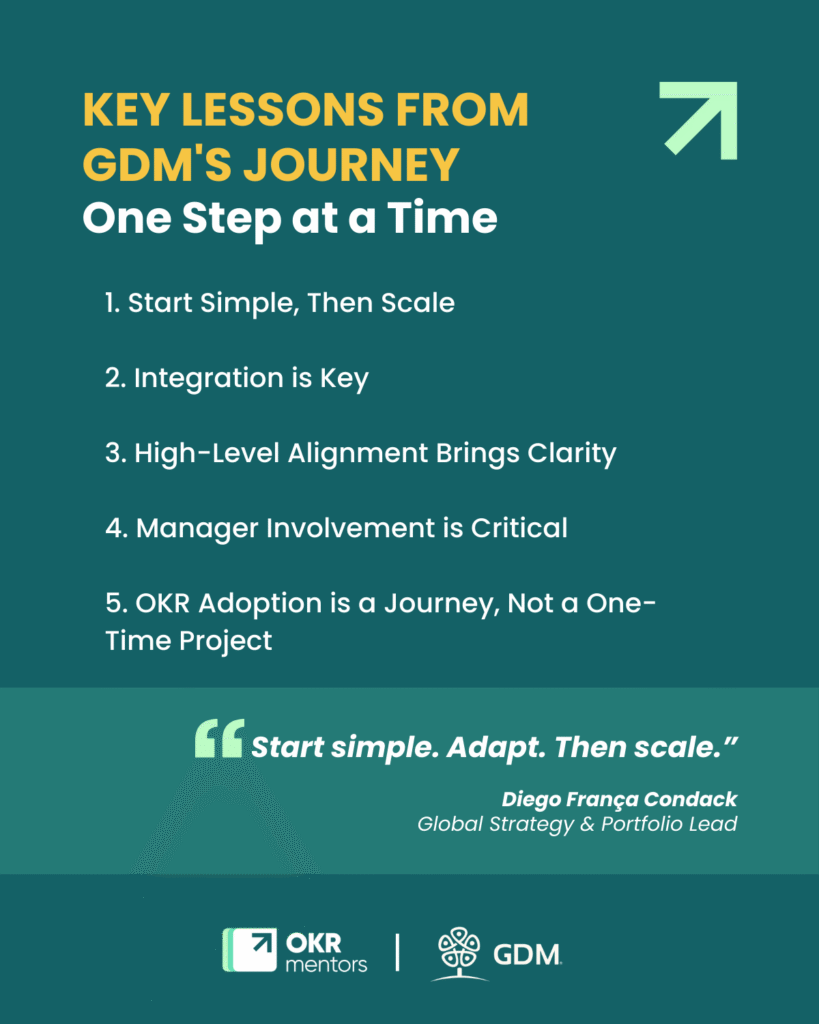
Key Lessons from GDM’s Journey
GDM’s approach offers valuable insights for organizations considering OKR implementation:
1. Start Simple, Then Scale
Begin with the basics (objectives only) and gradually add complexity (key results) as teams adapt. This approach builds familiarity and reduces resistance.
2. Integration is Key
Connecting OKRs to the tools teams already use creates a seamless workflow and higher adoption rates. This integration made it possible to include external vendors in the system.
3. High-Level Alignment Brings Clarity
When leadership aligns on strategic objectives first, teams gain clarity on priorities and focus.
4. Manager Involvement is Critical
Managers were essential in helping teams adapt, especially when mistakes occurred. They provided guidance and reinforcement of the new approach.
5. OKR Adoption is a Journey, Not a One-Time Project
GDM emphasized that building an OKR culture takes time. Their advice: “Start small, adapt, and scale gradually.”
Future Plans: Expanding the OKR Framework
In 2025, GDM plans to continue maturing their OKR approach by:
- Expanding OKR processes to all departments
- Constructing an IT strategic area to establish a full-scale OKR framework
- Balancing OKRs with operational work (80% focus on foundations, 20% on significant changes and new technologies)
Conclusion
GDM’s approach to OKR implementation demonstrates that successful adoption doesn’t require an all-or-nothing approach. By starting with just objectives and gradually adding key results as teams became comfortable, they created sustainable change and built a culture focused on outcomes rather than just project delivery.
Their story proves that patience, adaptability, and a willingness to customize the OKR framework to fit an organization’s unique needs can lead to meaningful transformation, even in established industries with complex processes.