

What’s in Your Way to Become a Strategy Execution Leader?
Achieving strategy execution maturity, turning vision into results, depends on how effectively an organization defines and aligns its goals. Goal-setting frameworks provide the structure to turn vision into clarity, focus, and shared priorities. Among the many approaches, OKRs stand out for their ability to connect ambition with strategy execution. And through benchmarking, leaders gain insight into both the progress made and the obstacles that hold maturity back.
Strategy Execution Leaders don’t just choose a goal-setting framework and hope for the best. They build the surrounding capabilities that allow those goals to be delivered consistently. They know that a framework like OKRs is only as effective as the strategy execution system supporting it. At OKR Mentors, we see this pattern across industries: the framework is rarely the limiting factor, the surrounding system is.
The 5 Most Popular Goal-Setting Frameworks (Explained)
Goal-setting frameworks give structure to ambition. The right one aligns teams, focuses effort, and measures progress. Here are the five we see most often when working with clients:
- SMART Goals – Ensures objectives are Specific, Measurable, Achievable, Relevant, and Time-bound.
- KPIs (Key Performance Indicators) – Tracks ongoing performance against strategic targets.
- OKRs (Objectives and Key Results) – Aligns ambitious objectives with measurable outcomes to drive strategy execution.
- MBO (Management by Objectives) – Manager-led goals, set top-down, with clear measures of success.
- BHAGs (Big Hairy Audacious Goals) – Inspiring, long-term goals designed to push beyond the norm.
Goal-Setting Framework Comparison

Connecting Goal-Setting Frameworks to Strategy Execution Benchmarking
Decades of research support what we observe in practice. Locke and Latham’s goal-setting theory shows that specific, challenging goals paired with regular feedback boost performance. Today’s most-used goal-setting frameworks, from SMART to OKRs, are built on that principle.
But there’s a gap. Setting ambitious goals is not the same as delivering them consistently. The strategy execution maturity assessment closes that gap by evaluating the maturity of the system around your goals:
- How well your strategic intent aligns with day-to-day priorities.
- How effectively progress is monitored and acted upon.
- How quickly your organization learns and adapts.
- How capable you are of scaling what works.
- How empowered your teams are to take action without bottlenecks.
In short, goal-setting frameworks define the what and the why. Strategy execution maturity defines the how well and the how consistently.
How SEM360 Reveals the Path to Strategy Execution Leadership
But setting goals is only half the story. Delivering them consistently requires the systems, habits, and capabilities that Strategy Execution Leaders master. At OKR Mentors, we use the Strategy Execution Maturity 360™ assessment to measure how ready an organization is to execute its strategy across five dimensions: Align, Execute, Improve, Scale, Empower. Each is rated on a scale, producing a 100-point maturity index.
Strategy Execution Leaders, the top performers in our benchmarks, consistently score 20 to 30 points higher than the average organization.
What they do differently:
- Empower people to make decisions at the right level.
- Align goals at every level so teams understand how their work connects to strategy.
- Execute with discipline, reviewing progress frequently and removing roadblocks early.
Improve continuously, embedding reflection into every cycle.

The Common Barriers That Hold Organizations Back
Our Global Strategy Execution Maturity index is a benchmark database that shows the same patterns across company sizes and industries. Here are the most common barriers to reaching top-performer status:
Misaligned priorities – Goals at the top don’t connect to team-level work.
Fix: Cascade goals with clear links between strategic objectives and team-level outcomes.
Slow feedback loops – Reviews happen too late to act.
Fix: Adopt shorter strategy execution cycles and regular check-ins to address problems before they escalate.
Overloaded portfolios – Too many initiatives spread focus thin.
Fix: Limit active priorities and focus resources on the highest-value initiatives.
Limited empowerment – Teams wait for approvals instead of acting.
Fix: Define decision rights clearly and delegate authority to the right level.
How Benchmarking Strengthens Your Goal-Setting Framework
When you combine a clear framework like OKRs with a maturity-based approach like the Strategy Execution Maturity 360™ assessment, you get both clarity on the goals and confidence in the delivery system.
At OKR Mentors, we see this clarity make the difference between ambitious goals that stay on paper and those that drive sustained strategy execution. Benchmarking shows exactly where to focus so your chosen framework can operate at full potential.
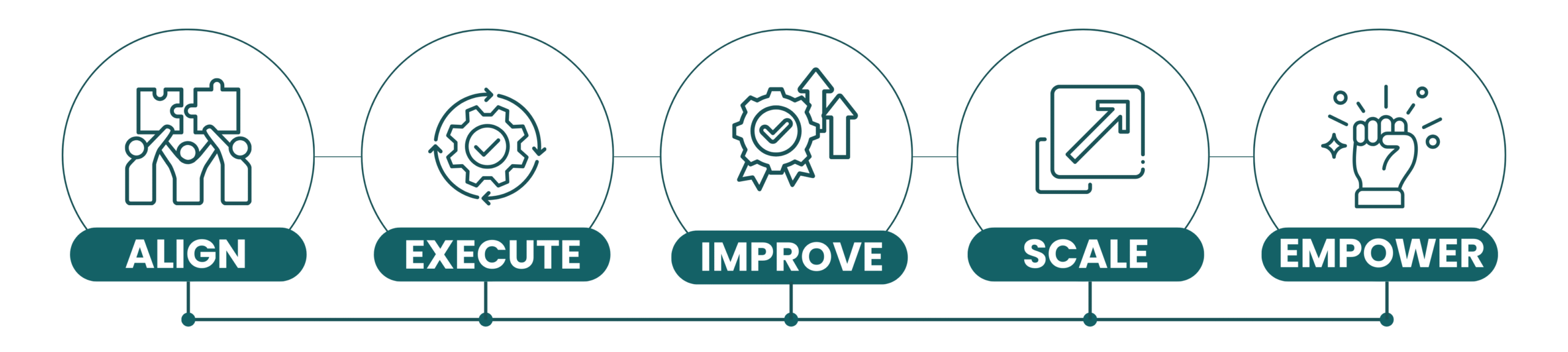
- Align: Shows if top-level goals cascade effectively.
- Execute: Reveals discipline in monitoring and acting on progress.
- Improve: Tests whether reflection and learning cycles are embedded.
- Scale: Measures ability to expand success without losing consistency.
- Empower: Identifies if decision rights and ownership are truly distributed.
In our experience, the fastest improvements happen when leaders focus on one or two dimensions at a time, not a full overhaul. Read our other blogs on strategy execution best practices and deep dive into our strategy execution playbook to continue the journey.
- Strategy Execution Maturity: Turning Vision into Results
- The Core Elements Of Strategy And Why They Matter
- Evaluating the OKR Framework as a Tool for Strategy Execution
