

Setting goals is one thing. Turning them into meaningful results is something else entirely. That is why strategy execution is so important. Decades of research in organizational psychology show that clear and challenging goals significantly improve performance. But goals alone are not enough. The way they are structured, reviewed, and aligned across teams makes the difference between scattered efforts and real execution. That is where frameworks like OKRs (Objectives and Key Results) and KPIs (Key Performance Indicators) come into play. Both are widely used to improve focus, track progress, and support strategic planning. However, they are often thought as OKRs vs KPIs, yet they serve very different purposes.
Confusing them often leads to poor goal-setting habits and missed opportunities. Importantly, OKRs and KPIs often use the same metrics. What changes is the intent behind them.. A metric like churn might sit on a dashboard as a KPI, but when it becomes strategically critical, it can be reframed as a Key Result. In the OKRs vs KPIs debate, this article explores how each work, how they differ, and how they can complement each other. It also looks at legacy frameworks like MBOs (Management by Objectives) and the Balanced Scorecard to give a full picture of how organizations structure performance.
Drawing on experience from hundreds of teams we have worked with at OKR Mentors, we will show how these tools can be combined into a more mature and effective execution system.
What Are OKRs?
OKRs, short for Objectives and Key Results, help teams define bold ambitions and track measurable outcomes. Born at Intel in the 1970s and popularized by Google, they remain the go-to framework for fast-moving, cross-functional environments.
- Objectives are qualitative, inspiring statements of what you want to achieve.
- Key Results are specific, time-bound, and measurable outcomes that signal progress.
OKRs are not activity lists. They are about outcomes, not tasks. At OKR Mentors, we help organizations treat OKRs not just as a framework, but as a mindset that strengthens alignment, focus, and adaptability.
Our Strategy Execution Maturity Model shows that mastering OKRs is a key step on the path from ad-hoc goal-setting to disciplined execution.
What Are KPIs?
Key Performance Indicators are metrics that track performance over time. They can measure revenue, churn, NPS, or any operational dimension. KPIs are stable and ongoing, forming the foundation of executive dashboards.
But KPIs are not goals, they are signals. On their own, they won’t tell you whether the business is moving in the right direction. That is why mature organizations do not think in terms of OKRs vs KPIs but layer OKRs over KPIs.
They keep you honest about current performance, while OKRs focus energy on where you need change.
KPIs are metrics that describe performance in a specific area. For example:
- Monthly Recurring Revenue (MRR)
- Customer Acquisition Cost (CAC)
- Percentage of support tickets resolved in 24 hours
These metrics are valuable indicators, but without context or strategic focus they can become vanity numbers.
One of the most common challenges we observe in our strategy work is confusing KPIs with strategic goals. A number without context can be misleading or even misused. That is why OKRs, when layered over KPIs, bring clarity and ambition to performance management.
OKRs vs KPIs: Key Differences
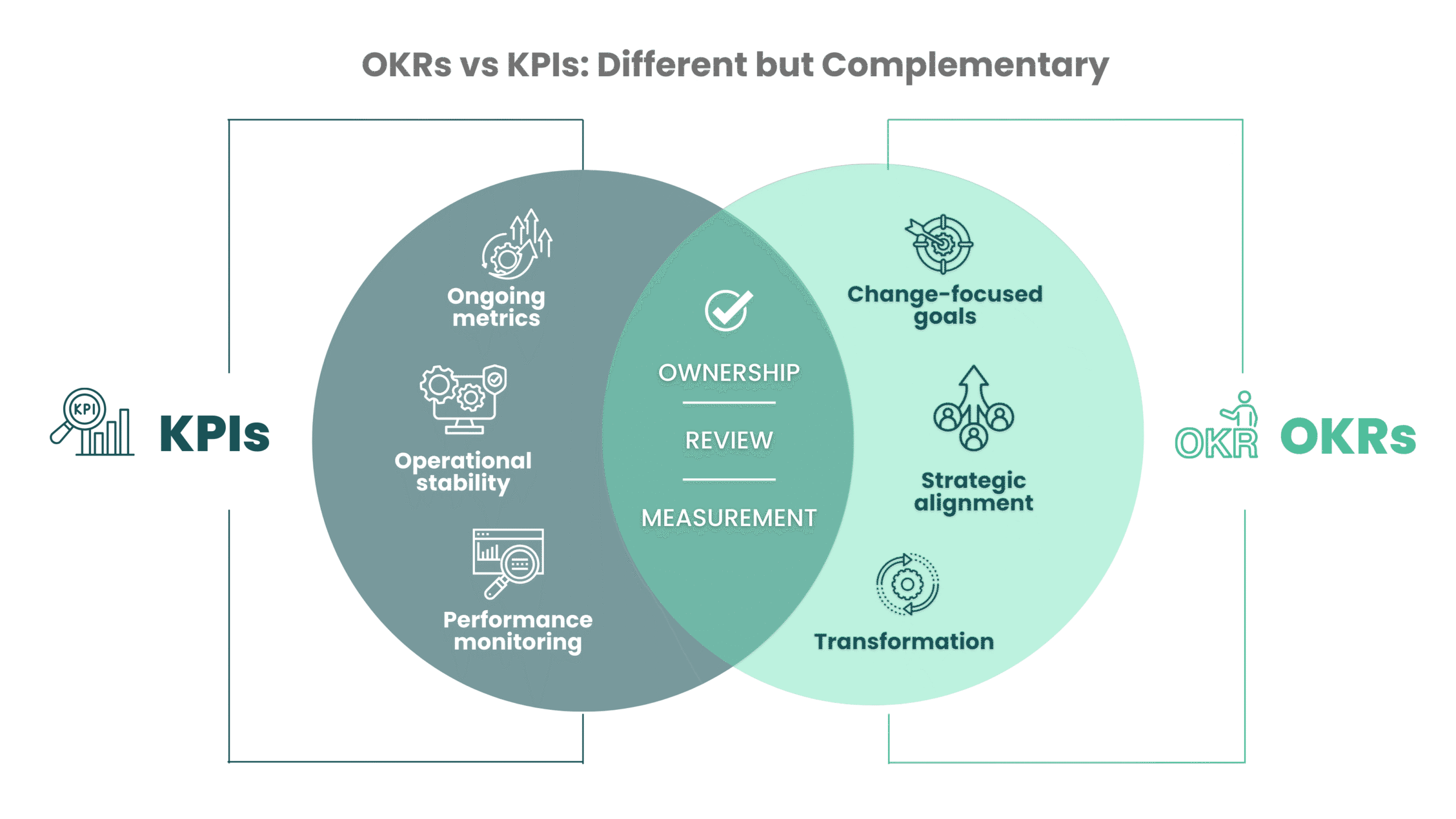
While both OKRs and KPIs involve measurement, they are designed for different purposes. OKRs are used to drive change. They define where a team wants to go next, what progress looks like, and how to stay focused on what matters most.
OKRs are built around a few ambitious objectives, each supported by measurable outcomes. They are reviewed frequently and encourage alignment across teams. This makes them especially useful in fast-moving environments where direction and priorities evolve quickly.
KPIs, on the other hand, are used to monitor performance. They help teams track how a business function is operating over time. A KPI is not a goal but an indicator. It shows whether performance is healthy or at risk. While OKRs push teams to stretch and improve, KPIs provide a stable foundation for decision-making and control.
A simple way to visualize this is to think of KPIs as your dashboard, telling you whether the car is running smoothly, while OKRs are your GPS, showing you where you are heading and how to get there.
The two frameworks are not in conflict. It is not really OKRs vs KPIs. In fact, research shows that the most effective organizations use them side by side, with KPIs tracking operations and OKRs steering change.
| Feature | OKRs | KPIs |
|---|---|---|
| Purpose | Drive strategic progress | Monitor business performance |
| Format | Objective + 2–5 Key Results | Individual metrics |
| Timeframe | Short-term (usually quarterly) | Ongoing, real-time |
| Orientation | Aspirational and dynamic | Operational and stable |
| Ownership | Often cross-functional | Departmental or individual |
| Review cadence | Regular check-ins and retrospectives | Weekly or monthly dashboards |
| Success measure | Progress toward outcomes | Metric thresholds and targets |
Case Example: From KPI to Key Result
Same metric, different intent. When customer churn is stable, you monitor it as a KPI. When churn spikes, you turn the same metric into a Key Result with a clear target and due date.
Here is what that looks like in practice:
Regain competitive edge by improving the customer experience
Decrease customer churn rate from 14% to 7% by the end of the quarter
Achieve 90% satisfaction among customers engaging with new AI features
KPIs provide the ongoing signal. Key Results drive the focused change.
OKRs vs MBOs and Balanced Scorecards
OKRs did not appear in a vacuum. They build on earlier frameworks, but fix some of their shortcomings.
- MBOs (Management by Objectives), introduced by Drucker in the 1950s, linked performance to compensation but were often too top-down and static. OKRs evolved as a more agile and transparent alternative.
- Balanced Scorecards (BSC), introduced in the 1990s by Kaplan, helped organizations monitor strategy across financial, customer, process, and learning dimensions. But BSCs often became heavy, reporting-focused tools. OKRs inject agility by focusing on change rather than static maps.
This evolution shows why OKRs are now seen as the modern standard for execution. They complement rather than replace these older tools, especially when integrated into a maturity-based system.
OKRs vs KPIs: Can They Work Together?
This is not an either-or. In fact, the most mature organizations do not just use OKRs with KPIs. They embed them in each other.
At OKRmentors, we coach teams to treat KPIs as ongoing signals and OKRs as focused interventions. For example, you may track customer support ticket resolution time (a KPI), but your Q3 OKR is to delight customers with faster support, with a key result to reduce average resolution time from 12 hours to under 6.
Another example: you may monitor Net Promoter Score (NPS) as a KPI. If it drops sharply, you might set an OKR to raise NPS back above 60 by the end of the quarter. The KPI remains as ongoing monitoring, while the OKR drives the corrective action.
This is how OKRs add meaning to KPIs. When used together, KPIs provide the early warning signals, while OKRs provide the focused response. They translate metrics into meaningful goals. At the same time, KPIs validate whether your OKRs are addressing the right areas of the business.
| Role | KPIs | OKRs |
|---|---|---|
| Track | Ongoing performance | Progress on change |
| Type | Lagging or operational indicators | Leading and outcome-based |
| Usage | Dashboards and reviews | Goal-setting and alignment |
| Integration | Can feed into Key Results | Often reference key KPIs |
Using both OKRs and KPIs well is a sign of strategy execution maturity. Organizations that treat these tools as complementary rather than competing are more likely to align effectively, execute strategy with discipline, and adapt when needed.
Which One Should You Use?
The question is not OKRs vs KPIs, whether to use one or the other. It’s how to use each in the right way. Both matter. The real challenge is using each in the right way, with clear ownership, aligned cadences, and visible outcomes.
- Use KPIs to monitor ongoing performance.
- Use OKRs to drive change, innovation, and alignment.
Organizations that apply both as part of a maturity journey, supported by tools like our Strategy Execution Maturity Model, are better at turning strategy into results.
Conclusion
KPIs are the signals. They tell you if the engine is running smoothly. OKRs are the steering wheel. They help you adapt, change direction, and accelerate. Used together, they give you both control and progress. This is what separates strategy execution leaders from beginners.
What matters most are not more frameworks, but better habits: clarity of goals, alignment across teams, and disciplined review.
If you want to learn more about how to strengthen those habits: