

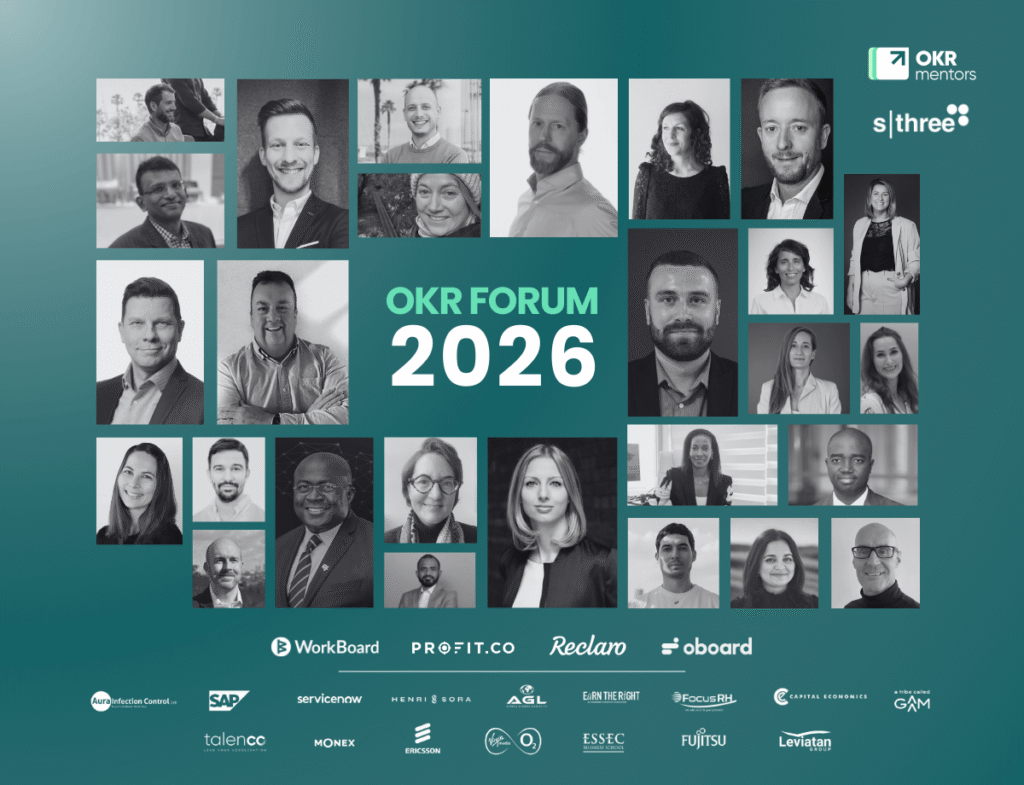
OKR Forum 2026, the eighth edition co-hosted by SThree and OKR Mentors, invited global attendees to connect, learn, and exchange insights on strategy execution excellence. The focus was on using OKRs to translate strategy into tangible results, moving beyond simple templates to real-world execution. This emphasis stems from OKR Mentors’ 18-month research, which identified patterns differentiating top organizations and correlating higher strategy-execution maturity with stronger outcomes like financial gains and faster growth.
This blog explores key forum insights on scaling alignment, building accountability, blending technology/skills, leveraging data/AI, case studies, technology demos, and the OKR Awards.
In his opening keynote, Mikko Lampinen (Fujitsu) shared how Fujitsu approached transformation starting in 2020 and how “OKR thinking” helped align work across Europe’s diversity – different cultures, languages, and structures – through a shared rhythm, common goals, and a strong emphasis on cultural change. The session included a Q&A moderated by Henri Sora (Sora Consulting).
“Culture eats strategy for breakfast.”
– Mikko Lampinen, 2026
Fujitsu treated transformation as a culture shift first and built explicit principles to make that real. Mikko framed the transformation around the idea that how people work, think, and collaborate determines whether strategy can land. This matters because cross-border alignment isn’t just about distributing goals; it’s about changing day-to-day behaviors at scale especially when teams are spread across “dozens of countries” and are tempted to operate in silos.
Scaling alignment relied on a repeatable operating cadence – and OKRs were used to create clarity, focus, and visibility within that cadence. Mikko described a “quarterly agile cycle” as the “heartbeat” of the transformation, then showed how Europe adapted the global approach as “connecting the dots” with a DX network of change agents and “OKRs to set common goals.”
As the world moves faster than ever, leaders need focus, alignment, and visibility, and this is tied to practical choices like narrowing company objectives over time and overcommunicating the strategy so managers can translate direction into “down-to-earth” team-level decisions. The point is that OKRs become a mechanism for consistent direction-setting and outcome-focused conversations across a complex organization.
Hosted by Pete Wilkinson from Reclaro, this panel featured Laura Edgar from Aura Infection Control, Chloe Garel from a tribe called GAM, and Anca Alexa from Leviatan Group. They discussed what it takes to make accountability and transparency show up in daily work, not just in OKR documents.
Trade perfection for momentum in your organization. Don’t chase the perfect OKRs.
– Anca Alexa, 2026
As Anca puts it bluntly: “trade perfection for momentum in your organization.” Pete links this to a practical shift: start with “basic” OKRs, get them working, learn, and keep course correcting. Anca reinforces that if something is not good, teams can change it and “iterate, experiment.” This matters because momentum produces real progress signals, and those signals are what make accountability and transparency usable in daily execution.
The panel also pushed hard on a second idea: transparency only helps when people feel safe, and when leaders use it to support good decisions rather than punish. Chloe calls out the risk of transparency turning into exposure, and argues leaders must model vulnerability and treat setbacks as learning through how they run retrospectives. Anca reinforces that accountability becomes a shared strength when transparency triggers support, decisions, and removing blockages, not blame or judgment. This matters because without safety, visibility can reduce trust, and the whole operating rhythm starts to get resisted instead of adopted.
Facilitated by Senthil Rajagopalan from Profit.co, this panel featured John Simon from Ericsson and Peter Kerr from Earn the Right Coaching. They explored how execution improves when OKRs, technology, and leadership habits reinforce each other.
We want to be human-led. We want to be AI amplified.
– John Simon, 2026
A core message was that execution discipline is built over time, and technology helps when it makes progress real and visible. John describes Ericsson’s journey as “an evolution, not a revolution,” moving from teams pulling in different directions to stronger alignment year by year. He links the impact of tooling to three practical shifts: visibility, alignment through real linking, and a cadence of check ins that turns OKRs into a habit.
The panel also challenged the idea that AI or tooling can substitute for leadership judgment and ownership. John’s “human-led, AI amplified” framing sets a clear boundary: AI accelerates, but humans stay responsible for strategy, trust, and decisions. Peter reinforces that platforms and AI can produce “beautiful OKRs” that do nothing if leaders disengage, and he emphasizes using transparency to check adoption and stay connected. This matters because the real goal is not output, it is an operating rhythm where leaders see reality early and act on it.
Hosted by Sameera Moinpour from WorkBoard, this panel featured Harry Blease from Virgin Media O2 and Francesco Redolfi from OKR Mentors. They discussed how data and AI can strengthen execution when it improves focus, visibility, and the quality of decisions.
A consistent thread was that execution breaks down when strategy becomes distant from the people doing the work. Harry points to leaders feeling “not that involved,” and the process becoming “over governed.” He brings it back to basics: clarity, transparency, and a cadence that makes progress easier to see and act on.
They also keep returning to the idea that systems only help if they create a shared source of truth that teams actually use. Harry describes banning PowerPoint to push the organization toward “a single source of truth,” so progress is not spread across slides, spreadsheets, and versions. Francesco adds that the goal is balance: clear enough to see the forest, but detailed enough to find bottlenecks fast and course correct.
Data and AI are only as good as the quality of the data that you are feeding it, and so to keep data accurate, you have to build a culture of accountability and operational rhythm.
– Francesco Redolfi, 2026
The transform path frames OKRs as a change vehicle, not just a goal-setting template. By calling out a non-agile environment and global alignment, it points to the hard reality many organizations face: transformation is often about building execution muscle inside existing constraints, not waiting for perfect conditions. Organizations are at different stages and need different kinds of learning. Some sessions are about foundational shifts in how work is aligned; others are about accelerating what already exists – making the forum’s content feel more usable, not one-size-fits-all.
Execution is not a phase, but it’s a system you design
– Sandeep Voona, 2026
In this transform path workshop, Scott McKenzie and Claire Bonenfant from SThree shared how they introduced OKRs in a context that was not “very agile,” where objectives were largely cascaded top down. They walked through what changed, what resisted, and what helped OKRs become an anchor for transformation across clarity, engagement, and ways of working.
A big transformation theme was moving strategy from a document into everyday choices. Scott frames OKRs as the link between strategy, the plan, and “people’s actual activities.” Claire reinforces that in a pressured, short sales cycle environment, OKRs gave strategy “a voice” so teams could hold onto long term intent while managing short term demands. This matters because transformation fails when strategy stays abstract, and OKRs help turn intent into repeatable conversations and priorities.
Another transformation theme was adoption without disruption. Both speakers describe keeping things simple to lower resistance, then using repetition to shift habits over time. Claire integrated OKRs into existing routines using a simple spreadsheet and a weekly review touch point. Scott started with a basic template and introduced OKRs “by stealth,” focusing first on better discussions and alignment, not tools. This matters because in a non-agile environment, transformation sticks when it feels doable, familiar, and repeatable, not like a sudden methodology overhaul.
In this transform path session, Sandeep Voona from ServiceNow looks at why execution breaks even when organizations have clear intent and frameworks. He uses the Apollo mission as a metaphor for what “engineered execution” looks like, then connects that to ServiceNow’s system level view of data, planning, and people.
A key takeaway is that transformation fails when execution is treated as a set of meetings, dashboards, and follow ups layered on top of broken foundations. Sandeep describes a predictable pattern where leaders align on strategy using “yesterday’s truth,” plans stay disconnected, and skills lag behind what the strategy demands. Those gaps create more coordination and firefighting, but not better outcomes, so the organization stays busy while progress stalls.
Another takeaway is that sustained transformation comes from designing one operating system across three planes: real time context, connected execution, and people evolution. He argues these cannot run as parallel initiatives, because execution speed only compounds when data, planning, and capability move together. This matters because it reframes OKRs as “mechanics,” while the real transformation work is building trust in live data, connecting outcomes to funding and work, and evolving skills alongside the roadmap.
In this transform path session, Asta Cisse and Dieudonné Gabaï from Africa Global Logistics shared how they used OKRs to rebuild culture, not just manage goals. The session is framed and hosted by Raphaël Tchomnou Ngantchop, who sets the context as a cultural turnaround story.
Asta makes the transformation challenge clear by starting from the human reality behind performance. Low engagement was not treated as a communications issue or a motivation campaign. She links it to customer satisfaction going down, a “top down” leadership style, and people not feeling free to take initiative. This matters because it reframes OKRs as a vehicle for changing how people lead and contribute, not a quarterly reporting routine.
The story also shows why transformation needs patience and design, not just effort. Asta is direct that routines were inconsistent, middle management was under pressure, and people got tired of change. Their response focused on commitment and visibility, including a “transformation pact,” monthly updates on what was working or going wrong, and making the change visible through dashboards and clear messages. This matters because cultural change often stalls in the “messy middle,” and they used OKRs to keep a shared language alive long enough for behaviors to shift.
Another insight is that transformation shows up in conversations before it shows up in metrics. Dieudonné describes a moment where engagement had moved “less than one point,” and a board member questioned if it was “just another well intention? HR initiative?” What kept them going was not the dashboard, but hearing a frontline manager say the team now talks about key results every Monday and feels their voice matters. This validates a hard truth in culture work: you often have to hold conviction while results lag, and look for behavioral signals that the shift is taking root.
“Culture does not shift in dashboards first. It shifts in conversation.”
– Dieudonné Gabaï, 2026
The accelerate path treats execution as something you can speed up through better cadence, focus, and visibility. In other words, it’s for organizations that need sharper throughput and decision speed, not just cultural reinvention. The path connects learning to context. By explicitly pointing participants to different sessions under different tracks, the forum makes it easier to self-select into the kind of acceleration that fits: scaling focus in growth, strengthening execution habits, or tightening the connection between priorities and outcomes.
In this accelerate path session, Raphaël KATTAN from Talenco spoke with Isabel Torcheux-Vijitkasem from ESSEC Business School about using OKRs to execute ESSEC’s 2024–2028 strategic plan. They explored what changes when OKRs are applied in a higher education context that is multi campus and operating on an academic year cadence.
A central theme was that OKRs forced clarity at the top. Isabel says the method “really forced” the leadership team to make strategy clear and set priorities, and the key result exercise was new for them. The hard part was not inventing metrics, but aligning on which results mattered most, and making “what we want to achieve concretely” clearer for leaders and the managers who turn strategy into action plans.
Another strong thread was that alignment becomes real when it crosses boundaries, not when it stays neatly inside departments. Isabel points to a current challenge around shared action plans, since some key results are shared across business units and departments. She also frames this as a maturity signal because the method now pushes them to “break silos,” not just write school level OKRs. That matters because strategy execution stalls when ownership is clear on paper but collaboration is undefined in practice.
In this Accelerate path session, Robert Brockmann and Vivien Rose from SAP Signavio shared their strategy execution journey through post merger integration, hypergrowth, and scaling inside a large enterprise. They focus on what changed when OKRs stopped being “the thing” and became one part of a broader execution approach.
A key point is that OKRs can stall when they are expected to solve clarity, prioritization, and alignment on their own. Vivien describes how OKRs drifted into “theoretical perfection” while the organization still thought in outputs. She says they realized OKRs were not part of daily conversations and felt like something “on top.” This matters because when OKRs sit outside the operating model, they become a parallel process that teams learn to ignore.
OKRs don’t necessarily fail because they’re wrong. They fail because they are asked to do a job they were never meant to do alone.
– Robert Brockmann, 2026
Their shift was to wrap OKRs in context and rhythm so strategy could be executed, not just stated. Robert describes introducing “game plans” that add mission, principles, dependencies, commitments, and “things we will not do.” They also redesigned cadence, with monthly leadership check-ins and game plans as the cornerstone of Quarterly Business Reviews. This matters because execution speed comes from shared context, clearer trade offs, and decisions made close to the work without waiting for escalation.
In this accelerate path fireside chat, Tristan Pelloux from OKR Mentors spoke with Rheann Randall from Monex about linking OKRs to initiatives and projects. The focus was how portfolio thinking helps a company move from many good ideas to a smaller set of prioritized work that matches strategy.
Definitely, I found that we sometimes try and do everything at once, and we can’t do everything at once well.
– Rheann Randall, 2026
A strong takeaway was that portfolio led execution creates focus by turning “yes and no” into a strategy based conversation. Rheann describes initial hesitation when teams fear priorities are being ignored, even though the goal is to concentrate effort into key initiatives. She ties the benefit to alignment and resource management, especially when organizations try to do “everything at once.” This matters because without a portfolio view, effort fragments into “a 101 different initiatives,” and the organization loses the ability to move the needle on what leadership actually cares about.
Another takeaway was that making strategy executable depends on shared definitions, not just shared intent. Rheann calls out “definition of success” as a real challenge, because people can agree on the words while picturing different outcomes. She also notes that teams sometimes exclude work from the portfolio view, even when it consumes shared resources and affects delivery. This matters because execution breaks when success is ambiguous and work is invisible, and both issues increase the risk of burnout and late surprises.
The day closed with the OKR Awards, positioned as a way to spotlight teams that did more than define strategy and instead made it “become real” with measurable outcomes. The organizers said there were more than 50 applications, with four nominees in each category.
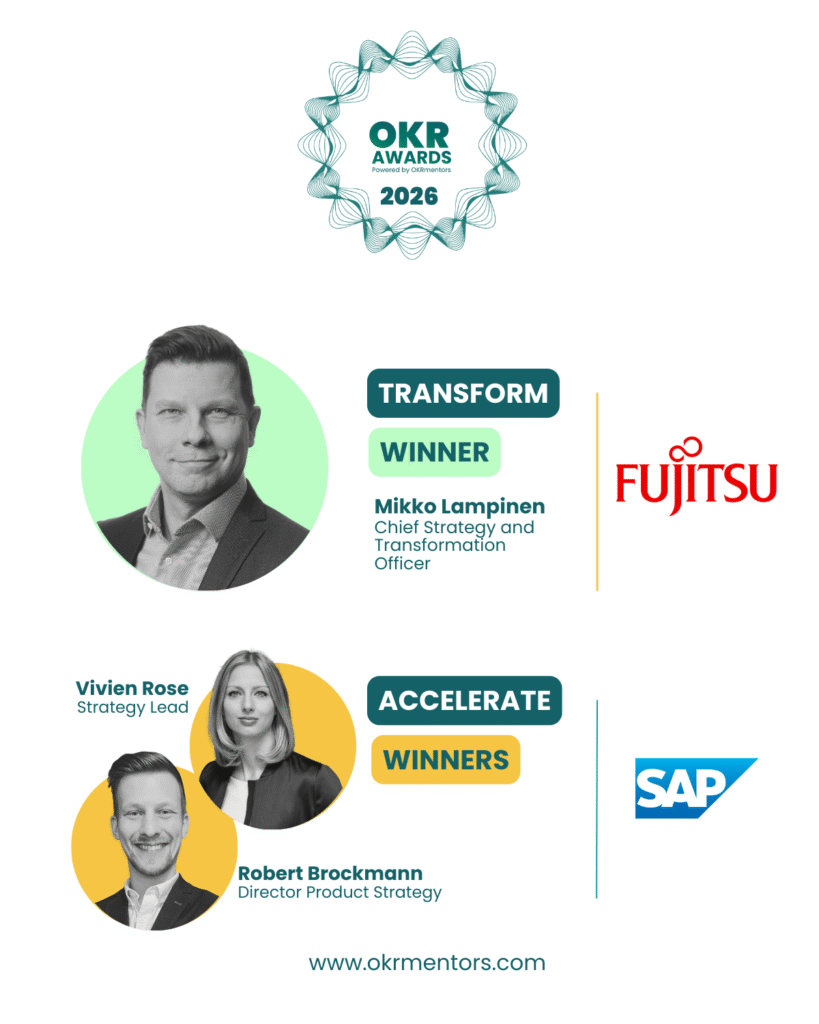
Two categories were awarded, one focused on acceleration and one on transformation. Each category had its own jury of leaders in strategy execution and organizational systems.
For the acceleration category, the jury was Henri Sora, Francesca Nardocci, and Peter Kerr. Peter said the group discussions were strong, and the winner became “really clear” based on what resonated with them as coaches, including the quality and honesty of the submission and the courage shown through tough, honest conversations.
For the transformation category, the jury was Marga Lenten – van Boxtel, Nathalie Arrizabalaga, and Raphaël Kattan. The presenter, Marga Lenten van Boxtel, explained how they assessed transformation signals such as cultural shift, empowerment, leadership, execution rigor, scalability, and the maturity of the story shared.
Nominees: Vivian Group, Monex, ESSEC Business School, SAP Signavio.
Winner: SAP Signavio.
The jury highlighted SAP Signavio for the courage to have tough, honest conversations early, and for a submission whose quality and honesty strongly resonated with them. Francesco also connected the win to driving acceleration and empowering teams in a post merger context, which he framed as especially challenging.
The jury referenced three stories during the announcement: Africa Global Logistics, Capital Economics, and Fujitsu.
Winner: Fujitsu.
The jury described Fujitsu’s submission as mature across dimensions, with a deep cultural shift, authentic leadership, and empowered teams. They emphasized that OKRs appeared as a natural part of how Fujitsu works, combining strong execution with a clear transformation story. Francesco added that the story helped unite people across different cultures and required the courage to challenge “the usual way of doing” work.
To re-watch the OKR Forum videos and dive deeper into each session’s insights, click here. All sessions are available on-demand, allowing you to revisit the valuable discussions, expert panels, and practical implementations shared throughout the day.
As organizations continue to face rapid change and increasing complexity, the lessons shared at OKR Forum 2026 provide valuable guidance for enhancing strategic execution capabilities. Whether starting fresh, scaling up, or breaking new ground, success lies in adapting OKRs to serve unique organizational needs while maintaining focus on meaningful outcomes.
👉 Want to learn more about implementing OKRs in your organization? Connect with our expert team at OKR mentors to discuss how we can help you transform your strategic execution.