

At Trimble, a global industrial technology company known for connecting the physical and digital worlds, the journey to implement Objectives and Key Results (OKRs) has spanned nearly five years. What started as a promising methodology to enhance their strategy execution faced a significant challenge in 2024 – adoption had plateaued.
In this case study, we explore how Trimble, under the leadership of Duncan Hawksbee, Director of Strategic Execution, identified the slowdown in their OKR program and engineered a strategic shift to reignite momentum.
The Journey Begins: Connecting Strategy to Execution
Trimble’s OKR story began in late 2019 when the company recognized a fundamental challenge: while they excelled at defining strategy, they struggled with execution. Their new CEO, wanted a framework to connect corporate strategy to day-to-day work across the organization.
“We were very good at defining our strategy. We knew what we were doing, but we were maybe not quite as good at actually executing,” explains Hawksbee.
The company needed a more balanced approach beyond financial metrics, which sometimes blocked strategic execution. They required a system that would help leadership focus on strategic priorities rather than constantly closing operational gaps.
Building the Foundation: From Grassroots to Formal Program
Trimble’s journey toward organization-wide OKRs wasn’t starting from scratch. Several teams had already adopted the methodology on their own in early 2019, using multiple different tools such as Google Sheets, to track their progress. These early adopters became internal advocates, convincing leadership that a more formal, company-wide approach could be beneficial.
With executive support secured, Trimble officially launched their OKR program in 2020, selecting an industry platform to provide consistent tracking, visibility, and reporting across the organization. This moved teams away from siloed tracking systems to a unified approach that enabled cross-organizational alignment.
Throughout 2021, the company expanded adoption, but by 2022, they encountered their first major roadblock: the centralized team initially responsible for the program was dissolved, causing a temporary setback in alignment and momentum. set objectives, monitor key results, and ensure alignment with organizational goals,” explains Kelauradze.
Creating Infrastructure for Success
To recover from this setback and build a sustainable program, Trimble established two critical support structures:
1. Results Management Office (RMO)
Approximately 18 months before their 2025 pivot, Trimble formed the Results Management Office (RMO) – a decentralized Results Management leadership team with responsibility for OKR execution in their respective areas. Everyone has a day job so their OKR responsibility is in addition to their core responsibilities.
This design ensures that OKR champions are embedded throughout the organization, working daily with their teams to align strategy with execution. The RMO meets bi-weekly as a group, with weekly one-on-one check-ins to maintain alignment.
The RMO also maintains responsibility for:
- Tracking strategic progress of the OKR program itself
- Managing the OKR platform
- Supporting users across the organization
2. OKR Coach Community
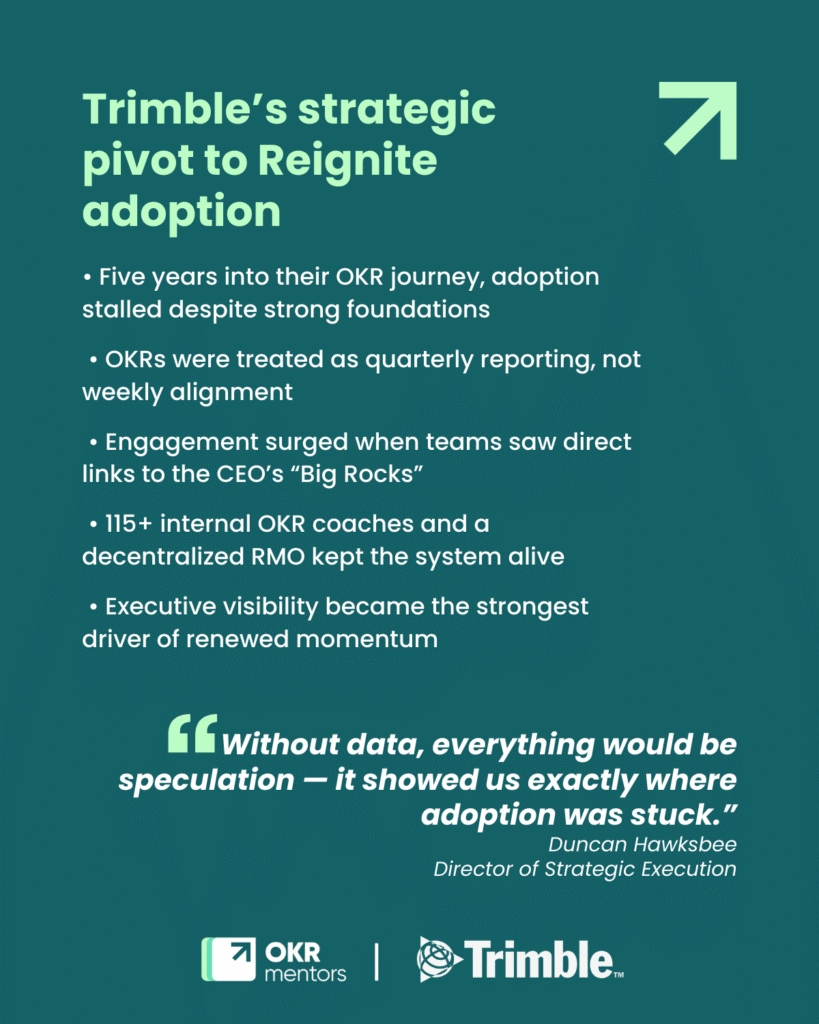
Recognizing that the RMO alone couldn’t support 12,000 employees, Trimble certified over 115 internal OKR coaches. These coaches don’t treat this as their primary role but incorporate coaching into their regular responsibilities, generally dedicating 5-15% of their time to supporting teams with OKR creation and management.
Initially, Trimble relied on WorkBoard’s coach certification program. In 2024, they brought this training in-house, customizing it to better align with Trimble’s specific context and culture. Coaches meet regularly to share best practices and receive updated guidance.
Measuring Progress and Identifying the Plateau
As their program matured, Trimble began tracking adoption metrics to measure progress. From 2021 through 2023, the numbers showed consistent growth in both active teams and unique objectives created, suggesting positive momentum.
However, 2024 revealed a concerning pattern: despite ambitious targets of exceeding 400 active teams, adoption had plateaued. The program’s growth had stalled, prompting the RMO to dig deeper into the data to understand why.
Two key metrics revealed important insights:
Key Result Freshness
Analysis showed that updates to Key Results followed a clear pattern – spikes at the end of each quarter, with minimal activity between these periods. This suggested that teams were treating OKRs as a quarterly reporting requirement rather than a continuous strategic alignment tool. This correlated to the number of teams with quarterly Key Results who may not have paid attention to what’s going on, just updating their Key Results when they had to at the end of a quarter.
Platform Usage
Directly connected to the freshness metric was platform usage data showing many teams only logged into the OKR tool quarterly, further confirming they weren’t integrating OKRs into their daily or weekly work rhythms.
This data-driven approach to program management proved invaluable. As Hawksbee notes, “If we didn’t have this data, everything would be speculation. People would be telling us, ‘Oh, this is not working’ or ‘It is working,’ but we would never be able to actually dig in and determine what the real root cause was.”

Want to learn directly from stories like this?
The OKR Forum is where these real-world journeys are shared first—by the leaders who lived them. Join us in 2026 to get firsthand insights, ask your questions live, and connect with practitioners who are driving real strategy execution and transformation across industries.
The Behavioral Breakthrough: Big Rocks and CEO Alignment
In 2024, Trimble’s CEO introduced a concept called “Big Rocks” – initiatives deemed vitally important to the company’s strategic direction. These Big Rocks were directly connected to the CEO’s own Key Results through a cascade of supporting metrics and initiatives.
The RMO observed something important: when teams realized their work would directly contribute to the CEO’s Objectives, engagement spiked dramatically. This behavioral insight became the cornerstone of Trimble’s 2025 strategic pivot.
The Strategic Pivot: From Broad and Deep to Leadership Focus
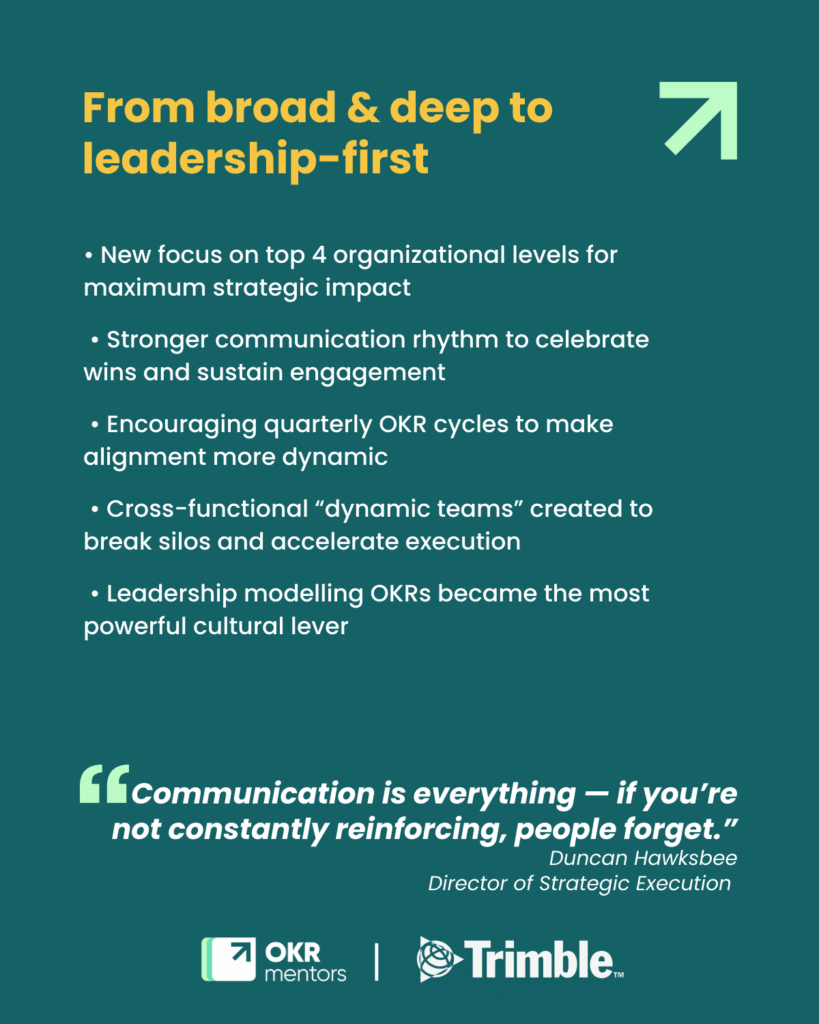
For four years, Trimble had pursued a “broad and deep” approach to OKR adoption – simultaneously targeting horizontal reach across departments and vertical penetration down through organizational layers.
“We went across the organization and we went down in the organization, and we were trying to hit teams much lower down in the organization,” Hawksbee explains. “We were giving equal attention to executive leadership and somebody who might be five or six levels down the organization.”
The data clearly showed this approach wasn’t delivering the expected results, prompting a fundamental rethinking for 2025.
The new strategy represents a significant shift in focus:
1. Leadership-First Focus
Rather than continuing to spread resources thinly across all levels, Trimble is now concentrating efforts on the top four organizational levels, starting with the CEO and cascading down.
This approach doesn’t mean abandoning teams at lower levels – they’re still receiving support – but the primary focus and resources has targeted leadership teams where visibility and impact can be greatest.
2. Communication Enhancement
Recognizing that consistent communication is essential for sustaining momentum, the RMO is significantly increasing its communication efforts. This includes:
- Regular updates on the program’s progress
- Showcasing success stories from across the organization
- Recording video interviews with leaders who’ve successfully used OKRs
- Leveraging peer-to-peer advocacy rather than relying solely on the OKR team
“Communication is everything,” Hawksbee emphasizes. “If you don’t communicate about your program and what you’re doing and celebrating your successes, people will forget it. You have to keep pushing and pushing and pushing.”
3. Quarterly Cadence
To address the issue of teams only engaging with OKRs at quarter-end, Trimble is encouraging more teams to adopt quarterly OKR cycles. This shift aims to make OKRs more relevant and dynamic, requiring teams to regularly reassess and realign their priorities.
4. Cross-Functional Collaboration
Building on the success of their “Big Rocks” approach, Trimble is putting greater emphasis on shared work across organizational boundaries. By creating what they call “dynamic teams” – cross-functional groups aligned around common objectives – they’re breaking down silos and encouraging collaboration.
“A couple of our segments definitely intersect in their work and the customers they support” Hawksbee explains. “So it makes total sense for them to work together.”
The Road Ahead: Measuring Impact
As Trimble implements this new approach in 2025, they’re maintaining clear goals for their OKR program:
- Embedding Strategic Execution – Making OKRs an integral part of how teams operate, not a separate exercise
- Focusing Teams – Ensuring clear priorities on strategically important work
- Accelerating Execution – Increasing the pace at which strategic initiatives are completed
- Delighting Customers – Ultimately delivering better outcomes for their customers
Key Insights: Lessons from Trimble’s OKR Journey
1. OKR Implementation is a Journey
Five years into their journey, Trimble continues to refine their approach. As Hawksbee repeatedly emphasizes, “An OKR program is really a journey. You have to stick at it.”
Organizations must plan for the long term, anticipating shifts in strategy as they learn what works and what doesn’t in their specific context.
2. Data Should Drive Direction
Trimble’s ability to identify and address their plateau came directly from their commitment to measuring program health. Key metrics around participation, engagement, and usage patterns revealed issues that might otherwise have remained hidden.
“Without data, everything would be speculation,” Hawksbee notes, highlighting the importance of establishing clear metrics from the start.
3. Governance Structures Matter
The temporary setback Trimble experienced when their initial central team was disbanded underscores the importance of sustainable governance. The decentralized RMO structure they subsequently developed created resilience by distributing responsibility across the organization while maintaining central coordination.
4. Leaders Must Model the Way
The dramatic improvement in engagement when teams connected their work to the CEO’s Objectives demonstrates the power of visible leadership commitment. When executives actively participate in and advocate for the OKR process, it signals importance to the rest of the organization.
5. Communication is Continuous
Trimble’s renewed emphasis on communication acknowledges that sustaining an OKR program requires ongoing reinforcement. Success stories, particularly from peer leaders rather than program managers, provide social proof that the methodology delivers value.
6. Be Willing to Pivot
Perhaps most importantly, Trimble’s willingness to fundamentally rethink their approach after years of investment demonstrates the flexibility required for long-term success. Rather than simply pushing harder with the same strategy, they analyzed their data and crafted a targeted approach addressing the specific challenges they faced.
For organizations facing similar OKR plateaus, Trimble’s story offers a powerful lesson: sometimes the path to wider adoption isn’t pushing harder on the same approach, but strategically shifting focus to where impact will be greatest.