

This is an extract from the Global State of Strategy Execution report. You can read the full version for all dimensions, insights, and benchmarks.
Understanding the dimensions of strategy execution is essential before looking at how organisations actually perform. The SEM360 framework outlines five core dimensions, each describing a critical part of how strategy becomes action: Align, Execute, Improve, Scale, and Empower. These dimensions provide a shared structure for assessing maturity, identifying strengths, and uncovering capability gaps across teams and leadership levels. The SEM360 Dimensions guide explains these foundations in detail, and this article builds on that base by exploring how organisations score in practice and what distinguishes the top performers.
Align: Ensuring strategic priorities are clear and shared across the organization
Key drivers: Strategic Clarity, Team Alignment.
Alignment turns strategic intent into collective focus. It includes Strategic Clarity and Team Alignment. High-maturity organizations limit priorities and embed them in OKRs and reviews. Strong alignment relies on joint planning, goal adaptation, and ownership. Without it, teams diverge and strategy execution fragments.
Key Insights
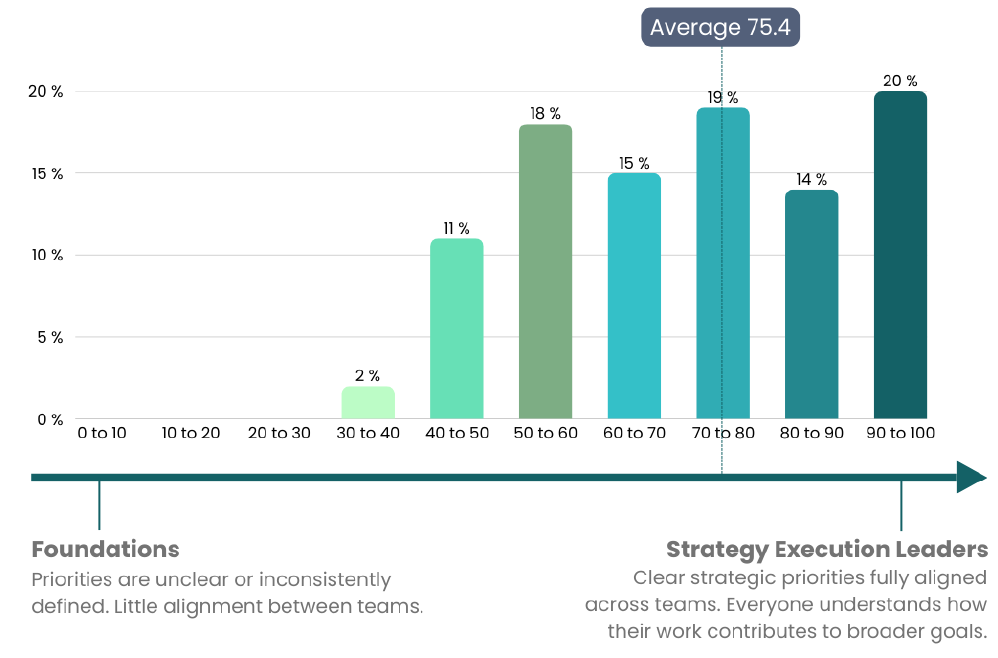
- Align is the strongest dimension overall, with an average score of 75.4, making it the area where organizations tend to perform best.
- Executives directly responsible for strategic planning report stronger alignment (77.4) than sponsors (71.7), highlighting the importance of ownership.
- By industry, Telecom companies show the strongest alignment at 78.8, while Automotive firms trail at 71.4, underlining sectoral contrasts.
- Strategy Execution Leaders outperform the global average by +19.8 points (95.2 vs 75.4), setting a higher bar for alignment.
What Strategy Execution Leaders Do
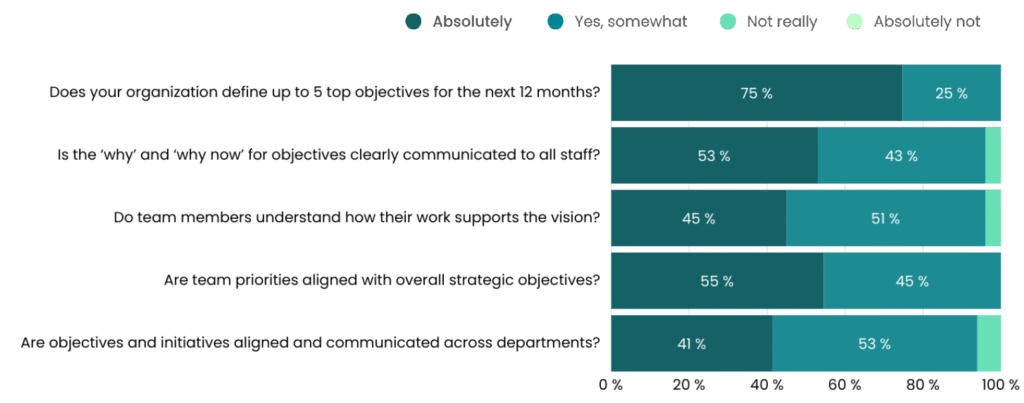
- Ensure objectives and initiatives are communicated and aligned across departments; they are 2.34× more likely to do this (96% vs 41%).
- Explain the “why” and “why now” behind objectives more consistently, being 1.85× more likely than peers to make the rationale clear (96% vs 52%).
- Keep their top strategic objectives to five or fewer each year, ensuring focus across the organization.
- Turn objectives into team priorities, linking individual work to the broader vision.
- Coordinate initiatives across departments through joint planning and transparent progress tracking.
- Use project management or planning software more frequently than peers (1.4× more likely, 65% vs 47%) to maintain shared visibility.
- Enhance communication and collaboration across teams more often (1.45× more likely, 91% vs 63%), reinforcing a culture of shared accountability.